


The Singapore Artificial Intelligence Paradox
Singapore has become one of Asia Pacific’s leading hubs for artificial intelligence adoption. According to the Infocomm Media Development Authority (IMDA), AI adoption among large enterprises has surpassed 60%, while small and medium-sized businesses continue to accelerate their investments in AI-powered transformation initiatives.
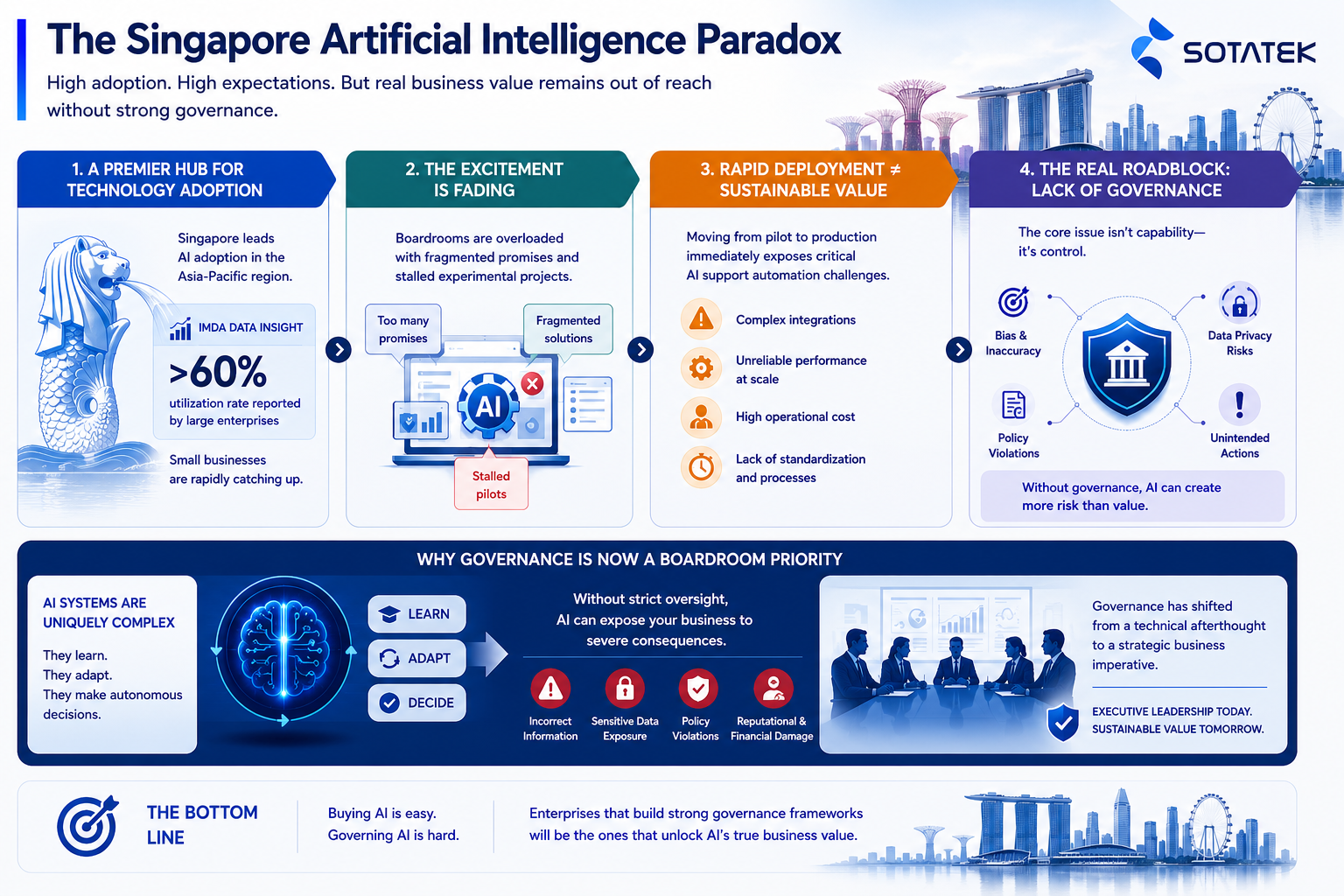
However, as organizations move beyond experimentation, many discover that successful AI adoption requires more than selecting the right tools. The real challenge lies in building a robust AI governance strategy that ensures security, compliance, accountability, and long-term business value.
At SotaTek, a leading Blockchain & AI innovation partner, we have observed a common pattern across enterprises in Singapore: AI pilot projects generate excitement, but scaling them into production environments often exposes governance gaps, data security concerns, and operational risks. Without a structured AI governance framework, organizations struggle to balance innovation with control.
The conversation around AI is therefore shifting. Instead of asking "How can we deploy AI faster?", business leaders are increasingly asking "How can we govern AI responsibly at scale?"
This shift highlights the growing importance of enterprise AI governance, AI compliance, and responsible AI practices as organizations seek sustainable and secure growth.
Why an AI Governance Strategy Matters for Enterprise AI Success
To understand why so many initiatives fail in the execution phase, we must look closely at the gap between daily usage and official company policy. A large percentage of the working population in Singapore uses generative tools on a daily basis. Employees are finding ways to work faster, but they are doing so without formal company approval. This creates a massive disconnect between what the company thinks is happening and what employees are actually doing.
| Current Reality | The Underlying Business Problem |
| Widespread Unofficial Use | Employees are using unauthorized tools to process company data. This creates massive blind spots for security teams. |
| Lack of Oversight Frameworks | Very few organizations maintain a comprehensive rulebook for how these systems should be used, updated, and monitored. |
| Increasing Security Threats | Cyber attacks targeting cloud software have increased drastically. Hackers actively look for poorly managed automated agents. |
| High Project Failure Rates | Many autonomous projects are cancelled before launch because risk management teams cannot verify their safety. |
This widespread unofficial use is commonly known as shadow IT. When employees use unapproved software, the company loses control over its own information. Navigating these hidden hurdles is the first critical step toward a successful digital transformation with AI. If an organization cannot track where its data is going, it cannot protect its customers or its intellectual property.
An effective AI governance strategy bridges this gap. It provides employees with approved and secure tools that help them work faster while keeping the IT department in complete control of the data flow. Without this strategy, companies are essentially allowing their most valuable data to leak into public servers without any tracking or accountability.
Why an AI Governance Strategy Is Now a Top Priority for Executives

Why an AI Governance Strategy Is Now a Top Priority for Executives
As AI systems become increasingly autonomous and integrated into business operations, governance has become a strategic business imperative.
Modern AI systems interact directly with customers, process sensitive information, access internal systems, and increasingly make decisions with limited human intervention. Without a structured governance framework, a single AI failure can create operational disruption, compliance violations, financial losses, or reputational damage.
For executive leadership teams, an AI governance strategy has become a critical component of enterprise risk management.
Key Reasons AI Governance Strategy Has Become a Business Priority
1. Regulatory Compliance and Accountability
Singapore continues to promote AI innovation through a governance-driven approach that emphasizes transparency, accountability, and responsible deployment.
Organizations must ensure compliance with regulations such as:
- Personal Data Protection Act (PDPA)
- Model AI Governance Framework
- AI Verify testing and validation initiatives
- Industry-specific compliance requirements
A robust AI governance framework helps organizations establish clear accountability, maintain auditability, and reduce regulatory exposure.
2. AI Risk Management and Security Protection
AI systems often access large volumes of sensitive business and customer information.
Without governance controls, organizations face risks such as:
- Unauthorized data exposure
- Prompt injection attacks
- Model manipulation
- Inaccurate AI-generated outputs
- Uncontrolled access to internal systems
An effective AI risk management approach ensures that AI systems operate within defined security boundaries while maintaining business continuity.
3. Controlling AI Development and Operational Costs
As AI adoption expands across multiple departments, organizations frequently encounter:
- Duplicate software purchases
- Redundant AI initiatives
- Inconsistent vendor selection
- Fragmented technology stacks
Unmanaged growth rapidly inflates your AI development cost. A centralized AI governance strategy helps executives prioritize investments, eliminate duplication, and maximize ROI from AI programs.
Instead of isolated experiments, organizations can focus on scalable platforms supported by a clear AI implementation roadmap.
4. Establishing Responsible AI Practices
Responsible AI is becoming a core expectation from regulators, customers, and stakeholders.
Organizations must address:
- Bias and fairness concerns
- Explainability requirements
- Human oversight mechanisms
- Ethical decision-making processes
- Transparency standards
A mature AI governance model ensures that AI systems align with organizational values while maintaining trust among customers and employees.
5. Managing Identity, Access, and Autonomous Decision-Making
One of the most overlooked governance challenges involves determining what AI systems can see, access, and execute.
Without clear controls, AI agents may receive excessive permissions that expose sensitive systems and data.
Executives should prioritize:
- Role-based access control (RBAC)
- Least-privilege access policies
- Human approval checkpoints
- Segregation of duties
- Continuous monitoring and audit logging
Organizations increasingly adopt human-in-the-loop AI approaches to ensure critical decisions remain under human supervision.
Executive Takeaway
The question is no longer whether enterprises should govern AI. The real question is how quickly organizations can establish an enterprise AI governance framework before AI adoption outpaces their ability to manage risk.
For executives, a strong AI governance strategy has become more than a compliance exercise. It is now a competitive advantage that enables innovation, strengthens security, and creates a sustainable foundation for long-term AI transformation.
Overcoming Sector-Specific Roadblocks with a Targeted AI Governance Strategy

While the core principles of AI governance strategy apply across industries, implementation priorities differ significantly depending on operational requirements, regulatory obligations, and data sensitivity.
Instead of applying a one-size-fits-all governance model, organizations should tailor their AI governance framework to address the specific risks and compliance requirements of their industry. This sector-specific approach enables enterprises to scale AI responsibly while maintaining operational resilience.
Manufacturing: Governing AI Across Smart Operations
Manufacturers are rapidly adopting AI to automate workflow, which includes optimize production planning, predictive maintenance, quality inspection, inventory management, and supply chain operations. As AI becomes increasingly integrated with operational technology (OT), governance becomes essential to prevent costly disruptions.
AI governance priorities for manufacturing:
- Establish human approval for high-impact operational decisions
- Validate AI recommendations before triggering production workflows
- Monitor model performance continuously to prevent model drift
- Secure integrations between AI systems, ERP, MES, and IoT platforms
- Define role-based access for factory operators, engineers, and supervisors
- Maintain audit logs for automated operational decisions
For example, an AI-powered procurement agent may automatically reorder raw materials based on predicted demand. Without governance controls, inaccurate forecasting or corrupted input data could trigger excessive purchases, inventory shortages, or production downtime.
Similarly, computer vision systems used for automated quality inspection require continuous validation. Even highly accurate models gradually degrade as manufacturing conditions change. Without ongoing monitoring and recalibration, defect detection accuracy may decline, increasing product recalls and operational costs.
An effective enterprise AI governance program establishes performance monitoring, human oversight, and clear escalation procedures to ensure AI continues operating safely throughout its lifecycle.
Healthcare: Protecting Patient Data Through Responsible AI Governance
Healthcare organizations are under increasing pressure to improve efficiency while maintaining strict patient privacy and regulatory compliance.
AI applications such as clinical documentation, appointment scheduling, medical imaging, and patient support introduce significant governance challenges because they process highly sensitive personal information.
AI governance priorities for healthcare
- Enforce strict compliance with healthcare privacy regulations
- Mask or anonymize patient information before AI processing
- Define clear AI policies for clinical and administrative use cases
- Maintain full auditability of AI-generated recommendations
- Require human review for clinical decision support
- Monitor models for bias, safety, and explainability
Healthcare organizations cannot rely solely on AI outputs. Instead, AI should augment healthcare professionals rather than replace them.
This is where responsible AI practices become critical. Governance mechanisms, which includes human review, transparent decision-making, and continuous monitoring, help ensure AI supports better patient outcomes without compromising safety or trust.
Enterprise Operations: Scaling AI Securely Across the Organization
Beyond industry-specific use cases, enterprises increasingly deploy AI across shared business functions such as customer service, HR, finance, legal, procurement, and IT support.
While these deployments often deliver quick productivity gains, they also create new governance challenges when multiple departments independently adopt AI solutions.
AI governance priorities for enterprise operations
- Standardize AI usage policies across business units
- Centralize AI vendor evaluation and procurement
- Implement enterprise-wide identity and access management
- Prevent shadow AI through approved platforms
- Monitor AI usage and operational performance continuously
- Establish governance ownership across IT, Legal, Security, Risk, and Business teams
Without centralized governance, departments often purchase different AI tools that duplicate functionality, increase licensing costs, and introduce inconsistent security standards.
A unified AI governance model enables organizations to consolidate AI investments while ensuring every deployment follows the same security, compliance, and operational requirements.
Enterprises seeking to scale AI successfully should work with an experienced AI implementation partner capable of designing governance alongside deployment rather than treating governance as an afterthought.
Why AI Proofs of Concept Fail Without an AI Governance Strategy

Many organizations mistakenly assume that a successful Proof of Concept (PoC) automatically validates enterprise readiness. In reality, most AI initiatives fail during the transition from experimentation to production not because the underlying technology is ineffective, but because the organization lacks a scalable AI governance strategy.
A PoC typically operates within a controlled environment, using limited datasets, a small user base, and simplified workflows. Production environments are fundamentally different. They require enterprise-grade security, governance, scalability, compliance, and operational resilience.
Without these foundational capabilities, even technically successful AI projects struggle to deliver long-term business value. Thus before scaling AI initiatives, organizations should evaluate whether they have addressed the following governance gaps:
- Lack of an enterprise AI governance framework
- Poor data quality and fragmented data ownership
- No scalability planning beyond pilot deployment
- Weak identity and access management
- Insufficient AI risk management processes
- Lack of cross-functional ownership and executive sponsorship
- Missing AI policies and operational standards
- Limited monitoring, auditability, and model lifecycle management
- Treating AI as an isolated IT initiative instead of a business transformation
These challenges often compound over time, making production deployment significantly more difficult than the initial pilot.
Introducing SotaAgents: Governed and Enterprise-Grade
For businesses exhausted by empty marketing promises, the solution lies in software designed from the very beginning with strict governance and security in mind. This is where SotaTek steps in as your premium implementation partner.
Our proprietary solution is called SotaAgent. It is built specifically to tackle these exact enterprise roadblocks and serve as the technical foundation for your AI governance strategy. Unlike generic off-the-shelf tools that contribute to the shadow IT problem, SotaAgent is designed for deep and secure integration into your existing business systems. We understand that automation is useless if it puts your company data at risk.

Deep Dive into SotaAgents Capabilities
SotaAgents is not just a simple chatbot. It is a comprehensive platform that allows businesses to build, deploy, and manage automated workers with total control. Here is a detailed look at what SotaAgents can do for your organization.
1. Custom Knowledge Base Grounding
One of the biggest risks of using artificial intelligence is hallucination, which happens when the system confidently invents false information. SotaAgents solves this by strictly grounding its answers in your approved company data. You can connect it securely to your internal documents, your product manuals, and your company policies. When a customer or an employee asks a question, SotaAgents only uses the specific information you have authorized. It will not search the open public internet for answers, which ensures absolute accuracy and brand consistency.
2. Strict Role-Based Access Control
Governance requires strict boundaries. SotaAgents features advanced permission settings. You can dictate exactly what the automated system is allowed to see and what actions it is allowed to take. For example, a support agent designed for external customers will only have access to public troubleshooting guides. Meanwhile, an internal agent designed for your human resources team can securely access employee benefit documents. This role-based system prevents sensitive data from leaking across different departments.
3. Comprehensive Audit Logging
To maintain compliance with local Singaporean regulations, you must know exactly what your automated systems are doing at all times. SotaAgents includes a fully transparent audit trail. Every question asked, every answer generated, and every action taken by the system is recorded. If an error occurs, your IT team can trace the exact sequence of events to find the root cause. This level of visibility is crucial for continuous improvement and for passing security audits.
4. Secure API Integrations
Support automation often requires connecting to other software, like your customer relationship management system or your inventory database. SotaAgents is designed to communicate with these external platforms securely. It uses encrypted connections to pull necessary data, update customer records, or trigger specific workflows without exposing your main database to external threats.
5. Autonomous Task Execution with Human Oversight
SotaAgents can handle complex, multi-step tasks. If a customer needs to process a return, SotaAgents can verify their receipt, check the return policy, generate a shipping label, and update the inventory system. However, we built SotaAgents with mandatory approval checkpoints for sensitive actions. If a task involves a high financial value or a complex dispute, SotaAgents will automatically pause and route the issue to a human manager for final approval. This blended approach ensures efficiency while maintaining strict human governance over critical decisions.
These features are why SotaAgents consistently ranks among the top AI agent platforms for businesses looking to transition smoothly from pilot to full-scale production without compromising security.
Strategic Next Steps for Enterprises Building an AI Governance Strategy

To move from a stalled experimental phase to a governed and enterprise-wide deployment, organizations must completely restructure their approach. Building an AI governance strategy takes time, but following a structured plan ensures that your investments actually generate returns.
Step 1: Conduct a Thorough Internal Audit
You need to understand your current baseline before you introduce complex automation. Begin with a comprehensive AI readiness checklist to evaluate your existing data infrastructure. You must identify where your data is stored, who has access to it, and how clean it is. Automated systems rely entirely on the data you feed them. If your internal data is disorganized, the automated system will produce disorganized results. This audit phase should also uncover all the unauthorized tools your employees are currently using so you can transition them to secure alternatives.
Step 2: Establish Clear Cross-Functional Ownership
Governance fails when it is treated solely as an IT problem. Your AI governance strategy requires input from across the entire company. Your legal team must be involved to ensure compliance with privacy laws. Your human resources team must be involved to manage how these tools affect employee workflows and job descriptions. Your operations team must ensure the tools actually solve real business problems. Creating a dedicated steering committee ensures that all risks are evaluated before a new system is deployed.
Step 3: Select a Secure Implementation Partner
The final and most crucial step is choosing the right technical partner. You need a team that prioritizes security, architecture, and long-term stability over quick and flashy integrations. Working with experienced professionals ensures that your foundation is solid. Recognized as one of the top AI outsourcing companies in Vietnam, SotaTek brings a wealth of hands-on experience serving the Singapore market. We specialize in delivering tangible returns on investment while helping our clients avoid the common mistakes of unmanaged deployments.
Conclusion
The era of experimenting with ungoverned technology has come to an end. For enterprises in Singapore to maintain their competitive edge, resolving these automation hurdles through robust rules and oversight is no longer optional. It is a strict business requirement. Moving past failed experimental projects requires a strategic shift toward secure, accountable, and deeply integrated systems.
The focus must move away from the novelty of the technology itself. Instead, business leaders must shift their attention entirely toward risk management, data security, and sustainable execution. Platforms like SotaAgent provide the necessary structure to turn chaotic and fragmented tools into a unified and secure digital workforce. By implementing a strong AI governance strategy, companies can finally unlock the true value of automation without exposing themselves to unnecessary risks.
Ready to transform your strategy from a risk factor into a governed competitive advantage? Contact SotaTek today to consult with our enterprise software architects. Partner with a company specialized in AI development services to discover how SotaAgents can secure your operational future and drive genuine business growth.

 https://www.sotatek.com/
 (+84)2466585248




