Key Takeaways
- Blockchain is most useful when multiple independent organizations need to agree on the same events and conventional databases cannot create enough trust between them.
- The strongest retail use cases are traceability, inventory-event synchronization, partner settlement, smart contracts, fraud prevention, and audit trails.
- Enterprise blockchain should complement ERP, POS, OMS, WMS, and eCommerce systems rather than replace them.
- A permissioned network and a hybrid on-chain/off-chain data model are often better suited to enterprise retail requirements than a fully public architecture.
- Retailers should pilot a narrow, measurable workflow before scaling to more products, partners, regions, or channels.
Introduction
Blockchain development in retail is the design and integration of blockchain-based systems that let retailers, suppliers, logistics providers, and other partners share verifiable transaction records. The strongest applications include supply chain traceability, inventory reconciliation, smart-contract automation, fraud prevention, and controlled data sharing. In this article, SotaTek will explain how blockchain works in a retail context, which processes benefit most, and how your enterprise can leverage it for a measurable competitive advantage.
What Is Blockchain Development in Retail?
Blockchain development in retail means building software and infrastructure that use a distributed ledger to record business events in a way that participating organizations can verify and audit. In a retail context, the network may connect suppliers, manufacturers, carriers, warehouses, stores, marketplaces, eCommerce operations, payment or settlement teams, and auditors.
The important distinction is that blockchain does not replace a retailer’s core transactional systems. ERP, POS, OMS, WMS, and eCommerce platforms can continue to manage day-to-day operations. Blockchain adds a shared trust layer for events that cross organizational boundaries, such as a shipment being handed over, stock being received, a return being approved, or a supplier invoice becoming eligible for settlement.
How Blockchain Works in a Retail Environment
- Permissioned network: approved organizations and users receive controlled access.
- Shared event ledger: participating parties can reference the same confirmed record instead of maintaining disconnected versions.
- Smart contracts: predefined rules validate events or trigger the next workflow step.
- Identity and access controls: permissions determine which parties can read, submit, or approve specific data.
- Off-chain storage: sensitive, large, or high-volume data can remain in conventional databases while the ledger stores proofs, references, and important state changes.
Blockchain vs. Traditional Database: When Does Retail Need Blockchain?
A blockchain project is not automatically a better architecture than a conventional database. The deciding factor is usually the relationship between the organizations that create and consume the data.
| Requirement | Traditional database | Blockchain |
|---|---|---|
| One organization owns the process end-to-end | Usually sufficient | Often unnecessary |
| Several organizations contribute records | Possible, but trust depends on a central owner | Strong fit when shared verification is needed |
| Shared audit trail across partners | Possible with application controls | Strong fit |
| Very high-volume, low-value events | Usually preferable | Use selectively or keep high-volume data off-chain |
| Business rules span multiple organizations | Requires application logic and integration | Smart contracts can help enforce shared rules |
| Sensitive data must remain private | Straightforward | Use permissioned access and hybrid storage |
A useful rule is simple: use blockchain when the cost of mistrust, reconciliation, disputes, or audit friction is higher than the complexity of operating a shared ledger. If one trusted organization already owns the process and a standard database solves the problem, blockchain may add unnecessary complexity.
Why Retailers Are Considering Blockchain
| Retail challenge | Why it matters | Potential blockchain role |
|---|---|---|
| Multi-party workflows | Each partner keeps a different version of events | Create a shared, verifiable event history |
| Supply chain visibility gaps | Origin, custody, and handover records are fragmented | Track product and custody events across partners |
| Inventory discrepancies | Different channels can show conflicting stock states | Coordinate key stock events across organizations |
| Fraud and disputes | Investigations rely on incomplete or conflicting records | Provide stronger evidence and rule-based validation |
| Audit and governance pressure | Teams must prove who did what and when | Maintain traceable event and access records |
| Manual settlement | Approvals and exceptions create delays | Automate agreed rules with smart contracts |
Top Blockchain Use Cases in Retail
The most promising retail blockchain applications are not the ones with the most technology. They are the workflows where trusted, shared records can remove a measurable operational bottleneck. For a broader breakdown of practical retail use cases, see SotaTek's guide to applications of blockchain in the retail industry.
The most promising retail blockchain applications are not the ones with the most technology. They are the workflows where trusted, shared records can remove a measurable operational bottleneck.
1. Supply Chain Traceability
Retail supply chains involve repeated handoffs between suppliers, manufacturers, logistics providers, warehouses, distributors, and stores. Each participant may record the same event in its own system. When a shortage, delay, quality issue, or recall occurs, teams can spend significant time reconciling whose record is correct.
Blockchain can record shipment creation, custody transfers, receipt confirmations, batch information, and other key events as a shared history. The goal is not to place every document on-chain. Instead, the ledger provides a trusted sequence of events while detailed documents and large files remain in existing systems. For interoperability, GS1 standards for blockchain and event data sharing provide a useful foundation for identifying products and exchanging traceability information across trading partners.
Business outcomes can include faster root-cause analysis, clearer accountability at handoffs, improved provenance for regulated or high-value products, and better recall coordination. Deloitte similarly highlights blockchain's role in improving supply-chain transparency, traceability, and collaboration across complex multi-party networks in its research on blockchain supply chain innovation.
2. Inventory Synchronization Across Channels
Omnichannel retail creates a constant stream of inventory events: receiving, transfers, reservations, picks, shipments, returns, and store-level adjustments. When systems synchronize late or apply inconsistent rules, retailers can see overselling, cancelled orders, stockouts, or excess inventory. For online and omnichannel contexts, many of the same challenges also appear in blockchain in eCommerce.
A blockchain layer can record critical stock events consistently across participating parties. Smart contracts can also enforce business rules such as requiring a receiving confirmation before a transfer becomes final or checking a return against an original sale event.
Relevant KPIs include stock accuracy, order cancellation rate caused by unavailable inventory, reconciliation effort, inventory holding cost, and write-offs.
3. Smart Contracts for Retail Workflows
Smart contracts are useful when multiple parties have agreed on objective conditions for the next step in a workflow. In retail, examples include settlement after delivery confirmation, SLA validation, supplier incentives, and exception handling.
A smart contract should be treated as production business logic, not as an ungoverned script. Rules require clear ownership, testing, version control, exception handling, and an agreed process for changes.
4. Fraud, Counterfeit, and Dispute Prevention
Counterfeit claims, invoice disputes, return abuse, and other fraud risks become harder to investigate when the underlying records are fragmented. A shared, time-stamped event history can make it easier to establish what happened and which organization confirmed a particular step.
Blockchain does not detect fraud by itself. It improves the quality and integrity of the records used by investigators and automated controls. For advanced detection, the blockchain data can be combined with analytics, rule engines, or AI-based monitoring. This is where combining trusted event data with AI in blockchain can support anomaly detection, forecasting, and investigation workflows.
5. Customer Data Transparency and Controlled Sharing
Retailers increasingly need to demonstrate how data is accessed and shared across internal teams and external partners. A blockchain system can record consent, authorization, or access events while keeping sensitive personal data off-chain.
The principle is important: put evidence of a transaction or permission on the ledger, not personal data simply because the ledger can store it. Privacy requirements, retention rules, and the right data architecture must be considered before deployment.
6. Partner Settlement and Reconciliation
A further opportunity is reducing friction between retailers and suppliers, logistics providers, or other partners. If the participants agree on the events that establish a payable or billable state, shared records and smart contracts can reduce manual reconciliation and shorten settlement cycles.
The strongest candidates are workflows where disputes repeatedly arise from mismatched delivery, quantity, quality, or SLA records.
Read more: 6 Potential Applications of Blockchain in Retail Industry
What Benefits Can Blockchain Development Deliver in Retail?
| Benefit | How value is created | Possible KPI |
|---|---|---|
| Faster reconciliation | Partners reference shared event records | Reconciliation hours per month |
| Better traceability | Key product and custody events are linked | % of products traceable end-to-end |
| Lower dispute cost | Evidence is available without rebuilding the history | Dispute resolution time / cost |
| Workflow automation | Shared rules trigger validated actions | Approval or settlement cycle time |
| Stronger auditability | Events are timestamped and attributable | Time to produce audit evidence |
| More controlled data sharing | Identity and permissions are explicit | Access-policy violations |
Blockchain does not create savings merely by being deployed. The economic case comes from removing work caused by fragmented records, slow reconciliation, disputes, manual checks, or weak audit evidence. That is why every project should connect a technical design to a baseline cost or operational KPI.
Read more:
Retail Blockchain Architecture: What the Enterprise Stack Can Look Like
A practical retail architecture is usually hybrid. Existing systems continue to own operational data, while a permissioned blockchain network becomes the shared layer for events that need multi-party verification.
| Layer | Typical responsibilities |
|---|---|
| Retail systems | ERP, POS, OMS, WMS, eCommerce, procurement, logistics, CRM |
| Integration layer | APIs, event streaming, connectors, identity mapping, data validation |
| Blockchain layer | Shared events, participant identity, permissions, smart contracts, audit history |
| Off-chain data layer | Documents, images, customer data, large datasets, operational detail |
| Experience layer | Partner portals, dashboards, consumer QR-code experiences, reporting and alerts |
This architecture keeps blockchain focused on the information that benefits from shared proof. It also reduces pressure on the ledger to act like a conventional enterprise database. When designing traceability workflows, GS1's traceability standards are also relevant for defining critical tracking events and the data elements exchanged across supply-chain participants.
When Blockchain Is a Good Fit - and When It Is Not
Blockchain is a strong fit when:
- Multiple independent organizations must agree on the same events.
- Disputes are frequent enough to create meaningful cost or delay.
- A durable audit trail matters.
- Partner access needs to be controlled and observable.
- Shared business rules can be defined clearly.
- The project can start with a measurable workflow and a limited number of participants.
Blockchain may not be the right choice when:
- One organization owns and controls the complete process.
- A conventional database already provides the required integrity, security, and audit controls.
- The workload requires extremely high write volume for low-value events with no multi-party trust problem.
- Partners are unwilling or unable to participate in a shared governance model.
- The team cannot define what should be shared, who can access it, or how errors and rule changes will be handled.
How to Implement Blockchain in Retail: A Four-Phase Roadmap

Phase 1: Assess the Use Case and Build the Business Case
Start with a business problem, not a blockchain feature. Map the workflow across organizations and identify where records diverge, where manual reconciliation happens, and where disputes create cost or risk.
- Define the business problem and baseline KPI.
- Map every participant and the event flow end-to-end.
- Identify which events need shared proof.
- Estimate current dispute, reconciliation, and audit costs.
- Rank candidate use cases by value, feasibility, and partner readiness.
The output should be a short list of candidate use cases with a clear reason to use blockchain and a measurable definition of success.
Phase 2: Design the Target Architecture
Once a use case is selected, design the smallest architecture that can support it. For many retail environments, that means a permissioned network, explicit identity and access management, well-defined smart-contract rules, and connectors to the retailer’s existing systems.
- Define the event model: what is written, when it becomes valid, and who confirms it.
- Decide what stays on-chain versus off-chain.
- Define participant identity and permissions.
- Design integrations with ERP, POS, OMS, WMS, eCommerce, or logistics platforms.
- Document governance for contract changes, new partners, disputes, and erroneous data.
Phase 3: Pilot with Real Transactions
A pilot should run a real business workflow, not just demonstrate a dashboard. Limit the scope to one region, product category, workflow, or partner group, and measure the agreed KPIs before and after deployment.
- Use real data and real operational constraints.
- Validate partner onboarding and data-quality controls.
- Test exceptions, rejected events, and recovery procedures.
- Confirm that blockchain integration does not create a new operational bottleneck.
- Measure business results against the baseline established in Phase 1.
Phase 4: Govern and Scale
Scaling a blockchain network is primarily a governance and operating-model challenge. As more partners join, the organization needs explicit rules for identity, access, contract changes, incidents, disputes, upgrades, and decommissioning.
- Formalize roles and responsibilities across participants.
- Monitor network health, integrations, and smart-contract execution.
- Audit rule changes and privileged actions.
- Keep sensitive and high-volume data off-chain where appropriate.
- Scale by adding partners and workflows only after the original use case is operationally stable.
Build vs. Buy: When Custom Retail Blockchain Development Makes Sense
| Approach | Best suited for | Main trade-off |
|---|---|---|
| Off-the-shelf platform | Narrow, standardized traceability or workflow requirements | Faster start, less flexibility |
| Custom development | Complex integration, custom governance, unique partner workflows, region-specific rules | More control, but higher design and engineering effort |
| Hybrid approach | Standard infrastructure plus custom connectors, contracts, and interfaces | Good balance for enterprise environments |
Custom development becomes more compelling when blockchain must connect deeply with ERP, WMS, OMS, POS, or eCommerce workflows, or when business rules vary across geographies, products, and partner ecosystems. The objective should still be selective customization rather than rebuilding every existing retail system on a blockchain. Businesses considering external delivery capacity can also review SotaTek's perspective on choosing a blockchain outsourcing company.
Risks and Challenges of Blockchain in Retail
A credible blockchain strategy should address the limitations as directly as the benefits. Several risks determine whether a promising concept can become a reliable enterprise system.
- Data quality: blockchain can preserve bad input. If a supplier enters an incorrect event, immutability does not make the underlying fact true.
- Partner adoption: a multi-party network only creates value when the relevant participants contribute reliable data and follow governance rules.
- Integration complexity: the blockchain must fit existing ERP, OMS, WMS, POS, and eCommerce processes rather than creating a parallel operating model.
- Privacy: sensitive personal or commercial data may need to remain off-chain, with the ledger storing references or proof instead.
- Smart-contract risk: incorrect business logic can automate the wrong outcome, so testing, versioning, review, and change control are essential.
- Scalability: high-volume retail events should be designed carefully, with off-chain systems handling data that does not need shared proof.
- Governance: the network needs explicit rules about onboarding, permissions, contract updates, disputes, and incidents.
Carrefour's Blockchain Traceability Case Study
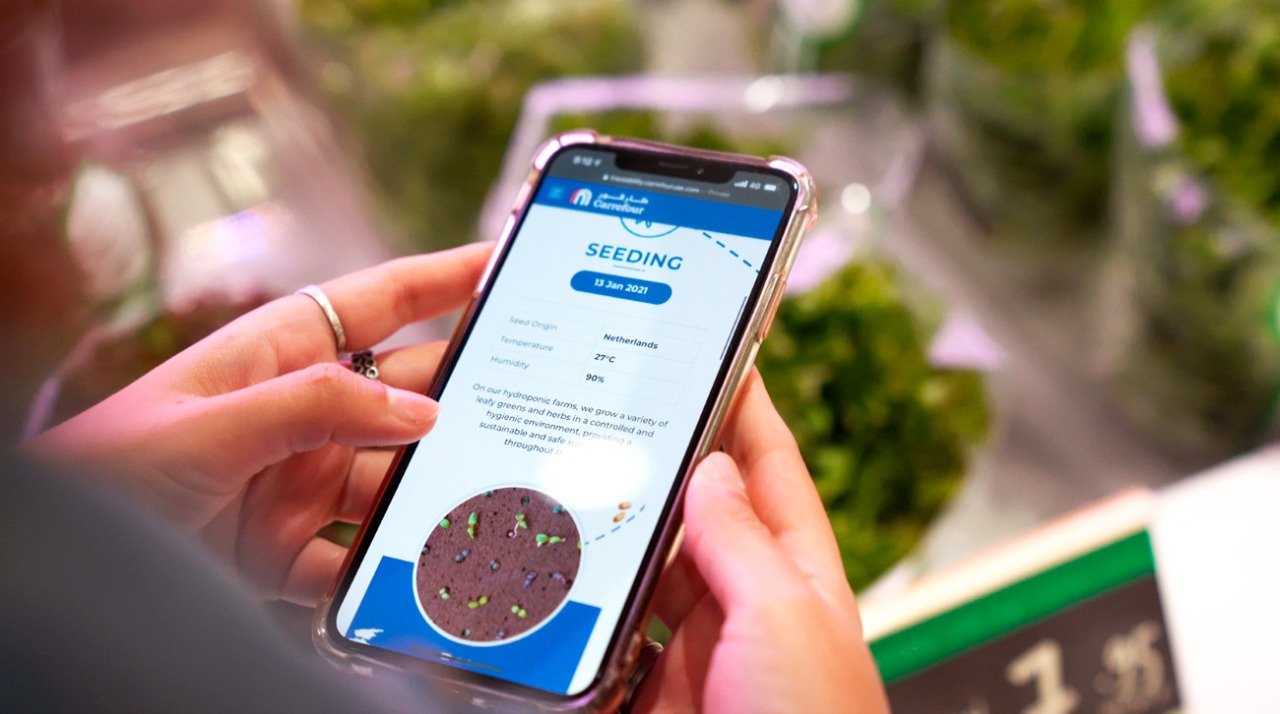
Image Source: Dubai Media Office
Carrefour provides a well-known example of blockchain being applied to a concrete retail problem: food traceability. Carrefour states that it began using blockchain for Carrefour Quality Line products in 2018 and later expanded the approach to additional products and markets. The company describes using QR codes so consumers can access information about product origin and journey.
Carrefour also states that it joined the IBM Food Trust platform to help establish food traceability across links in the supply chain, from producers through sales channels. The published description emphasizes sharing traceability, quality, and food-safety information across supply-chain participants.
The lesson for other retailers is not that every product needs blockchain. The stronger lesson is architectural: when multiple parties contribute information about a product and consumers or regulators need credible provenance, a shared traceability layer can become valuable.
This case also illustrates an important implementation principle: the consumer-facing experience can remain simple - such as scanning a QR code - while the underlying system connects supply-chain participants and records the events required to support that experience.
How to Choose a Blockchain Development Partner for Retail
A retail blockchain partner should be able to connect business-process design with enterprise engineering. Blockchain expertise alone is not enough if the team cannot integrate with the systems that already run the retailer.
Evaluate the partner across six areas:
- Retail understanding: Can the team map supply chain, inventory, returns, settlement, and partner workflows?
- Enterprise integration: Can it connect blockchain with ERP, POS, OMS, WMS, eCommerce, APIs, and event-driven systems?
- Architecture: Can it explain what belongs on-chain, what stays off-chain, and why?
- Security and governance: Can it define identity, permissions, auditability, contract controls, and incident processes?
- Delivery approach: Does it begin with an assessment and a focused pilot rather than proposing a large rebuild?
- Measurement: Can it connect the technical rollout to concrete operational KPIs and an ROI hypothesis?
A strong vendor should also be comfortable saying when blockchain is not the best solution. That is a sign that the recommendation is based on the business problem rather than on selling a particular technology.
Read more: Best Blockchain Outsourcing Company: How to Choose the Right Partner in 2026
The Future of Blockchain Development in Retail

The role of blockchain in retail is likely to become less about standalone blockchain applications and more about verified data and workflow infrastructure embedded inside broader digital systems. As retailers add channels, suppliers, logistics providers, marketplaces, connected devices, and compliance requirements, the need to establish trusted cross-company events remains relevant. Five areas worth watching include:
- Blockchain + AI: trusted event histories can provide better inputs for anomaly detection, forecasting, and investigation workflows. (
- Digital product identity: retailers can combine provenance data with digital product records to improve traceability and lifecycle visibility.
- Automated settlement: smart contracts can reduce manual steps where payment or settlement depends on verifiable operational conditions.
- Connected supply chains: IoT and logistics systems can feed operational events into shared workflows, subject to strong validation at the data source.
- Hybrid enterprise architectures: Retailers are likely to continue using blockchain selectively as a shared trust layer alongside conventional databases, APIs, and analytics platforms. In markets affected by emerging product-traceability requirements, official frameworks such as the EU's work on digital product passport implementation arrangements also reinforce the importance of interoperable, structured product data. Blockchain may support these architectures in selected use cases, but it is not automatically required.
The central trend is not “blockchain everywhere.” It is the more disciplined use of shared, verifiable records where multiple organizations need to coordinate without maintaining conflicting versions of the truth.
Start Your Retail Blockchain Program with a Focused Assessment
Blockchain can be a practical enterprise technology when it solves a genuine multi-party trust problem. The strongest retail programs start with the workflow, not the technology: identify where records diverge, quantify the cost of that friction, determine what information needs shared proof, and then design the smallest architecture that can solve the problem.
Whether the opportunity is supply chain traceability, inventory coordination, smart-contract automation, partner settlement, or fraud prevention, the right next step is a focused assessment that connects the use case to architecture, integration requirements, governance, and measurable KPIs.
Ready to evaluate a retail blockchain use case? Talk to SotaTek’s blockchain team about your workflow, integration requirements, and implementation roadmap. Learn more about SotaTek's blockchain development services and discuss the right delivery model for your retail use case.

 https://www.sotatek.com/
 (+84)2466585248