


Most companies asking “AI PoC vs MVP?” are asking the wrong question. The real question is: what uncertainty could kill this AI project first?
If you still do not know whether the model can solve the problem with your data, build a Proof of Concept. If the technology is already credible but you do not know whether users will adopt it, trust it, or generate enough business value from it, build an MVP. And if neither question is genuinely uncertain, there is little value in adding validation stages simply because an AI project plan is “supposed” to have them.
A PoC is primarily an evidence-generation exercise. An MVP is a usable product designed to learn from real behavior. Confusing the two leads teams to either over-engineer experiments or expose under-engineered demos to real users. If your organization is already building an AI roadmap, our AI readiness guide is a useful companion before deciding how much to invest in validation.
AI PoC vs MVP: The Short Answer
An AI Proof of Concept (PoC) determines whether a risky technical assumption is feasible. An AI Minimum Viable Product (MVP) determines whether a usable AI product creates enough value for real users to justify further investment.
| AI PoC | AI MVP | |
| Core question | Can this work? | Will this create enough value? |
| Primary uncertainty | Technical feasibility | User and business viability |
| Typical audience | Internal technical and business stakeholders | Real users or a controlled user group |
| Data | Representative data may be sufficient | Real or production-like data |
| UX | Minimal or unnecessary | Usable end-to-end experience |
| Architecture | Experimental | Stable enough for real use |
| Security | Appropriate to controlled testing | Real identity, permissions and controls |
| Integrations | Can be mocked when irrelevant to the hypothesis | Critical integrations should be real |
| Evaluation | Technical success criteria | Technical + user + workflow + business metrics |
| Scalability | Usually secondary | Must have a credible path to scale |
| Decision | Continue, change approach, or stop | Improve, expand, pivot, or stop |
AWS guidance on architecting a generative AI PoC frames the PoC side similarly: the point is to validate feasibility and business assumptions before committing to a larger implementation, rather than to prematurely engineer a production system.
Atlassian's MVP framework approaches the question from the product side, defining an MVP as the smallest functional version that can be placed in front of users to generate learning and guide subsequent development. Its MVP material also provides a useful visual reference for the build–measure–learn concept.
The definitions are simple. Choosing correctly is not.
From AI PoC to MVP to Production: Not a Mandatory Sequence

A common AI roadmap looks like this: Idea → PoC → MVP → Pilot → Production
That sequence is useful as a mental model, but it becomes dangerous when organizations treat every box as mandatory. PoC, prototype, MVP, and pilot are better understood as different instruments for removing different types of uncertainty.
Consider two projects. A manufacturer wants to detect microscopic defects using proprietary camera data captured under difficult lighting conditions. Technical uncertainty is high, so a PoC is justified. A customer-support team wants to use a mature LLM to summarize tickets and retrieve approved knowledge. The basic language capability is already well established; the meaningful uncertainty is whether employees will use the system, whether retrieval is accurate enough, and whether the workflow saves enough time. A generic chatbot PoC adds little evidence.
Our position is simple: Build the smallest artifact capable of removing the largest remaining uncertainty.
Microsoft's AI adoption guidance similarly encourages organizations to prioritize use cases based on business impact and technical feasibility, establish measurable success criteria, and use targeted validation before expanding implementation.
Start With an Uncertainty Map, Not a Deliverable
Before deciding between an AI PoC and MVP, identify what you genuinely do not know. Different uncertainties require different forms of validation.
| Uncertainty | Best validation artifact |
| Can the model achieve the required quality? | PoC |
| Is the available data sufficient? | PoC |
| Can latency meet the workflow requirement? | PoC |
| Is inference economically viable? | PoC |
| Can two unusual systems integrate? | PoC / technical spike |
| Do users understand the experience? | Prototype |
| Will users actually adopt the solution? | MVP |
| Does it improve the real workflow? | MVP |
| Will users trust AI recommendations? | MVP |
| Can it generate measurable business value? | MVP / Pilot |
| Can it survive real operational conditions? | Pilot |
| Can it scale securely and reliably? | Production engineering |
This approach prevents a common failure mode: building much more software than the decision requires. If the only question is whether an LLM can classify historical support tickets above an agreed quality threshold, you do not need authentication, polished UX, workflow orchestration, notifications, or a production database. You need a representative dataset and a defensible evaluation.
For a broader view of how business workflows should shape AI design, see our guide to AI workflow integration.
What an AI PoC Should Actually Prove

A good PoC is narrow enough to fail quickly. That is not pessimistic engineering; it is disciplined validation. Before implementation starts, write the hypothesis in a form that can actually be disproved. For example: Given representative internal policies, can a retrieval + LLM pipeline answer compliance questions with acceptable correctness, grounding, latency, and cost?
The PoC then needs measurable thresholds rather than subjective demo feedback.
Example: PoC evaluation configuration
experiment: policy_qa_poc
dataset:
name: policy_questions_v1
cases: 250
success_criteria:
correctness: ">= 0.90"
groundedness: ">= 0.95"
p95_latency_ms: "<= 4000"
cost_per_query_usd: "<= 0.08"
failure_conditions:
critical_hallucinations: 0
unauthorized_sources: 0
This is intentionally simple. The goal is to convert a vague statement such as “the model looks good” into an experiment that can produce a go, change, or stop decision.
A strong AI PoC usually validates four areas:
- Technical feasibility: Can the selected model, retrieval strategy, vision model, agent design, or prediction pipeline meet the minimum technical requirement?
- Data feasibility: Is there enough representative data, and does real data behave the way the team assumed?
- Economic feasibility: Is there a plausible cost envelope at meaningful usage volume?
- Production feasibility: Have we identified any architectural, security, integration, or compliance issue that could make production impractical?
AWS recommends keeping experimental generative AI architecture deliberately lightweight so teams can focus on prompts, retrieval, model behavior, evaluation and application logic before investing heavily in infrastructure.
If your main challenge is connecting technical performance to economic impact, our manufacturing downtime analysis provides a useful example of how AI metrics ultimately need to map back to operational outcomes.
What an AI PoC Should Not Become

The most dangerous PoCs are often the ones that look too polished. Stakeholders see an attractive interface, click through a few successful examples, and assume the engineering risk is largely behind them.
Behind that interface, however, the system may still depend on sample data, a shared API key, manually curated prompts, one developer account, no access controls, limited evaluation, no fallback logic, and no monitoring. None of those omissions makes the PoC bad; they simply mean it remains a PoC.
The problem starts when presentation maturity is mistaken for engineering maturity.
A PoC should spend engineering effort only where that effort affects the hypothesis. If authentication does not affect the question being tested, mock it. If retrieval quality is central to the hypothesis, use realistic documents and measure it properly. If latency is critical, test the real model and infrastructure path instead of estimating performance from a local demo.
What Makes an AI MVP Fundamentally Different

An MVP moves uncertainty out of the experiment and into a real workflow. People use it, real data enters it, integrations fail, permissions matter, latency becomes visible, and AI mistakes begin to carry actual consequences.
That changes the minimum technical baseline. An MVP may still be intentionally narrow, but it can no longer ignore the controls necessary for real users.
A typical AI MVP architecture starts to look more like this:
User
│
▼
Identity & Authentication
│
▼
Application / API Layer
│
├── Authorization
├── Input Validation
├── AI Orchestration
│ ├── Retrieval / Context
│ ├── Model
│ ├── Tools
│ └── Guardrails
│
├── Enterprise APIs
├── Human Approval
│
▼
Business Outcome
│
├── Trace
├── Feedback
├── Evaluation
├── Cost
└── Monitoring
The MVP does not need enterprise-scale infrastructure from day one, but certain controls become part of the minimum viable scope when real risk exists. If employees access internal data, identity and authorization matter. If the AI can modify customer records, permission checks and auditability matter. If an output can affect a regulated decision, human review may be part of the MVP rather than a later enhancement.
Google Cloud's production-ready AI guidance makes the same broader point when discussing the prototype-to-production gap: moving an AI system into real usage adds infrastructure, security, scalability, reliability, and monitoring requirements around a probabilistic component.
For enterprise teams evaluating conversational AI specifically, our enterprise AI chatbot guide offers a related perspective on moving beyond a simple conversational demo.
PoC Metrics and MVP Metrics Should Not Be the Same
If a PoC and an MVP use exactly the same scorecard, one of them is probably being measured incorrectly. A PoC asks whether the technical hypothesis survives. An MVP asks whether the system remains useful after it encounters real users, real workflows, and real operational friction.
| PoC metrics | MVP metrics |
| Accuracy / precision / recall | Task-completion rate |
| Groundedness | User adoption |
| Retrieval quality | Repeat usage |
| Hallucination rate | Escalation rate |
| Model latency | End-to-end workflow time |
| Cost per inference | Cost per completed task |
| Tool-call accuracy | Human review workload |
| Dataset coverage | User satisfaction |
| Technical failure rate | Business KPI improvement |
The distinction between cost per inference and cost per completed task is particularly important. A cheap model can still support an expensive workflow if users repeatedly retry prompts, correct outputs manually, wait for slow tools, or escalate a high percentage of cases.
For leadership, the useful unit of economics is rarely the token. It is the successful business outcome.
When You Should Build an AI PoC First
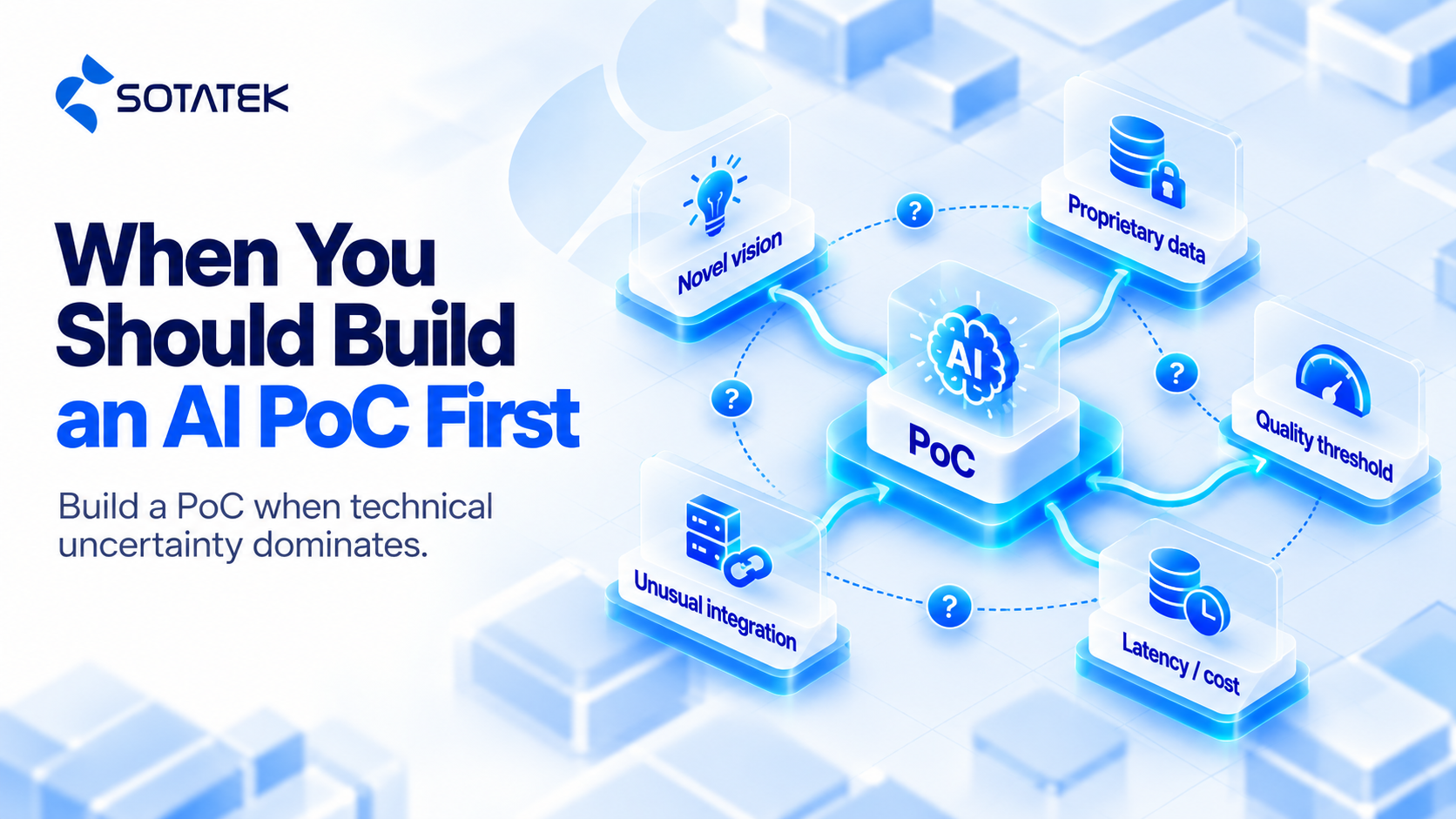
A PoC is appropriate when technical uncertainty dominates the investment decision. Typical examples include novel computer-vision conditions, proprietary data whose predictive value is unknown, model quality that must cross a hard threshold, unusual legacy-system integration, or a cost/latency constraint that has not yet been demonstrated.
Imagine a manufacturer evaluating automated visual inspection on highly reflective components. Building an inspection-management product before establishing whether the model can reliably separate genuine defects from reflections would be backwards. The difficult assumption is model feasibility, so that is where the first investment should go.
The same discipline applies in high-stakes industries. Healthcare and financial-services applications often have additional constraints around data quality, permissions, review, explainability and compliance. For adjacent examples, see our articles on AI automation in healthcare and digital transformation in banking.
When You Should Skip the PoC and Build an MVP
Not every AI initiative deserves a PoC.
If the core capability is already mature and the real unknown is adoption, workflow fit, trust, or business value, another technical demonstration may simply prove something the organization already knows. An internal meeting assistant, for example, rarely needs a project whose primary question is whether an LLM can summarize a meeting. The more useful questions are whether employees will use the tool, whether it retrieves the right internal context, how much review it requires, and whether it saves enough time to justify operating it.
Those questions require a real workflow and real users. Build an MVP.
The rule is not “skip technical validation.” The rule is to avoid pretending that known capabilities are still the riskiest part of the project.
The Technical Delta From PoC to MVP
A successful PoC does not automatically become an MVP codebase. The two artifacts optimize for different things: a PoC optimizes for learning speed, while an MVP optimizes for controlled real-world use.
| PoC implementation | MVP implementation |
| Notebook / experimental script | Deployable application or service |
| Static sample dataset | Maintained production-like data pipeline |
| Shared developer credentials | Identity + secrets management |
| Manual prompt changes | Versioned prompts/configuration |
| One model call | Managed AI workflow |
| Manual evaluation | Repeatable evaluation pipeline |
| Developer console logs | Structured tracing and monitoring |
| Happy-path behavior | Failure handling and fallback |
| Mock integration | Real critical integrations |
| Local execution | Dev / staging / production |
| Ad hoc access | Role-based authorization |
| Demo feedback | Product analytics + user feedback |
Example: the architecture should change with the risk
A PoC might be as simple as:
docs = load_test_documents()
index = build_retrieval_index(docs)
answer = model.generate(
question=user_question,
context=index.search(user_question)
)
evaluate(answer)
An MVP introduces a wider execution boundary:
def answer_question(user, question):
authorize(user, permission="policy.read")
context = retrieve_authorized_context(
workspace=user.workspace,
question=question
)
result = ai_service.generate(
question=question,
context=context
)
trace.record(
user=user.id,
sources=result.sources,
model=result.model,
latency=result.latency,
cost=result.cost
)
return apply_guardrails(result)
The second example is not “better AI.” It is a different product maturity level. The model may be identical, but the surrounding system now handles identity, scoped retrieval, traceability and policy enforcement because real usage requires them.
AWS's guidance for advancing generative AI systems beyond experimentation similarly adds architecture formalization, CI/CD, broader evaluation datasets and controlled user validation as teams move toward pre-production.
Carry the Evidence Forward, Not Necessarily the Code
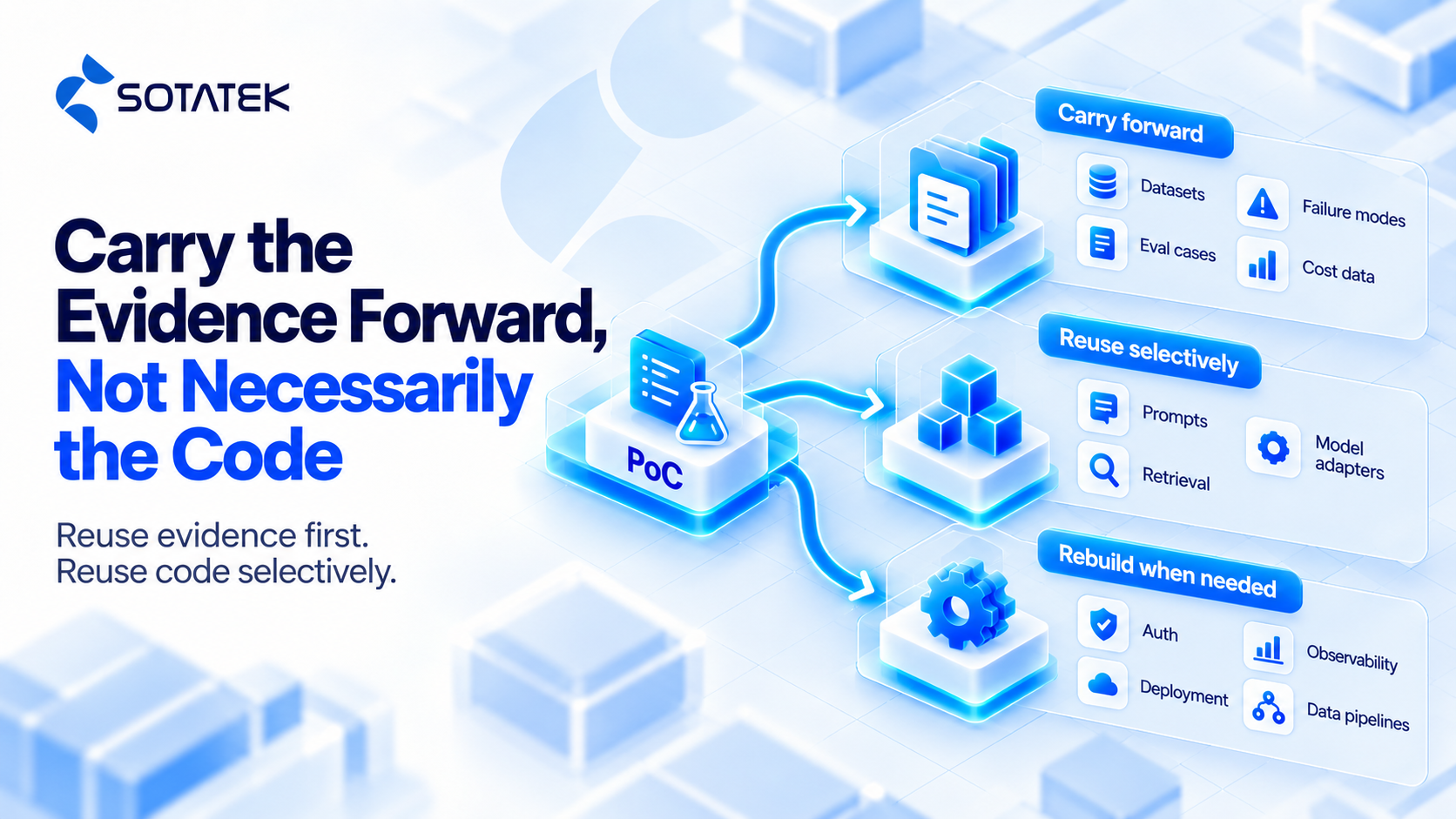
The most valuable output of a PoC is the evidence it generates: the dataset, failure cases, evaluation criteria, latency observations, cost assumptions, architecture constraints and lessons about the problem.
Some code may survive. Some should be discarded.
Teams get into trouble when they feel emotionally attached to a prototype simply because it already exists. Reusing weak PoC architecture can create more technical debt than rebuilding a small production-shaped core.
Our recommendation is:
- Always carry forward: datasets, evaluation cases, failure modes, model comparisons, cost data and technical decisions.
- Reuse selectively: prompts, retrieval logic, model adapters and well-designed integrations.
- Rebuild when necessary: authentication, authorization, data pipelines, deployment, observability and application architecture that were deliberately simplified for experimentation.
This is why the PoC-to-MVP transition should include an architecture review rather than a ceremonial “promotion” of the existing repository.
The AI PoC → MVP Decision Gate
Before funding an MVP, the PoC should leave behind evidence rather than excitement.
| Decision area | Question before MVP |
| Problem | Is the problem still worth solving? |
| AI necessity | Does AI outperform a simpler approach enough to justify the complexity? |
| Data | Is the required data available, usable and maintainable? |
| Model quality | Does the approach meet the minimum technical threshold? |
| Failure modes | Do we understand where the system breaks? |
| Economics | Is there a plausible unit-economics path? |
| Latency | Can the workflow tolerate real response times? |
| Integration | Can required enterprise systems be connected reliably? |
| Security | Are there blockers that fundamentally change the architecture? |
| Business case | Does the evidence justify the next investment? |
If several answers remain unknown, the PoC is probably unfinished. If they are known and positive, continuing to optimize the experiment becomes wasteful; move to an MVP and start testing product and workflow assumptions.
For organizations that need an external build partner at this stage, our list of AI development partners covers the technical and delivery criteria we believe matter when choosing a team.
What an AI MVP Should Validate

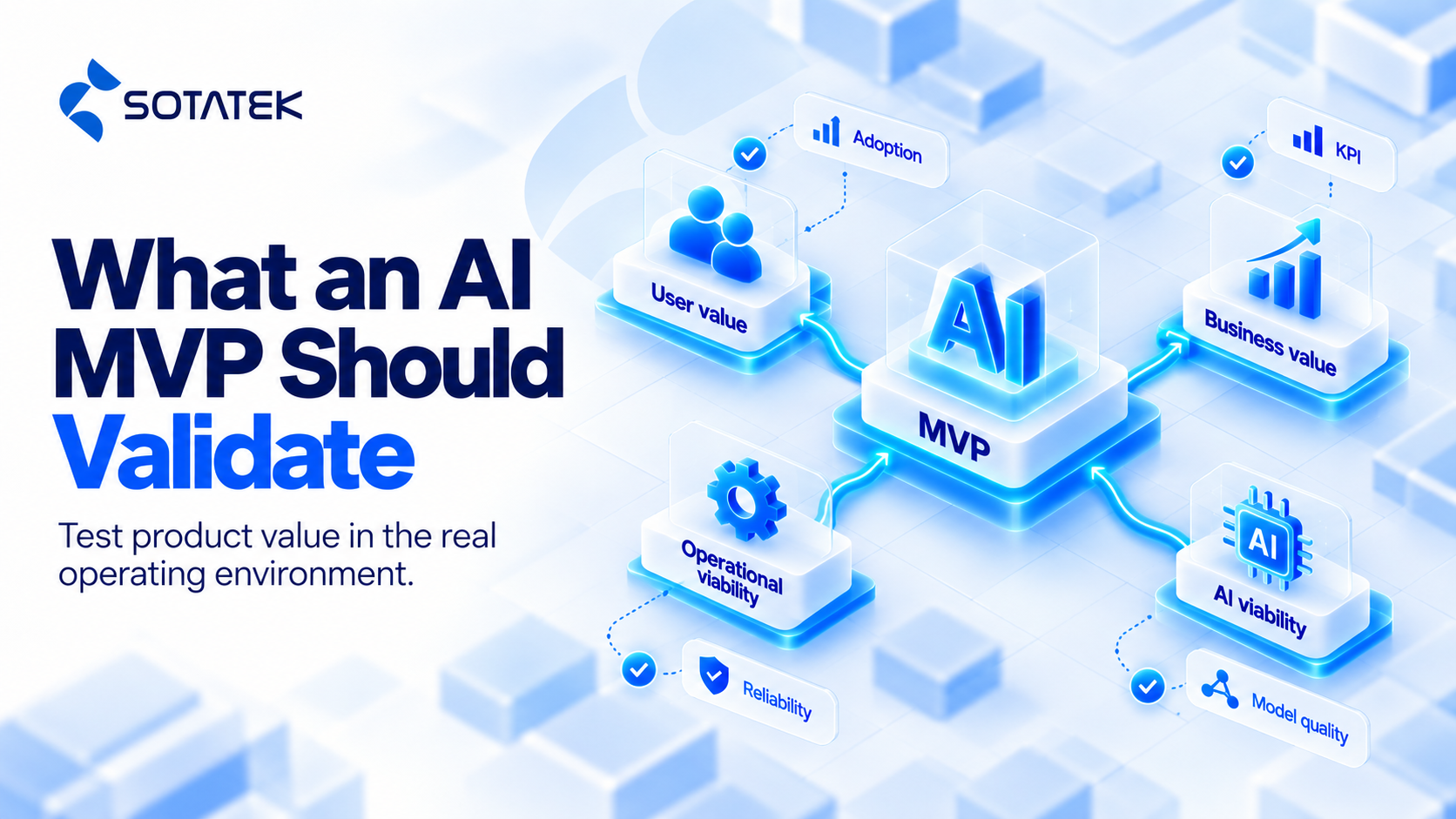
An MVP should expose enough of the real operating environment to reveal whether the product deserves to exist. That requires validation across four dimensions rather than model quality alone.
User value
Measure whether people actually complete meaningful work with the product. Adoption, repeat usage, workflow completion and qualitative feedback are more informative here than model benchmarks.
Business value
Track the KPI the product was supposed to influence: cycle time, throughput, conversion, operational cost, error reduction, response time, revenue or another measurable outcome.
Operational viability
Observe what happens when the MVP meets incomplete data, upstream failures, edge cases, permission problems and real usage patterns. Reliability problems that never appeared in the PoC often surface here.
AI viability
Continue monitoring model quality after deployment because real inputs are rarely as clean or balanced as an evaluation dataset. Groundedness, tool accuracy, escalation, human correction and failure categories should remain measurable throughout the MVP.
AI products also change how work is divided between people and software. For that organizational dimension, see our analysis of AI's impact on the workforce.
PoC, Prototype, MVP, and Pilot Are Different Things
These terms are often used interchangeably in project plans, which makes teams optimize the wrong artifact.
| Artifact | Primary question |
| PoC | Can the critical technical assumption work? |
| Prototype | How should the experience work? |
| MVP | Does a usable version create real user and business value? |
| Pilot | Does the solution operate reliably in a limited real environment? |
| Production | Can we secure, support, monitor and scale it continuously? |
A prototype may fake the AI completely if the purpose is to validate UX. A PoC may have almost no UX if technical feasibility is the only question. An MVP cannot fake the core value proposition because real users need enough of the actual solution to generate meaningful evidence.
How SotaTek Approach AI PoC vs MVP

We do not believe every AI engagement should automatically begin with a PoC. The first job is to identify what still needs to be proven, because that determines what should be built.
For technically uncertain projects, we favor a narrow PoC with explicit success and failure criteria. For mature AI capabilities where the larger uncertainty is adoption or business impact, we would rather move toward a usable MVP and start learning from real workflows.
The delivery logic is straightforward:
Business problem → uncertainty map → validation artifact → evidence → next investment decision
That validation artifact can be a PoC, prototype, MVP, or controlled pilot. In some cases, the evidence says the project should stop. That is not a failed validation program; stopping an economically or technically weak idea before full implementation is one of the highest-value outcomes a PoC can produce.
From PoC to Proof of Value With SotaAgents

For agentic AI, we increasingly prefer the term Proof of Value because proving that an LLM can generate text or call a tool rarely answers the business question that matters.
The stronger test is whether an agent can perform a real workflow using real enterprise context, inside the organization's security boundary, and achieve an agreed operational result.
That is the logic behind SotaAgents. Rather than treating the first implementation as an isolated chatbot demo, the platform can support a progression from controlled agent validation toward governed deployment, with model policies, enterprise tools, MCP integrations, memory, guardrails, traceability and human approval incorporated into the wider runtime.
A PoC and MVP can use the same capability model while exposing different authority
For example, a claims agent at PoC stage might only receive read capabilities:
stage: poc
tools:
- policy.search
- claim.read
permissions:
write_actions: false
evaluation:
correctness: true
groundedness: true
tool_accuracy: true
The objective is to prove that the agent can understand the case, retrieve the right policy and produce a defensible recommendation.
At MVP stage, the workflow can introduce controlled action:
stage: mvp
tools:
- policy.search
- claim.read
- claim.update
permissions:
claim.update:
requires_human_approval: true
observability:
trace_tool_calls: true
record_sources: true
record_cost: true
These examples are illustrative rather than literal SotaAgents configuration syntax, but the architectural principle is important: authority should expand only when evidence justifies it.
The PoC proves reasoning and retrieval. The MVP adds identity, workflow integration, approvals, monitoring and real operational feedback. Governance is therefore introduced as capability grows rather than bolted onto an autonomous prototype after the fact.
For teams evaluating broader automation architecture around these workflows, our AI Automation vs RPA comparison provides additional context on when probabilistic AI should sit alongside deterministic automation.
Our Rule for AI PoC vs MVP
A useful decision framework is:
| If this is the biggest uncertainty... | Build... |
| Can the technology work? | PoC |
| Will the user experience work? | Prototype |
| Will users and the business get value? | MVP |
| Will it survive real operations? | Pilot |
| Can we operate it repeatedly at scale? | Production system |
Do not build every stage because a methodology diagram includes every stage. Do not skip technical validation because a demo looked convincing, and do not continue running PoCs after the technical question has already been answered.
The purpose of validation is to earn the next investment decision with evidence.
AI PoC vs MVP: Final Decision Checklist
Before deciding what to build, answer the following:
- Is there a genuine technical assumption we have not proven?
- Could that assumption invalidate the entire project?
- Can we answer it without building a user-facing product?
- Is the core model capability already well understood?
- Is the larger uncertainty now adoption, workflow fit or business value?
- Do we need real users to obtain useful evidence?
- Are we ready to support real identity, data, integrations and monitoring?
- What exact evidence would cause us to continue, redesign, or stop?
If the first three questions dominate, build the PoC. If the middle questions dominate, move toward the MVP. If you cannot answer the final question, define the decision criteria before building either.
Conclusion
The difference between AI PoC vs MVP is not primarily budget, polish, or project duration. It is the type of uncertainty the organization needs to remove.
A PoC should prove whether the difficult technical assumption works. An MVP should prove whether a usable AI product creates enough value under real conditions. Strong teams avoid automatically building both; they identify the riskiest assumption, design the smallest credible test, measure the result, and let that evidence determine the next investment.
That discipline is what keeps AI programs from becoming an endless series of demos.
If you are deciding whether your next AI initiative needs a PoC, MVP, or narrower proof of value, talk to our AI engineering team about mapping the uncertainty before deciding what to build.

 https://www.sotatek.com/
 (+84)2466585248




