


Enterprise AI rarely fails because the model cannot generate language. It fails because the model does not understand what the business means by “customer,” which policy is still valid, which table contains the approved revenue metric, whether an employee is allowed to see a document, or what changed in the ERP five minutes ago.
An enterprise knowledge layer for AI addresses that problem by turning fragmented data, documents, metadata, business definitions, relationships, permissions, and operational context into a reusable foundation that AI applications can retrieve and reason over. The objective is not to copy every enterprise system into one giant vector database. It is to give AI the right knowledge, with the right meaning, freshness, authority, and access controls, at the moment the application needs it.
Let’s dive deeper into how an enterprise knowledge layer for AI works, why traditional RAG is often only the starting point, and what organizations should build if they expect multiple copilots and agents to share the same enterprise truth.
What Is an Enterprise Knowledge Layer for AI?
An enterprise knowledge layer for AI is a shared architecture that sits between enterprise information sources and the AI applications consuming them. It discovers and connects knowledge from documents, databases, SaaS applications, APIs, data warehouses, operational systems, and metadata catalogs, then enriches that information with the business context AI needs to interpret it correctly.
Microsoft now explicitly includes a knowledge layer in its reference architecture for enterprise AI workloads. Microsoft’s Azure Well-Architected AI application design guidance describes this layer as the combination of grounding data, knowledge graphs, and retrieval services that provide context to the intelligence layer while enforcing authorization and data-access policies.
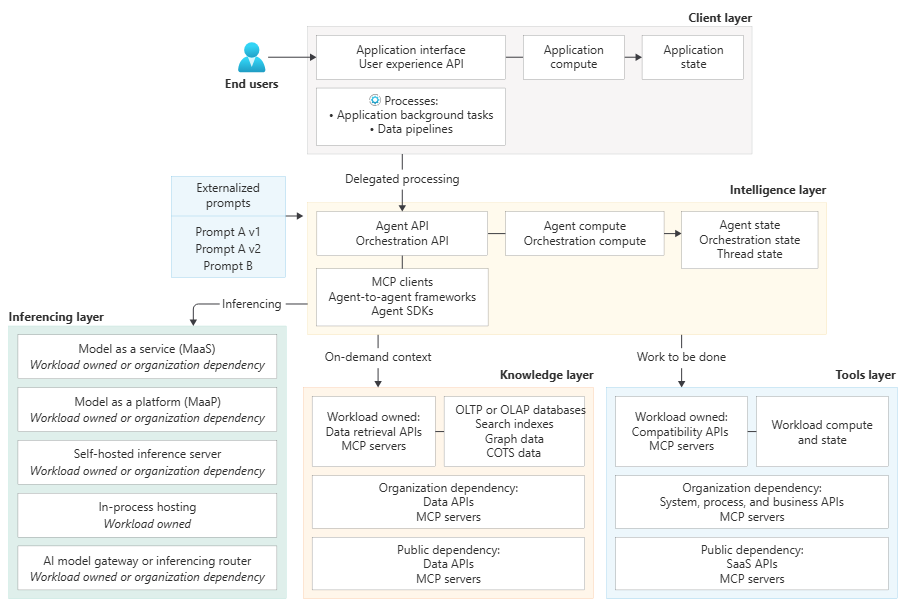
Source: Microsoft Azure
That definition is important because a knowledge layer is broader than a knowledge base. A knowledge base may contain documents that an LLM can search. The enterprise knowledge layer also captures what those documents and data assets mean, how they relate, which version is authoritative, who owns them, who can access them, and how AI should use them.
Consider the question: “How much recurring revenue did the Enterprise segment generate last quarter?.” A language model can understand the sentence. A vector database may even retrieve documents mentioning “revenue.” But the enterprise answer requires additional context: how Finance defines recurring revenue, which customer hierarchy determines Enterprise accounts, which reporting period is considered closed, which currency conversion logic applies, and which dataset is certified. That is knowledge, not simply data. A useful distinction looks like this:
| Layer | What it provides | Example |
| Raw data | Facts and records | invoice_amount = 40,000 |
| Metadata | Technical description | Column type, table owner, schema |
| Semantic context | Business meaning | “ARR excludes one-time implementation fees” |
| Relationships | How information connects | Customer → Contract → Invoice |
| Trust signals | Which source is authoritative | Finance-certified dataset |
| Permissions | Who can retrieve what | HR payroll restricted to HR |
| Retrieval layer | Finds context for a task | Hybrid/vector/graph search |
| Knowledge layer | Combines all of the above | Trusted context supplied to AI |
Google Cloud makes a similar distinction between passive metadata and active context. Google Cloud’s Knowledge Catalog documentation describes context as a combination of technical metadata, business semantics, operational signals, relationships, trust indicators, and agent guidance rather than a static catalog entry. This is the first architectural shift: AI needs enterprise meaning, not only enterprise content.
Read more: AI Readiness: How Ready Is Your Business for AI?
Why RAG Alone Is Not an Enterprise Knowledge Strategy

Retrieval-Augmented Generation solved an important problem. Instead of forcing a foundation model to rely only on what it learned during training, an application can retrieve current private information and place that information into the model's context. For many early enterprise applications, the architecture looked roughly like this:
Documents
↓
Chunking
↓
Embeddings
↓
Vector Database
↓
User Query
↓
Retrieve Top-K Chunks
↓
LLM
That can work very well for a bounded document collection. It becomes less convincing when dozens of AI applications begin rebuilding separate ingestion pipelines, vector stores, permission logic, metadata conventions, and retrieval strategies over the same company information.
Microsoft describes exactly this scaling problem in its introduction to Foundry IQ: as organizations move from a small number of copilots to larger fleets of agents, teams repeatedly rebuild RAG pipelines, access-control logic, and data connectors. Microsoft's response is a reusable knowledge layer that gives multiple agents a common endpoint for enterprise context while respecting source permissions.
The problem is therefore not that RAG is obsolete. RAG remains one of the core retrieval mechanisms inside the knowledge layer. The issue is where retrieval logic lives and whether enterprise knowledge is reusable across applications.
From retrieval to context engineering
A basic RAG system asks, “Which chunks look similar to this question?” A mature enterprise knowledge layer can ask a richer set of questions: Which source is authoritative? Does this user have permission to see it? Is the information current? Does the question require a policy document, relational database, knowledge graph, or live CRM call? Are two business terms actually synonyms? Which relationships need to be traversed before an answer can be generated?
This is why the enterprise architecture increasingly combines vector retrieval with keyword search, structured queries, knowledge graphs, metadata, semantic definitions, and real-time APIs. The shift can be summarized as: RAG retrieves relevant content. A knowledge layer delivers relevant context.
That distinction matters most for agents. An agent does not only answer a question; it may use retrieved context to decide which tool to call, which record to update, or whether an action requires approval. Weak knowledge therefore becomes weak execution.
Gartner's 2026 research reaches a similar conclusion. Its playbook for establishing an enterprise context layer argues that agentic AI needs a shared, trusted context foundation to move from pilots toward reliable, scalable production systems.
Read more: RAG vs Fine-Tuning: How to Choose the Right LLM Optimization Strategy
The Architecture of an Enterprise Knowledge Layer for AI

A good enterprise knowledge layer for AI should not become another central data lake that attempts to copy every system. In many environments, the better architecture is federated: data remains in authoritative systems while the knowledge layer builds the context, indexes, relationships, permissions, and interfaces needed to discover and retrieve it.
Conceptually, the architecture looks like this:
ENTERPRISE SOURCES
┌──────────┬──────────┬──────────┬───────────┐
│ Documents│ CRM / ERP│ Databases│ SaaS / API│
└─────┬────┴─────┬────┴─────┬────┴─────┬─────┘
│ │ │ │
└──────────┴────┬─────┴──────────┘
▼
INGESTION / CONNECTORS
▼
KNOWLEDGE PROCESSING
Parsing · OCR · Metadata · Entities
▼
CONTEXT / SEMANTIC LAYER
Glossary · Relationships · Lineage · Trust
▼
RETRIEVAL SERVICES
Vector · Keyword · SQL · Graph · Agentic Search
▼
POLICY + PERMISSION ENFORCEMENT
▼
KNOWLEDGE INTERFACE
API · MCP · SDK · Search
▼
AI APPS · COPILOTS · AI AGENTS
Google Cloud's Knowledge Catalog architecture follows a similar direction: information from structured and unstructured systems is enriched into a context graph that combines technical metadata with business semantics and relationships before being served to AI through APIs or MCP.

Source connectivity: bring knowledge together without destroying ownership
The first layer connects to the systems where enterprise truth already lives. That may include SharePoint, Google Drive, Confluence, Salesforce, SAP, ServiceNow, Snowflake, BigQuery, SQL databases, file stores, emails, data lakes, or specialist industry applications.
The goal is not necessarily physical consolidation. A customer account should remain owned by the CRM. An approved policy should remain governed by the document repository. The knowledge layer maintains enough indexed or linked context to make those systems discoverable to AI without turning itself into another uncontrolled copy of everything.
This is also where freshness starts. Static exports are acceptable for prototypes but become dangerous when the application answers questions about inventory, pricing, regulatory guidance, customer status, or operational events.
Knowledge processing: turn enterprise content into something AI can interpret
Documents may require parsing, layout-aware OCR, deduplication, language detection, section recognition, metadata extraction, and chunking. Structured data requires schema discovery, data profiling, relationship mapping, semantic descriptions, and sometimes verified query patterns.
The output should retain enough provenance to trace every retrieved fact back to its authoritative source. A useful knowledge object might carry the content plus source system, document version, owner, effective date, security classification, entity references, and update timestamp.
This is a place where enterprises often underinvest. They focus on embeddings while ignoring the metadata that tells the system whether one of two almost identical policies is the active one.
Semantic context: teach AI the language of the business
“Customer,” “net revenue,” “active employee,” or “critical incident” often means something precise inside an organization. Those definitions cannot safely be inferred from column names alone.
A semantic layer captures business glossaries, metric definitions, synonyms, relationships, verified SQL logic, entity hierarchies, and other rules that convert technical information into business meaning. Knowledge graphs can add another dimension by explicitly representing relationships between customers, products, contracts, policies, employees, locations, or events.
This does not mean every enterprise needs to build a massive knowledge graph before launching AI. The useful scope depends on the questions and workflows the system must support. A document assistant may primarily need strong metadata and retrieval; an agent reasoning across contracts, customer records, and policy obligations may benefit much more from graph relationships.
Retrieval: route the question to the right knowledge source
One vector index should not be expected to solve every retrieval problem.
Semantic search is useful when concepts are expressed differently. Keyword search remains strong for exact identifiers, product codes, and legal terminology. SQL is better for structured calculations. Graph traversal can answer relationship-heavy questions. Live APIs are appropriate when the application needs the current transactional state.
The knowledge layer can route between these mechanisms rather than forcing every query through the same retrieval method.
This is where agentic retrieval becomes particularly useful: the system can decompose a complex question, query more than one source, evaluate intermediate findings, and continue retrieving until it has enough evidence.
Read more: Enterprise AI Chatbots: From Simple Q&A to Business Workflows
Security belongs inside retrieval
Permission-aware retrieval cannot be an optional filter applied after the model sees the content.
If an employee cannot open a compensation document in SharePoint, an AI assistant should not retrieve the document and rely on the prompt to avoid exposing it.
AWS's 2026 guidance on access control for enterprise RAG highlights the same challenge: enterprise knowledge sources contain complex permission structures, so retrieval needs to enforce authoritative access controls at query time rather than treat the AI index as a separate security domain. The architectural principle is simple: AI should inherit enterprise permissions, not invent its own parallel permission universe.
How to Build the Knowledge Layer Without Creating Another Data Silo

The most effective way to build an enterprise knowledge layer for AI is to start from a small number of business questions and expand the shared layer as use cases prove value. Attempting to catalog every system, define every business term, and map every relationship before the first AI application goes live usually creates an infrastructure program with no visible outcome.
Start with the questions your AI must answer
Take a lending compliance agent. It may need to answer whether a new central-bank circular conflicts with an internal lending policy. That immediately defines the first knowledge scope: regulatory circulars, internal policy documents, effective dates, clause relationships, business definitions, and the people authorized to approve changes.
The same exercise for a sales agent produces a very different layer: accounts, opportunities, contracts, call transcripts, pricing rules, product documentation, and CRM permissions.
By starting with questions and actions, the organization discovers which knowledge is genuinely valuable instead of indexing information because it exists.
Establish authoritative sources and ownership early
Every important concept should have a source of authority. Finance may own official revenue definitions, HR owns employee policy, Legal owns contract templates, and Product owns product documentation.
When two systems disagree, the AI needs a rule for resolving the conflict rather than a larger context window.
This is where knowledge stewardship becomes an operating role. The knowledge layer can automate discovery and enrichment, but humans still need to certify critical definitions, relationships, and sources.
Separate knowledge from application logic
A recurring anti-pattern is embedding domain knowledge directly inside prompts:
"ARR means annual recurring revenue excluding implementation fees..."
That may be acceptable for a prototype. Once five agents use the same definition, the enterprise now has five copies of business logic hidden inside prompts.
A shared enterprise knowledge layer for AI lets the definition live once and be retrieved by multiple applications. Updating the business rule no longer requires locating every prompt where someone copied it six months earlier.
The same principle applies to retrieval pipelines. If Customer Support, Legal, and Sales all need access to the same product documentation, the organization should not automatically build three separate chunking pipelines and three vector stores.
Measure context quality, not just answer quality
Knowledge-layer evaluation should test whether the system retrieved the correct context before evaluating the final model response.
Useful questions include whether authoritative sources appeared in the top results, whether permissions were respected, whether stale content was excluded, whether business terminology resolved to the right concept, and whether retrieval cost and latency remain acceptable.
Google Cloud is moving explicitly in this direction, describing context construction as something that should become a measurable engineering discipline rather than a subjective configuration exercise.
A practical evaluation can separate the layers:
| Evaluation layer | Example question |
| Knowledge coverage | Is the required source represented? |
| Retrieval | Did the system find it? |
| Authority | Did it prioritize the certified version? |
| Permissions | Was unauthorized knowledge excluded? |
| Freshness | Was the current version used? |
| Generation | Did the model interpret the evidence correctly? |
This diagnostic separation matters. If retrieval fails, changing the language model may accomplish very little.
Read more: AI Workflow Integration: Connecting AI With Enterprise Systems
Design for reuse from the beginning
A knowledge layer becomes strategically valuable when the second and third AI applications can reuse what the first application created.
That means exposing knowledge through stable interfaces, maintaining shared identity and permission models, and keeping application-specific orchestration outside the core knowledge foundation.
MCP is becoming one useful interface for this model because agents can discover and consume enterprise context through a standardized protocol without embedding vendor-specific retrieval code into every application.
Google Cloud's Open Knowledge Format is pushing the same idea at the knowledge representation layer. It proposes a portable format for the metadata, curated context, and knowledge agents need, reflecting a broader industry shift away from knowledge that can only be consumed by one proprietary application.
What Enterprise Knowledge Layers Enable in Practice
The immediate use case is usually enterprise search or question answering, but the value expands considerably once the same knowledge becomes reusable across agents and workflows.
A customer-service assistant can retrieve approved support documentation while also reading account state from the CRM. A procurement agent can combine supplier contracts, procurement policy, historical orders, and ERP records before preparing a purchase recommendation. A compliance agent can compare a new regulation with internal policy and point reviewers directly to affected clauses.
The common pattern is that the AI needs multiple forms of context at once.
Enterprise knowledge assistants
An assistant answering employee questions about policies is one of the easiest places to start. But even this use case becomes more sophisticated when knowledge spans SharePoint, PDF manuals, ticket histories, databases, and department-specific permissions.
AWS published a current example with IskayPet, a large pet-care retail group. The IskayPet enterprise knowledge-base implementation combines hybrid retrieval with source citation and explicitly tunes the amount of retrieved context against evaluation results rather than assuming more retrieved passages will always improve quality.

That is an important production lesson: an enterprise knowledge layer for AI is not valuable simply because it indexes more documents. It is valuable when it retrieves the smallest sufficient set of trustworthy context for the task.
Analytics and data agents
Structured enterprise data creates another class of knowledge problem. An AI agent can generate SQL, but table schemas alone rarely tell it which joins are approved, how business metrics are defined, or whether a sandbox table should be used instead of a certified reporting dataset.
Google Cloud's 2026 Knowledge Catalog announcement provides a useful real-world example. Bloomberg Media's Data Access AI Agent case in Google Cloud Knowledge Catalog uses unified metadata and business context to help internal users explore enterprise data and generate grounded insights., illustrating why semantic context is becoming part of AI infrastructure rather than remaining a BI-only concern.
Multi-agent systems
As organizations deploy multiple agents, shared knowledge becomes even more important. A Sales Agent and Finance Agent may reason differently, but they should not maintain contradictory definitions of the same customer, contract, or revenue metric.
A common knowledge layer provides shared context while agents retain their own tools, prompts, skills, and permissions.
This is also where context boundaries matter. The enterprise does not need every agent to see everything. Finance, Legal, HR, and Operations can consume the same knowledge infrastructure while receiving different context based on identity, workflow, and purpose.
Read more: AI Agent Development Process: From Use Case to Production
How SotaTek Builds an Enterprise Knowledge Layer for AI

At SotaTek, we would not start this work by asking which vector database the company wants to use. The first question is which business workflows need shared enterprise context and what evidence the AI must retrieve before it can answer or act reliably.
That usually leads to a phased architecture. We map the systems of record, identify authoritative documents and data products, define access boundaries, and determine which knowledge should be indexed versus accessed live. Only then do decisions around parsing, chunking, embeddings, search, knowledge graphs, or MCP become useful.
For an enterprise knowledge layer for AI, the implementation can combine document intelligence, hybrid retrieval, vector databases, structured queries, business metadata, semantic models, APIs, and knowledge graphs. The exact combination depends on whether the use case needs document grounding, analytical reasoning, live operational state, or relationships that cannot be captured reliably through similarity search alone.
SotaAgents: knowledge as shared agent infrastructure
This architecture becomes especially relevant in SotaAgents. SotaAgents is designed so agents can work with enterprise documents, systems, tools, and governed model access inside one runtime. The platform can ingest PDF, DOCX, XLSX, images, engineering files, Drive, and SharePoint sources, while answers remain traceable to pages, rows, or messages.
The key architectural principle is that knowledge does not have to be hardcoded into each agent.
An airline operations agent may use approved manuals and bulletins. A banking compliance agent can compare new regulations against internal policies. A healthcare workflow may keep records entirely inside on-premise infrastructure. The agents are different, but ingestion, traceability, permissions, model policy, and knowledge delivery can remain shared platform capabilities.
Conceptually:
SOTAAGENTS RUNTIME
┌──────── Shared Knowledge ────────┐
│ │
Documents Systems
PDF · DOCX · Drive · SharePoint ERP · CRM · APIs
│ │
└─────────────┬────────────────────┘
▼
Knowledge Layer
Parse · Retrieve · Permissions
Sources · Memory · Context
│
┌────────────────┼────────────────┐
▼ ▼ ▼
Legal Agent Finance Agent Ops Agent
│ │ │
Tools Tools Tools
│ │ │
└────────────────┼────────────────┘
▼
Trace / Approval
This model is more scalable than building an independent knowledge pipeline every time a department asks for an AI assistant.
It also makes governance easier. If one department is allowed to use a particular data source while another is not, the boundary belongs in retrieval and platform policy rather than a sentence inside the prompt.
Read more: AI Implementation Partner: What Enterprises Should Look for Before Scaling AI
Conclusion
The enterprise knowledge layer for AI is becoming the bridge between powerful general-purpose models and the highly specific reality of how a business operates. Models know language and broad world knowledge; enterprises still need to provide definitions, policies, relationships, permissions, operational state, and evidence.
That requires more than putting PDFs into a vector database. A production knowledge layer needs connectivity to authoritative systems, strong parsing and metadata, reusable semantics, permission-aware retrieval, freshness, source traceability, evaluation, and interfaces that multiple applications can consume.
The larger strategic shift is equally important. Organizations should stop rebuilding knowledge infrastructure around every new chatbot or agent. Business knowledge is shared infrastructure. Once it is curated, governed, and made reusable, each new AI application can spend less effort rediscovering the enterprise and more effort solving the workflow it was built for.
If your organization is building enterprise assistants or AI agents but knowledge is still fragmented across documents, databases, SaaS applications, and department-specific RAG pipelines, contact SotaTek's AI team to design the knowledge architecture, retrieval layer, integrations, and governance required to move from isolated pilots to reusable enterprise AI infrastructure.

 https://www.sotatek.com/
 (+84)2466585248




