


The RAG vs Fine-Tuning debate is often framed as a choice between two competing ways to make an LLM “smarter.” That framing is misleading because the two techniques solve fundamentally different problems.
RAG changes what the model can access at inference time. Fine-tuning changes how the model behaves.
If your AI system gives outdated answers because it cannot see your latest policies, customer records, product catalog, or internal documentation, fine-tuning is usually the wrong fix. You have a knowledge-access problem, and Retrieval-Augmented Generation (RAG) is the more natural architecture.
If the model already has enough information but repeatedly fails to follow a specialized format, classify inputs correctly, reproduce a domain-specific style, or execute a narrow task consistently, retrieval may simply add more context without fixing the underlying behavior. That is where fine-tuning becomes more interesting.
For many enterprise applications, the final architecture uses both. But starting with both by default is usually unnecessary complexity. A better approach is to identify which layer is failing first, establish an evaluation baseline, and add the least complex intervention that solves the measurable problem.
If your organization is still deciding where model customization fits into a broader AI program, read our AI implementation roadmap for the path from use-case selection and data readiness to PoC, production, and continuous optimization.
RAG vs Fine-Tuning: The Short Answer
RAG retrieves external information at runtime and supplies it to the LLM as context. The model itself does not need to memorize that information.
Fine-tuning trains a pretrained model on additional examples so its parameters adapt toward a desired task or behavior.
| Dimension | RAG | Fine-Tuning |
| Main purpose | Add external knowledge | Change model behavior |
| Changes model weights? | No | Yes |
| Best for | Private, changing, source-based knowledge | Specialized behavior or repeatable tasks |
| Knowledge freshness | High; update the source/index | Low; retraining may be required |
| Citations | Naturally supported if retrieval metadata is preserved | Difficult; knowledge is encoded in weights |
| Data requirement | Documents/data to retrieve | High-quality training examples |
| Main engineering work | Ingestion, chunking, retrieval, ranking, context | Dataset preparation, training, validation |
| Main failure mode | Wrong information retrieved | Wrong behavior learned |
| Inference overhead | Retrieval + extra context can increase latency | Can reduce prompt complexity after tuning |
| Update process | Update/re-index knowledge | Create new training data and tune again |
| Explainability | Stronger when sources are cited | Weaker for factual provenance |
| Can they work together? | Yes | Yes |
A useful mental model is: RAG gives the model an open book. Fine-tuning changes how the student has learned to answer the exam.
What RAG Actually Changes

Retrieval-Augmented Generation inserts a retrieval layer between the user's request and the model. Instead of expecting the LLM to contain every relevant fact in its parameters, the application searches an external knowledge source, selects relevant information, and passes that information into the model's context.
Microsoft describes RAG as a pattern that combines a pretrained LLM with an external retrieval system, allowing applications to incorporate information that sits outside the model's original training data. Microsoft's RAG architecture reference
At a high level, the architecture looks like this:
┌───────────────────────┐
│ Enterprise Knowledge │
│ PDFs / DB / CRM / KB │
└───────────┬───────────┘
│
Parse / Chunk / Embed
│
▼
┌───────────────────────┐
│ Search / Vector Index │
└───────────┬───────────┘
│
User Query ───► Query Processing / Retrieval
│
Top relevant context
│
▼
┌───────────────────────┐
│ LLM │
│ Query + Context │
└───────────┬───────────┘
│
▼
Grounded Response
+ source references
The critical point is that the knowledge remains outside the model.
If a company updates its refund policy this morning, the system can re-index the new document and retrieve it on the next request. Retraining the LLM is unnecessary.
This makes RAG particularly attractive for enterprise applications where knowledge changes faster than models should be retrained.
A Production RAG Pipeline Is More Than a Vector Database

RAG is frequently reduced to: documents → embeddings → vector database → LLM. That architecture works for a demo. Production retrieval usually requires more decisions. A serious RAG pipeline may include:
- Document parsing and structure extraction
- OCR for scanned content
- Chunking based on document semantics
- Metadata enrichment
- Embedding generation
- Vector, lexical, or hybrid search
- Query rewriting
- Metadata filtering
- Reranking
- Context selection
- Citation mapping
- Answer generation
- Groundedness evaluation
A simplified implementation might look like:
def answer(query, user):
expanded_query = rewrite_query(query)
candidates = search(
query=expanded_query,
workspace=user.workspace,
permissions=user.permissions,
top_k=30
)
ranked_chunks = rerank(
query=query,
documents=candidates
)
context = ranked_chunks[:5]
response = llm.generate(
question=query,
context=context,
instructions="""
Answer only from the provided evidence.
Cite the supporting source for every factual claim.
"""
)
return response
The LLM has only one component. Retrieval quality determines what evidence reaches it.
That is why a weak RAG system should not immediately trigger a model change. If the correct document never reaches the context window, switching to a larger model often produces a more articulate version of the wrong answer.
For businesses using AI to interpret information inside larger operational processes, our guide to AI workflow automation provides the broader workflow context around how AI, enterprise systems, and automated decisions fit together.
What Fine-Tuning Actually Changes

Fine-tuning works at a different layer. Instead of retrieving additional context when a request arrives, the training process adjusts model parameters using examples of the behavior the application wants to reinforce.
Suppose a base model produces reasonable insurance summaries but consistently fails to use the required structure. A supervised fine-tuning dataset can show hundreds or thousands of examples of the desired input-output pattern.
For example:
{
"messages": [
{
"role": "user",
"content": "Summarize this claim: ..."
},
{
"role": "assistant",
"content": {
"risk_level": "medium",
"claim_type": "property_damage",
"missing_documents": [
"repair_estimate",
"incident_report"
],
"recommended_action": "request_documents"
}
}
]
}
The objective is not primarily to teach the model which claim happened yesterday. The goal is to make the model consistently transform inputs into the behavior the application requires.
Google Cloud identifies common fine-tuning use cases such as adapting models to specialized tasks, terminology, output style, edge cases, and high-volume workloads where a smaller specialized model can sometimes improve cost or latency.
Fine-tuning becomes attractive when you repeatedly see behavioral failures such as:
- The model understands the input but formats outputs inconsistently.
- Few-shot examples help, but the prompt has become excessively large.
- The model needs to classify or extract information using specialized rules.
- Domain terminology is repeatedly misunderstood.
- A smaller model needs to reproduce behavior previously achieved only by a larger model.
- The same task will run at enough volume for inference efficiency to matter.
In these cases, adding more retrieved documents may not fix the underlying issue.
The Real Decision: Is Your Problem Knowledge or Behavior?
This is the most useful way to think about RAG vs Fine-Tuning.
If the problem is knowledge, start with RAG
Typical symptoms include:
- The information is proprietary.
- The information changes frequently.
- Answers need citations.
- Different users are allowed to access different information.
- The knowledge base is too large to insert into every prompt.
- Source documents need to remain independently editable.
Examples include internal knowledge assistants, legal document search, product catalogs, policy Q&A, technical manuals, support documentation, and regulatory intelligence.
If the problem is behavior, consider fine-tuning
Typical symptoms include:
- The relevant information is already available.
- The model repeatedly fails the same task pattern.
- Output format must be highly consistent.
- The desired behavior is difficult to express entirely through instructions.
- Hundreds or thousands of representative examples already exist.
- A smaller specialized model may be preferable for high-volume inference.
Examples include classification, structured extraction, specialized summarization, brand-style generation, and repeatable domain-specific transformations.
The distinction is especially important in enterprise automation. A workflow may require the model to retrieve a current policy and then apply a consistent classification scheme. The first problem is retrieval; the second is behavior.
They should not be treated as the same optimization problem.
For a wider discussion of where probabilistic AI should sit inside business processes, see our AI Automation vs RPA decision framework.
When RAG Is the Better Choice

RAG should usually be the first architecture considered when the answer depends on changing, private, traceable knowledge.
Enterprise Knowledge Assistants
Consider an employee asking: “What is the current travel reimbursement limit for Singapore?”
The answer needs to come from the latest company policy rather than whatever information the base model happens to contain. A well-designed RAG system can retrieve the relevant policy section and return:
Travel reimbursement limit: SGD 180/night
Source:
Travel Policy v4.2
Section 3.4 — Singapore
Updated: September 2026
The source is part of the answer.
That is difficult to reproduce reliably through fine-tuning because fine-tuning is a poor database-update mechanism.
Regulated and High-Traceability Environments
Finance, healthcare, legal, aviation, and compliance workflows often need to answer a second question after the AI responds: Where did that answer come from?
RAG can preserve document IDs, pages, timestamps, database records, and other retrieval metadata. That creates an evidence chain between generated output and enterprise data.
In banking, for example, the problem is frequently less about teaching an LLM “finance” and more about giving it controlled access to the correct policy, regulatory circular, transaction record, or customer context. For the wider technology landscape behind these use cases, see our analysis of digital transformation in banking.
Information That Changes Frequently
RAG is particularly effective when the application depends on knowledge that changes faster than the underlying model should be retrained.
A foundation model can only rely on what was available during training unless the application gives it additional context at runtime. That creates an obvious problem for enterprise use cases: product catalogs change, policies are revised, customer records evolve, regulations are updated, and operational data can become stale within hours.
RAG solves this by keeping the knowledge outside the model. When a user submits a query, the application retrieves the most relevant information from an external knowledge base and adds that evidence to the prompt before sending it to the LLM.
The knowledge layer does not have to be a vector database. Depending on the use case, it can be:
- A vector database for semantic retrieval across unstructured documents
- A traditional search index for keyword or hybrid search
- A relational database for structured operational data
- An enterprise knowledge repository, document store, CRM, or other governed data source
This distinction matters because different applications need different retrieval strategies. A customer-service assistant may retrieve relevant help-center articles, a shopping assistant may combine product catalogs with customer reviews, while a travel agent may need current flight and hotel information rather than facts encoded months earlier in model weights.
Conceptually, the runtime flow looks like this:
User Query
│
▼
Retrieve Relevant Information
│
├── Vector Database
├── Search Index
└── Relational / Enterprise Data
│
▼
Add Retrieved Evidence to Prompt
│
▼
Foundation Model
│
▼
Grounded Response
+ Source Evidence
This is why using fine-tuning to maintain frequently changing business knowledge is usually the wrong abstraction. Updating information embedded in model behavior may require preparing new training examples, running another tuning cycle, validating the resulting model, and managing another model version. With RAG, the knowledge source can be updated independently while the model remains unchanged.
The architectural advantage is therefore larger than “fresher answers.” RAG decouples knowledge lifecycle from model lifecycle. That makes it especially suitable for information such as:
- Product specifications and inventory
- Prices and offers
- Internal policies and SOPs
- Contracts and legal documents
- Regulations
- Support documentation
- Customer records
- Research and market intelligence
- Real-time or frequently changing operational information
RAG can also improve factual reliability when retrieval is well designed because the model receives relevant evidence rather than relying entirely on information encoded during training. More importantly for enterprise systems, that evidence can retain metadata such as document name, URL, section, record ID, or timestamp, allowing the application to provide human-verifiable sources alongside the generated answer.
That does not mean RAG automatically eliminates hallucinations. Retrieval quality still determines what evidence reaches the model. But when the application requires fresh knowledge, domain-specific information, and source traceability, updating the retrieval layer is usually far more practical than repeatedly retraining the model.

Google Cloud's conceptual diagram illustrates this pattern particularly well: external knowledge is retrieved first and then supplied to the foundation model as additional context rather than being permanently encoded into its weights.
The practical rule is straightforward: If the facts change frequently, keep them outside the model and retrieve them when needed.
When Fine-Tuning Is the Better Choice

Fine-tuning earns its complexity when you need to alter repeatable model behavior and can demonstrate that prompting alone is no longer sufficient.
Specialized Classification and Extraction
Imagine processing thousands of manufacturing incident reports into an internal taxonomy with 60 highly specific categories.
The model may already receive all the information it needs in each report. Retrieval adds little value because the problem is not missing context; the challenge is mapping inputs consistently to the organization's taxonomy.
A fine-tuned model can learn from historical labeled examples:
Input:
"Surface blistering detected near connector after thermal cycle."
Expected classification:
category = MATERIAL_DELAMINATION
severity = S2
inspection_route = MICROSCOPY
Given enough high-quality examples, this is exactly the type of repetitive behavior fine-tuning can target.
For a practical example of AI being embedded into manufacturing decision-making rather than used only for document retrieval, see our analysis of AI-driven manufacturing downtime reduction.
Structured Output at High Volume
Prompt engineering can enforce formats, but very large system prompts and numerous few-shot examples create their own operating cost.
If every request contains ten examples showing the model how to behave, a high-volume application repeatedly pays for those tokens and additional context.
Fine-tuning can potentially encode more of that behavior into the model, allowing the runtime prompt to become smaller.
The correct business case should still be measured rather than assumed:
Total run cost =
model inference
+ retrieval
+ reranking
+ context tokens
+ retries
+ human review
+ infrastructure
A lower token price does not automatically mean a lower workflow cost.
RAG vs Fine-Tuning: Cost, Latency, and Maintenance

There is no universal winner on cost. The architecture determines where the cost moves.
| Operational factor | RAG | Fine-Tuning |
| Upfront engineering | Retrieval/data pipeline | Dataset + training pipeline |
| Ongoing data updates | Re-index / synchronize | Potentially retrain |
| Inference latency | Retrieval and reranking add steps | Can be relatively direct |
| Prompt length | Retrieved context can be large | Often smaller |
| Storage | Documents, embeddings, index | Training data + model artifacts |
| Evaluation | Retrieval + generation | Model behavior |
| Primary maintenance | Data freshness and retrieval quality | Training data and model versions |
| Knowledge updates | Relatively easy | Expensive if encoded in weights |
| Auditability | Strong with source metadata | Harder for factual provenance |
Amazon's comparison work with model customization and RAG makes an important point: the decision depends on the use case, and hybrid approaches can outperform either technique when the system genuinely needs both dynamic knowledge and specialized behavior.
The practical lesson is that architecture cost should be measured per successful business task, not per model call.
RAG Has Its Own Failure Modes
RAG is sometimes sold as an easy solution to hallucination but it is not. RAG moves a large part of the quality problem into retrieval. Consider a user asking: “Can contractors access customer production data?” If the correct security policy is ranked #12 and only the top five chunks reach the model, the model cannot use evidence it never received. A RAG evaluation should therefore separate at least three layers:
| Layer | Question |
| Retrieval | Did we find the correct evidence? |
| Context | Did the correct evidence survive reranking and context selection? |
| Generation | Did the model correctly use the evidence? |
Useful retrieval metrics include:
- Recall@K
- Precision@K
- Mean Reciprocal Rank
- NDCG
- Reranker accuracy
Generation metrics can then evaluate:
- Groundedness
- Answer correctness
- Citation correctness
- Completeness
- Refusal behavior
This decomposition matters because a model team cannot fix a bad retrieval index by endlessly editing prompts.Poor chunking, metadata, search configuration, stale documents, and access-control filters are often more important.
Fine-Tuning Has Different Failure Modes
Fine-tuning moves risk into the training pipeline. The most common failure is not “training did not work.” It is that the model successfully learned exactly what the dataset accidentally taught it. Problems can include:
- Inconsistent labels
- Bad demonstrations
- Biased examples
- Narrow training coverage
- Duplicated examples
- Insufficient edge cases
- Overfitting
- Regression on general capabilities
This is why a training dataset should never double as the evaluation dataset. A basic split might look like:
all_examples
│
├── 70% training
│
├── 15% validation
│
└── 15% held-out evaluation
The held-out set should represent the real task distribution and contain difficult cases the model did not train on.
This is also where AI engineering becomes broader than model selection. Data pipelines, evaluation, deployment, monitoring, and integration determine whether a model optimization survives production. Our guide to the AI Engineer role covers that transition from model experimentation into deployable AI systems.
RAG and Fine-Tuning Can Be Combined — But Do It for a Reason

Some applications genuinely have both problems. Imagine an enterprise legal assistant. It must:
- Retrieve the latest contract, regulation, and internal policy.
- Produce its analysis in a strict legal review format.
- Apply organization-specific issue categories.
- Cite every factual conclusion.
The knowledge should come from RAG because it changes and requires provenance. The behavior may benefit from fine-tuning because the output structure and reasoning task are highly specialized.
The architecture becomes:
┌─────────────────────┐
│ Enterprise Sources │
└──────────┬──────────┘
│
RAG Retrieval
│
▼
User Query ─────────────► Retrieved Evidence
│
▼
┌─────────────────────┐
│ Fine-Tuned Model │
│ │
│ Learned behavior │
│ + runtime evidence │
└──────────┬──────────┘
│
▼
Structured Response
+ Source Citations
The fine-tuned model determines how to perform the task. RAG determines which current facts are available while performing it.
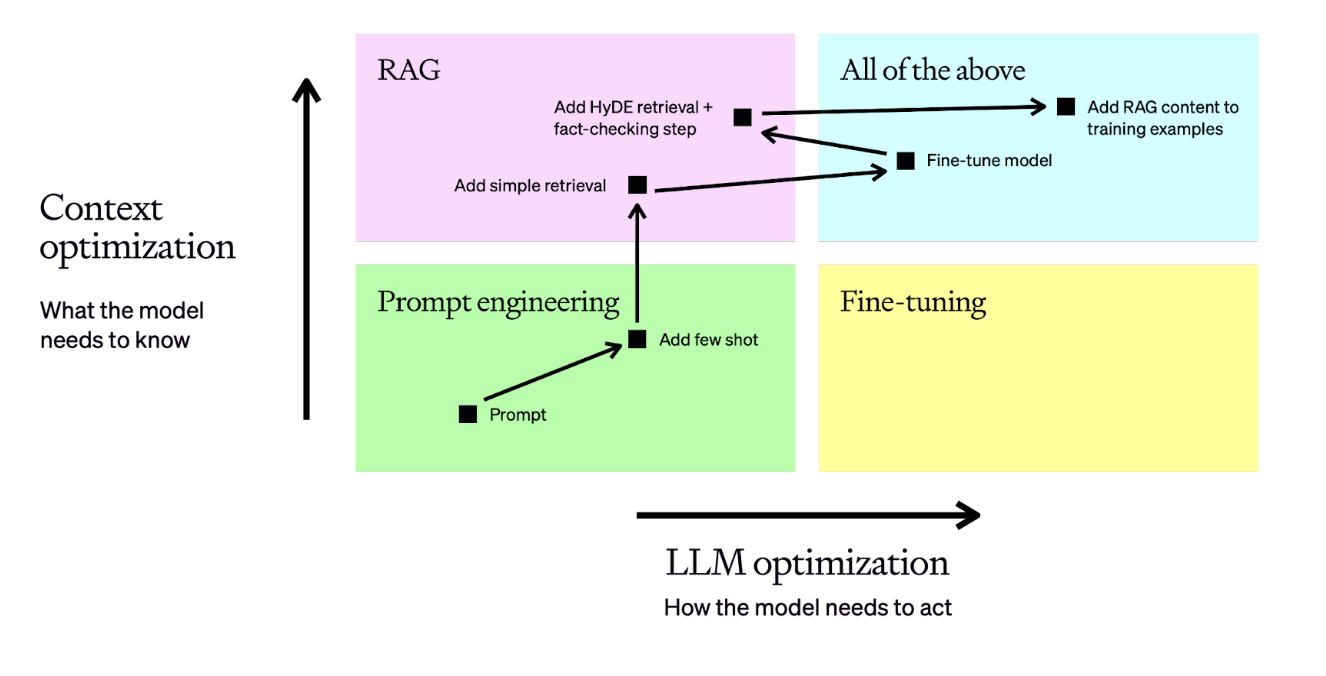
OpenAI’s LLM accuracy optimization matrix (Source: OpenAI)
OpenAI's optimization guidance provides a useful caution here: more sophisticated techniques are not automatically additive. In one documented evaluation, adding RAG to an already fine-tuned model reduced performance because irrelevant retrieval introduced noise. The correct answer was determined by evaluation rather than architectural fashion. That is the approach we recommend as well: add complexity only when your evals prove the simpler system is failing.
Do Not Forget Prompt Engineering
There is a third option teams often skip because RAG and fine-tuning sound more sophisticated, which is fixing the prompt. A surprising number of “we need fine-tuning” problems are actually caused by:
- Unclear instructions
- Missing examples
- Ambiguous output schemas
- Excessive context
- Contradictory system prompts
- Poor tool descriptions
Likewise, some proposed RAG architectures are unnecessary because the application only needs a small, stable amount of context that can fit naturally into the prompt.
Our default escalation path is:
Baseline Model
│
▼
Prompt / Structured Output
│
│ still below target?
▼
Evaluate Failure Type
│
├──────── Knowledge problem ───────► RAG
│
└──────── Behavior problem ────────► Fine-Tuning
│
both problems? ◄──────┘
│
▼
RAG + Fine-Tuning
This prevents architecture from becoming complex before the team even has a baseline.
For the wider question of how these technical decisions should fit into production delivery, our guide to preventing AI deployment failure explains why data readiness, workflow integration, and governance often matter more than adding another model technique.
A Practical RAG vs Fine-Tuning Decision Framework

Use this table before committing the engineering budget.
| Question | If YES, lean toward |
| Does the information change frequently? | RAG |
| Is the knowledge private or enterprise-specific? | RAG |
| Do answers need citations? | RAG |
| Must permissions affect what information can be used? | RAG |
| Is the knowledge set too large to place in the prompt? | RAG |
| Does the model already have the information but behave inconsistently? | Fine-Tuning |
| Do you have high-quality labeled examples? | Fine-Tuning |
| Is the same narrow task executed at very high volume? | Fine-Tuning |
| Does the output require a difficult domain-specific style or format? | Fine-Tuning |
| Do you need current knowledge and specialized behavior? | Both |
| Can prompt engineering already hit the required eval target? | Neither |
Google Cloud publishes a useful decision-tree visual comparing prompt engineering, RAG, and tuning. The most important idea in that framework is the same one: these techniques are complementary rather than a mandatory progression, and the correct choice depends on the problem being optimized.

Enterprise Use Cases: Which Architecture Fits?
Internal Knowledge Assistant → RAG
A company wants employees to query:
- Policies
- SOPs
- Contracts
- Product documentation
- SharePoint
- Google Drive
- CRM knowledge
The knowledge changes continuously and answers should point to supporting documents.
Choose RAG.
High-Volume Intent Classification → Fine-Tuning
A contact center needs to classify millions of messages into a proprietary intent taxonomy.
The information required is already contained in each incoming message, while the core problem is consistent classification behavior.
Fine-tuning is worth evaluating.
Customer Support Assistant → Usually RAG, Possibly Both
Support agents need up-to-date product information, customer context, policies, and troubleshooting instructions.
That strongly favors RAG.
If the application also needs highly specialized escalation, classification, or response behavior that prompting cannot deliver reliably, a fine-tuned model may later sit behind the retrieval layer.
For a broader view of how knowledge-based AI fits into automation, see our AI workflow automation analysis.
Financial or Compliance Assistant → RAG-First
Financial policy, regulatory guidance, and customer records must remain traceable and current. Encoding frequently changing compliance knowledge into model weights creates unnecessary maintenance and provenance problems.
RAG therefore provides the natural knowledge layer, potentially combined with specialized behavior when required.
Our banking digital transformation analysis explores the wider data, AI, cloud, and integration landscape surrounding these applications.
Education AI → Often Hybrid
Education illustrates why the answer is not always binary.
An AI tutor may use RAG to access a current syllabus, textbook, or course knowledge base while using model adaptation to improve pedagogical behavior, terminology, or task specialization.
SotaTek's DeepEdu project, discussed in our analysis of the benefits of AI technology in education, combines RAG, semantic search, NLP, and specialized model adaptation around Vietnamese curriculum knowledge—an example of how retrieval and model adaptation can occupy different layers of the same system.
How We Would Evaluate RAG vs Fine-Tuning in a Real Project
We would not start an implementation workshop by asking:
“Which vector database should we buy?”
or:
“Which model should we fine-tune?”
We would start by building an evaluation set.
Assume an enterprise assistant currently achieves:
| Baseline accuracy | 71% |
| Groundedness | 68% |
| Format compliance | 91% |
| Retrieval recall@5 | 62% |
That data already tells us something important.
Format compliance is relatively strong. Retrieval recall is weak.
Fine-tuning the model would be difficult to justify as the first intervention because the system is failing before the generation layer receives the right knowledge.
We would first improve:
chunking
→ metadata
→ query rewriting
→ hybrid search
→ reranking
→ context selection
If retrieval recall rises to 93% and overall answer accuracy reaches 89%, the RAG work solved most of the problem.
Suppose format compliance then remains stuck at 91%, while production requires 99.5%. Now fine-tuning becomes a much more defensible experiment.
The architecture should follow the evidence.
From Enterprise RAG to Governed Agents With SotaAgents

RAG becomes more strategically useful when retrieval is integrated into a wider business workflow rather than deployed as another isolated “chat with your PDFs” application.
SotaAgents is built around that wider model. The platform supports governed access to multiple LLMs, enterprise tools and MCP integrations, memory, guardrails, multi-agent execution, human sign-off, and traceable answers. Its knowledge layer can ingest documents and enterprise sources while preserving source-level evidence, so agents can work from organizational knowledge rather than relying solely on model memory.
That distinction matters because enterprise RAG usually needs more than semantic search.
Consider a compliance agent:
User:
"Compare the new regulation against our lending policy."
│
▼
Retrieve regulation
│
Retrieve internal policy
│
▼
Compare relevant clauses
│
▼
Identify conflicts
│
▼
Generate change proposal
│
▼
Human approval
│
▼
Trace + audit record
Retrieval is part of the workflow, but it is not the workflow. A simplified implementation could look like:
def compliance_review(query, user):
external_rules = retrieve(
source="regulations",
query=query
)
internal_policy = retrieve(
source="policy_repository",
query=query,
permissions=user.permissions
)
analysis = agent.run(
task=query,
context=[
external_rules,
internal_policy
]
)
return create_review_package(
findings=analysis.findings,
sources=analysis.sources,
assumptions=analysis.assumptions,
approval_required=True
)
Illustrative code; this is an architecture example rather than literal SotaAgents SDK syntax.
The important design principle is that knowledge remains retrievable and auditable while agent behavior remains independently controllable.
SotaAgents' public architecture also separates tools, skills, runtime behavior, permissions, model policy, and knowledge rather than forcing every requirement into model weights. That makes it possible to evolve enterprise knowledge independently from the model itself.
For many enterprise use cases, that is the architecture we prefer: retrieve facts dynamically, control behavior explicitly, and fine-tune only when evaluations show that model-level adaptation creates measurable value.
RAG vs Fine-Tuning: What Should You Build First?
Our recommendation is deliberately conservative.
Start with neither if the base model and prompt already meet the requirement.
More infrastructure is not a success metric.
Start with RAG when the missing capability is knowledge.
Especially when that knowledge is private, large, dynamic, permission-controlled, or citation-sensitive.
Consider fine-tuning when the remaining failure is repeatable behavior.
Only after you have enough representative training data and a proper held-out evaluation set.
Combine them when evaluations prove that the application needs both.
Do not combine them because the architecture diagram looks more sophisticated.
This approach also reduces one of the broader causes of AI project failure: teams often add technology faster than they add evidence. Our guide to choosing an AI development partner explains why evaluation, integration, deployment capability, and long-term operating discipline matter as much as model expertise when selecting an implementation team.
Conclusion
The most important difference in RAG vs Fine-Tuning is where customization happens.
RAG customizes the context available to the model at runtime. Fine-tuning customizes the behavior encoded in the model itself.
That leads to a straightforward decision rule:
Use RAG when the model needs access to knowledge. Use fine-tuning when the model needs to learn behavior. Use both only when your evaluations prove that both problems exist.
The harder engineering work begins after that decision. RAG requires reliable data ingestion, retrieval, reranking, access control, citation mapping, and evaluation. Fine-tuning requires curated examples, training pipelines, held-out testing, regression control, and model lifecycle management.
Neither technique eliminates the need for good AI engineering.
The companies that get the most value from LLM customization will be the ones that stop asking which technique is more advanced and start measuring which layer of their system is actually failing.
If your organization is evaluating RAG, fine-tuning, or a hybrid enterprise LLM architecture, explore SotaAgents or discuss the use case with our AI engineering team before committing to a model-customization strategy.

 https://www.sotatek.com/
 (+84)2466585248




