


Key Takeaways
- Credential verification is one of the most mature blockchain use cases in education, according to the OECD.
- Blockchain can improve data integrity, traceability and cross-institution verification without storing all student data on-chain.
- Smart contracts can automate selected education workflows, but they are not suitable for every process.
- Blockchain can support content provenance and ownership, but it does not directly detect plagiarism.
- The strongest use cases solve clear problems around trust, verification, sharing or multi-party coordination.
Introduction
Blockchain use cases in education are expanding as universities, schools, EdTech providers and government agencies look for better ways to manage academic records, verify qualifications, share educational resources and reduce administrative friction.
Many education systems still rely on fragmented databases, paper or institution-controlled certificates, manual verification processes and disconnected learning platforms. These limitations can make it harder to exchange academic records, verify credentials across institutions, manage content ownership and provide learners with portable evidence of their achievements.
Blockchain technology can address some of these problems by creating a shared, tamper-evident layer for recording and verifying information. Combined with distributed ledger technology, digital credentials and smart contracts, blockchain can support stronger data integrity, automated verification and more transparent information exchange between institutions.
The OECD Digital Education Outlook identifies credentialing as one of the most mature blockchain applications in education, particularly for issuing, sharing and verifying educational qualifications.
At SotaTek, we approach these opportunities by focusing on where blockchain can solve a specific education problem rather than introducing decentralization for its own sake.
This article explores five practical blockchain use cases in education, their potential benefits and how blockchain can work alongside AI in the next generation of education technology.
Key Blockchain Use Cases in Education

Blockchain in education is most valuable when multiple stakeholders need to share, verify, or manage trusted information across different systems. Rather than replacing existing education platforms, blockchain can act as a verification and coordination layer that supports academic records, credentials, identity, workflows, payments, and digital content.
Academic Record and Transcript Management
Academic records can include student records, transcripts, grades, qualifications, and course history that may need to be accessed by universities, employers, government agencies, or other education providers.
Blockchain can support tamper-evident academic records by recording cryptographic proofs, references, or status information on a shared ledger. This can help institutions verify whether a record has been altered and make cross-system verification more efficient.
A practical architecture does not require complete student records to be stored directly on-chain. Sensitive data can remain in controlled institutional databases, while blockchain is used to support integrity, provenance, and verification.
Digital Credential and Certificate Verification

Digital credentials are currently one of the strongest practical blockchain use cases in education.
Universities and training providers issue many forms of evidence about learning:
degrees, diplomas, certificates, micro-credentials, course completion records and professional qualifications.
Traditional verification may require the employer or receiving institution to contact the original issuer.
Blockchain can provide an additional verification layer.
An institution can issue a digital credential and associate it with cryptographic evidence. A student can then share the credential with another organization, which can validate its authenticity without depending entirely on a manual request to the issuing institution.
This model is increasingly supported by open digital credential standards.
In May 2025, W3C published Verifiable Credentials 2.0 as a Web Standard. It provides a way to express credentials, including university qualifications, in a format that is cryptographically secure, privacy-aware and machine-verifiable.
The model includes three primary roles:
- Issuer: the organization issuing the credential
- Holder: the learner receiving and controlling it
- Verifier: the employer, university or other organization checking it
Importantly, verifiable credentials do not inherently require blockchain. Blockchain can be one trust mechanism used within a credential ecosystem.
This distinction matters because organizations should choose architecture based on the actual verification problem rather than assuming every digital certificate needs a blockchain.
The European Commission provides another real-world example through European Digital Credentials for Learning, which support digitally signed diplomas, certificates, micro-credentials and other learning achievements that learners can store and share with employers or education providers.
Together, these developments show a broader movement toward portable, interoperable and digitally verifiable academic credentials.
Preventing Diploma Fraud

Diploma fraud is closely related to credential verification.
Paper certificates, scanned documents, and manually entered academic histories can be difficult for employers to validate efficiently, particularly when credentials come from another institution or country.
Blockchain can support a more reliable verification model by allowing institutions to issue digital credentials linked to cryptographic proofs. Instead of relying entirely on paper records or manual confirmation, employers and other authorized parties can verify whether a credential was issued by a trusted institution and whether it has been altered.
A privacy-aware architecture does not require the complete diploma or student record to be stored on-chain. Instead, the system can separate sensitive information from verification data:
- On-chain: credential hashes, issuer identifiers, issuance references, revocation or status information
- Off-chain: names, detailed academic history, personal information, and complete documents
When a learner presents a digital credential, the verifier can compare its cryptographic evidence with the trusted issuer information recorded in the system.
This can make diploma verification faster and more transparent while reducing reliance on repetitive manual checks. However, blockchain does not verify whether the original academic information was accurate when issued. The credibility of the system still depends on trusted institutions, reliable issuance processes, and appropriate governance.
Smart Contracts for Education Processes

Smart contracts can automate predefined actions when specific conditions are met. In education resource sharing, a simple workflow could look like:
Resource requested → access conditions checked → payment or permission validated → access granted
This can support use cases such as course purchases, licensing, subscriptions, settlement, access permissions, and institutional sharing agreements across connected platforms.
Combined with distributed storage and shared blockchain infrastructure, smart contracts can also make it easier for learners and institutions to access resources from multiple sources without relying on a single centralized platform. Rather than storing all educational content directly on-chain, institutions can keep large files in external storage while recording resource references, ownership information, access rights, and verification data on the blockchain.
This model can improve traceability, provenance, and cross-platform access across universities, research institutions, academic publishers, and digital learning platforms. It can also help maintain continuity if an individual system or node becomes unavailable.
However, smart contracts should only automate rules that can be clearly defined in software. Copyright disputes, academic judgment, and complex exceptions may still require human review. The goal is not to decentralize every learning platform, but to create a trusted coordination layer that improves resource interoperability, transparency, and automated access where multiple parties need to work together.
Secure Data Sharing Between Institutions
Cross-institution data sharing is often difficult because universities, schools, government agencies, and EdTech platforms operate different systems and data structures.
Blockchain can provide a shared verification layer that helps institutions exchange trusted information without requiring one party to control the entire network.
Potential use cases include:
- academic record verification
- credit transfer
- qualification recognition
- student mobility
- cross-border education records
- accreditation information
This can improve transparency and interoperability, but blockchain alone does not solve data-standardization issues. Participating institutions still need agreed formats, permissions, identity rules, and governance.
Education Payments
Blockchain can also support payment workflows in education without requiring institutions to adopt cryptocurrency.
Potential applications include:
- tuition payments
- scholarship disbursement
- grants
- cross-border education payments
- refunds
- institutional settlement
The focus should be on blockchain-based payment infrastructure, where the ledger helps improve transaction traceability, automation, or settlement between parties.
For example, smart contracts could release scholarship funds once predefined eligibility conditions are confirmed.
Blockchain does not automatically make every payment cheaper or faster, so organizations should evaluate transaction costs, regulation, integration, and payment-provider requirements before implementation.
Protecting Academic Content and Reducing Plagiarism

This is the section where the original article needs the biggest correction.
It suggested that blockchain could make plagiarism effectively obsolete because content and modifications could be recorded permanently. That goes too far.
Blockchain does not detect whether one piece of writing plagiarizes another. AI plagiarism detection, text comparison and academic review perform different functions.
What blockchain can support is content provenance and ownership.
For example, a researcher, professor or education publisher could create a cryptographic record associated with a piece of content at a particular time.
Subsequent versions or transactions could create additional records, producing an auditable history of:
- when the material was registered
- which entity registered it
- when ownership or licensing changed
- which version existed at a given time
- how a resource evolved
This can be useful for academic resources, open educational content, research outputs and digital intellectual property.
NIST's description of blockchain as a tamper-evident and tamper-resistant ledger provides the technical basis for this type of provenance record.
The distinction should remain clear:
Blockchain can help prove provenance.
It does not prove originality by itself.
A copied article could still be registered on a blockchain. The ledger would accurately record that registration, but it would not automatically know that the material had been copied from someone else.
For education institutions, blockchain should therefore complement rather than replace plagiarism detection systems, copyright processes and academic integrity policies.
Decentralized Sharing of Educational Resources
Educational resources now exist across universities, online learning platforms, publishers and open-learning ecosystems. They can include: courses, textbooks, videos, learning applications, research materials, podcasts and open educational resources.
Blockchain could support decentralized sharing of educational resources by providing a shared record of ownership, permissions, transactions or usage rights between participants.
For example, instead of one centralized marketplace controlling resource ownership and transactions, participating institutions could interact through shared blockchain infrastructure.
A resource publisher could register ownership or provenance information. Universities could reference the same record when using or licensing the resource. Learners could access content through connected education platforms while usage rights remain traceable.
The educational material itself does not necessarily need to be stored on-chain. Large videos, documents and course materials are usually better suited to conventional or distributed storage, while blockchain records references, ownership or transaction information.
Reducing Administrative and Operational Costs

Many education processes involve repetitive verification and record-management work.
Examples include checking certificates, confirming enrollment, transferring academic records, validating course completion and issuing qualifications.
Blockchain and smart contracts can potentially reduce administrative effort when several organizations repeatedly perform the same verification steps.
Consider academic credential verification.
A traditional workflow might involve:
Employer sends request → university staff locate record → institution validates information → confirmation returned
A blockchain-enabled workflow might allow:
Credential presented → cryptographic verification performed → status confirmed → exception escalated if needed
This does not eliminate institutional administration entirely, but it can reduce repetitive validation.
The OECD notes that decentralized verification can potentially reduce the record-sharing and maintenance burden placed on issuing institutions.
Smart contracts can also automate predefined transactions, approvals, and status updates, helping reduce repetitive manual work in selected education workflows.
Benefits of Blockchain in Education
The value of these blockchain use cases in education can be summarized across five areas.
| Benefit | How blockchain can contribute |
| Improved data integrity and security | Cryptographically linked records make unauthorized changes easier to detect |
| Faster academic credential verification | Digital proofs can reduce dependence on manual institution-to-institution confirmation |
| Better sharing of educational resources | Shared infrastructure can coordinate access, ownership and transactions across platforms |
| Greater transparency and traceability | Provenance and transaction histories can be recorded across organizations |
| Reduced administrative workload | Smart contracts and automated verification can reduce selected repetitive processes |
These benefits are not automatic. A poorly designed blockchain project can introduce unnecessary complexity, privacy risks and integration costs.
The strongest implementations begin by identifying a clear trust, verification or multi-party coordination problem, then determine whether blockchain actually improves on a conventional database or digital credential system.
How AI and Blockchain Can Work Together in Education
AI and blockchain solve different problems. Blockchain can provide trusted, traceable and verifiable information; while AI can analyze information, recognize patterns and automate workflows.
In education, blockchain might establish the provenance of a credential while AI helps process the information surrounding it.
For example:
Academic document submitted → AI extracts relevant fields → credential proof is verified → workflow rules are applied → exceptions are sent for human review
The division of responsibilities is important.
| Technology | Primary role in education |
| Blockchain | Trust, provenance, integrity, credential verification |
| AI | Analysis, classification, automation, search, anomaly detection |
| Existing education systems | Student records, workflows, institutional operations |
AI could support education organizations through document extraction, semantic search, anomaly detection, analytics or intelligent assistants.
Blockchain could provide a reliable record of credential status, provenance or transactions.
Together, they can support more intelligent education workflows without placing all institutional data or AI activity onto the blockchain.
This also aligns with the broader direction of digital education. The OECD Digital Education Outlook 2026 examines how AI is reshaping education beyond teaching and learning, including the management of educational systems and institutions.
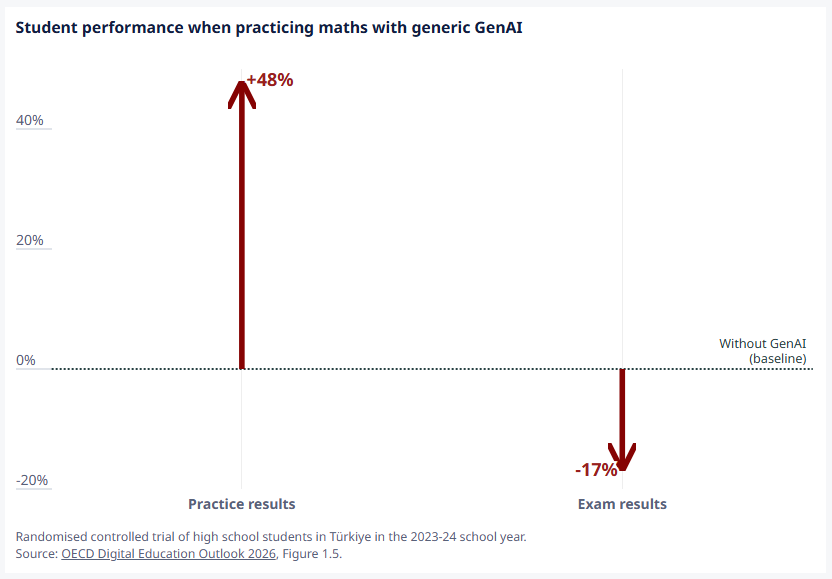
Image Source: OECD Digital Education Outlook 2026
For a deeper technical discussion, see SotaTek's AI in blockchain.
Why SotaTek Is Your AI & Blockchain Innovation Partner

At SotaTek, we focus on applying blockchain to problems where decentralized trust, verification or shared infrastructure creates practical value.
Blockchain Consulting and Development
Our blockchain development services can support projects from early assessment through architecture, development, integration, testing and deployment.
For education organizations, this can include blockchain architecture, credential verification systems, smart contracts, APIs, identity infrastructure and integration with existing education platforms.
The objective is not simply to deploy a blockchain network.
We first need to understand:
What information needs to be trusted? Who needs to verify it? Which organizations participate? Which data belongs on-chain? What should remain inside existing systems?
Those decisions determine whether the eventual architecture is secure, scalable and commercially justified.
Education and Government Experience
SotaTek's education blockchain experience includes work associated with Vietnam's National Qualifications Archive (NQA).
SotaTek and TomoChain worked with Vietnam's Ministry of Education and Training on the NQA initiative, with SotaTek acting as a technical partner responsible for planning, developing and deploying the blockchain-based system for qualification records. Sota Holdings' project publication describes the objective as building national diploma storage infrastructure and using blockchain to strengthen certificate verification.

The project is particularly relevant to blockchain use cases in education because qualification verification is not confined to one school or university.
It can involve: education institutions, government authorities, graduates and organizations verifying qualifications.
That is exactly the type of multi-party environment where a shared verification architecture can provide value.
Combining Blockchain With AI-Powered Education Solutions
As an AI & Blockchain Innovation Partner, we can also design systems where blockchain and AI perform complementary functions.
Blockchain can support trusted records, credential verification and provenance.
AI can add document intelligence, semantic search, analytics, workflow automation and decision support.
The result is not “AI on blockchain” for its own sake. The aim is an integrated education architecture in which each technology solves the problem it is best suited to address.
Conclusion
The most practical blockchain use cases in education are centered on trust and verification.
Blockchain can support the sharing of educational resources, provide verifiable academic credentials, strengthen diploma verification, improve content provenance and automate selected administrative workflows.
But its value depends on how it is applied.
Not every student record belongs on-chain. Not every education workflow needs a smart contract. And blockchain cannot replace plagiarism detection, institutional governance or reliable source data.
The strongest business case exists where multiple organizations need to coordinate around information that must remain verifiable, traceable and trustworthy.
For universities, education providers and public organizations exploring blockchain or AI-enabled education infrastructure, contact SotaTek to discuss the use case, architecture and implementation roadmap.

 https://www.sotatek.com/
 (+84)2466585248




