


Key Takeaways
- Blockchain development companies for education can support digital credential verification, student identity, academic record management and cross-institution information exchange.
- Blockchain is most valuable when several independent organizations need a shared trust and verification layer. It is not the right technology for every education workflow.
- Sensitive student information should not automatically be stored on an immutable public ledger. Enterprise implementations often combine on-chain proofs with controlled off-chain data.
- Organizations should evaluate vendors based on education experience, blockchain architecture, integration, security, privacy, scalability and real implementation evidence.
- AI and blockchain can complement each other: blockchain provides trust and provenance, while AI supports automation, document processing and data intelligence.
- Different providers serve different needs. Some offer custom blockchain development, while others provide digital credential or Web3 education platforms.
Introduction
Blockchain development companies for education are helping universities, EdTech providers and public-sector organizations modernize how academic credentials, student records and cross-institution data are issued, verified and exchanged. As digital transformation in education accelerates, fragmented databases and manual credential verification remain key challenges. At the same time, standards such as Verifiable Credentials 2.0 and the European Digital Credentials for Learning are pushing the ecosystem toward more secure, interoperable and machine-verifiable digital credentials.
Blockchain can support this transition by providing a trusted verification layer for digital credentials, academic records and multi-party transactions. However, successful blockchain implementation requires the right architecture, data privacy controls and integration with existing education infrastructure. This makes choosing the right blockchain development partner critical, especially one with capabilities across consulting, architecture, development, security, blockchain integration and enterprise software.
As an AI & Blockchain Innovation Partner, SotaTek works across blockchain, AI and software development to support organizations building scalable digital platforms.
This guide examines what blockchain development partners actually provide, major blockchain in education use cases, vendor-selection criteria, leading companies and how AI and blockchain can work together in modern education ecosystems.
Why Education Organizations Are Turning to Blockchain Development Companies
Interest in blockchain development companies for education is driven by practical problems around trust, interoperability and verification rather than blockchain technology itself.
Growing Challenges Around Academic Data and Credentials

Education organizations manage increasingly complex information, including:
- qualifications
- transcripts
- certificates
- course-completion records
- micro-credentials
- professional qualifications
- student identities
These records may exist across several organizations throughout a learner's education and career.
The challenge becomes greater when employers, universities or regulators need to validate them. Credential fraud, fragmented records and manual verification create friction for learners and institutions alike. The current SotaTek draft already identifies these issues as core reasons education organizations are exploring blockchain.
This creates demand for stronger academic credential verification, credential fraud prevention and portable digital certificates.
Why Traditional Education Systems Struggle With Verification and Interoperability
Most traditional education systems were designed to operate inside a single institution.
A university Student Information System, an employer's HR platform and a government qualification database may each use different data models and processes.
When information needs to move between them, organizations may encounter:
- manual verification requests
- incompatible data structures
- duplicated records
- limited data interoperability
- dependency on the original issuer
- inconsistent identity management
- disconnected institutional databases
This is where decentralized systems and distributed trust models can provide value.
Blockchain can create a shared verification layer without requiring one organization to control the entire infrastructure.
When Does Blockchain Make Sense for Education?
Blockchain should address a clear trust problem.
A conventional database may be sufficient when one organization controls the entire workflow and no independent verification is required.
Blockchain is more relevant when:
- several independent organizations exchange trusted information
- records require independent verification
- no single participant should fully control the shared ledger
- provenance and auditability matter
- credentials need to move across organizations
- multiple parties require a shared governance model
Organizations reviewing the challenges of blockchain in education should therefore assess whether decentralization is actually necessary before investing in development.
A good blockchain partner should be willing to recommend a conventional database when blockchain does not provide a meaningful advantage.
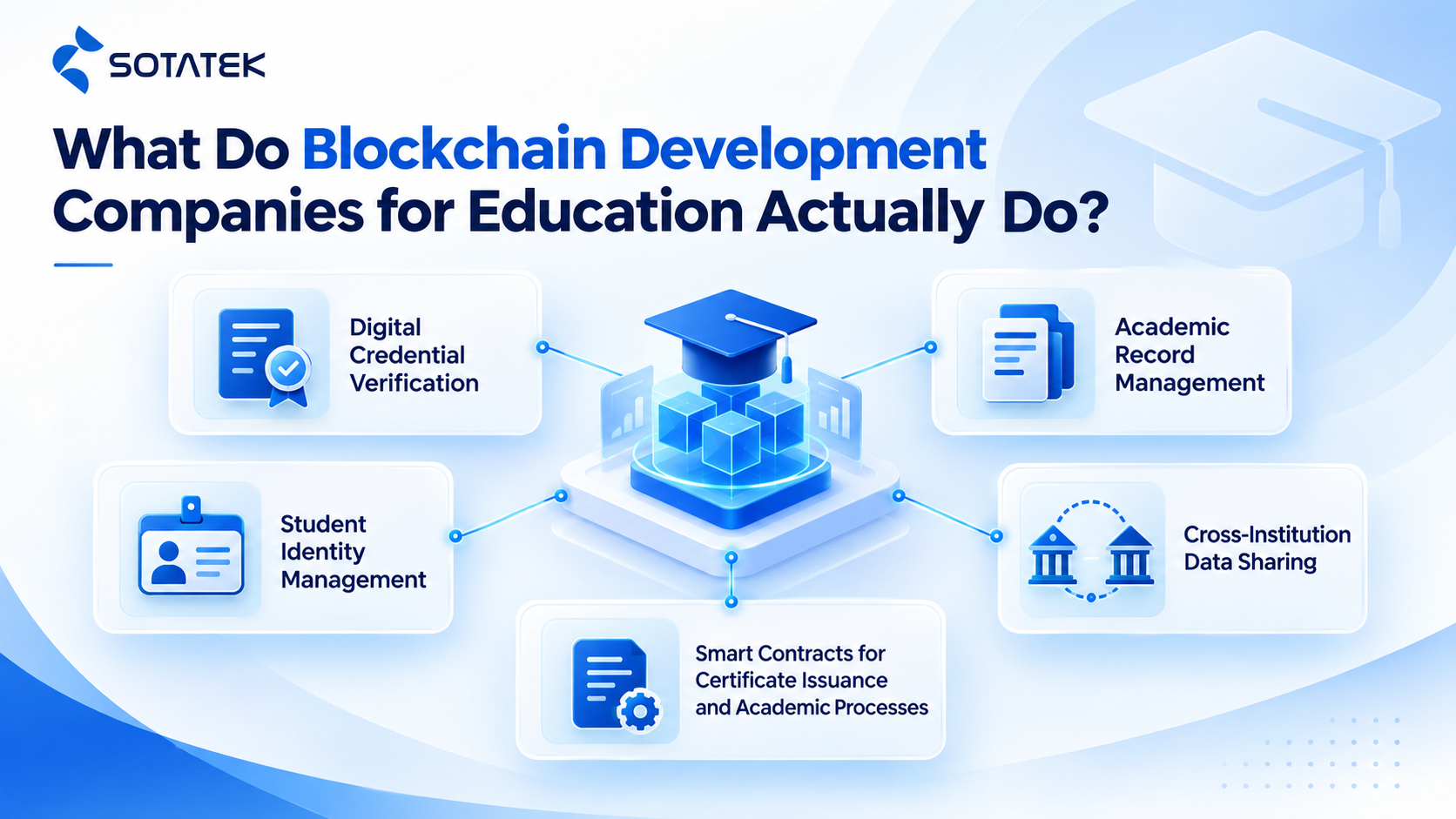
What Do Blockchain Development Companies for Education Actually Do?
Blockchain development companies for education design and integrate distributed systems around real education workflows.
Their responsibilities can extend from initial consulting through production deployment.
Blockchain Consulting and Solution Architecture
The first step should be understanding the business problem.
A blockchain consulting team may assess:
- participating organizations
- business processes
- trust relationships
- existing infrastructure
- privacy requirements
- transaction volumes
- governance
- identity
- integrations
- expected scale
Based on these requirements, the partner can design the appropriate blockchain architecture, including public, private, hybrid or permissioned blockchain models.
An important architectural decision is also what belongs on-chain and what should remain off-chain.
For education projects, this distinction is particularly important because academic information may include personally identifiable information.
Digital Credential and Certificate Verification Systems
One of the most established applications of blockchain in education is credential verification.
Potential functions include:
- digital credential issuance
- certificate verification
- issuer validation
- credential status and revocation
- learner-controlled credential sharing
- third-party verification
The W3C Verifiable Credentials framework defines an issuer-holder-verifier model for portable, machine-verifiable credentials.
However, verifiable credentials do not inherently require blockchain. A competent vendor should determine whether blockchain is necessary rather than forcing every credential solution onto a distributed ledger.
Student Identity and Academic Record Management
Blockchain can also support student identity management and academic records portability.
Potential architectures combine:
- digital identity
- decentralized identity
- verifiable credentials
- institutional identity systems
- controlled access to academic information
Sensitive information does not need to be stored directly on-chain.
A common enterprise approach is to keep personal or detailed academic records within controlled databases while recording identifiers, credential proofs or hashes on the blockchain.
Smart Contracts for Education Processes
Smart contracts can execute predefined logic when specific conditions are met.
Potential education applications include:
- certificate issuance
- completion validation
- approval processes
- access controls
- multi-party workflows
However, processes requiring frequent policy changes, human judgment or sensitive information may be better handled using conventional application logic.
Integration With Existing Education Infrastructure
Blockchain delivers limited value if it becomes another isolated system.
Blockchain integration may involve:
- Student Information Systems
- LMS platforms
- ERP systems
- government databases
- identity services
- credential platforms
- cloud infrastructure
- APIs
This requires broader software engineering and legacy system integration capabilities.
For organizations already operating complex EdTech platforms, integration expertise should be a major selection criterion.
Key Blockchain Use Cases in Education
The following blockchain in education use cases show where distributed trust and verification can create practical value.
Digital Credential Verification
Credential verification is one of the clearest use cases for blockchain development companies for education.
Employers or universities may need to confirm whether a qualification was issued by the stated institution and whether it remains authentic.
A blockchain-enabled solution can anchor cryptographic evidence associated with a credential to a distributed ledger.
The verifier can then use that evidence to validate authenticity without relying entirely on manual confirmation from the issuing institution.
Potential benefits include:
- faster verification
- lower administrative workload
- improved credential portability
- stronger provenance
- more efficient cross-border verification
Rather than describing these credentials as completely “tamper proof certificates,” a technically more accurate term is tamper-evident credentials, because unauthorized modifications can be detected cryptographically.
Academic Record Management
A learner's academic history may span multiple institutions and years.
Blockchain-enabled academic records management can provide a common verification layer while individual institutions retain control of their operational systems.
A practical architecture may separate data as follows:
Off-chain
- personal information
- transcripts
- documents
- detailed academic records
On-chain
- credential hashes
- identifiers
- verification references
- status information
This distinction supports data privacy while retaining blockchain's verification properties.
Research into blockchain-based academic credentials has also highlighted the privacy implications of storing personal information on immutable infrastructure, particularly under regulations that include rights relating to correction or erasure. Applied Sciences discusses these challenges in blockchain-based educational credential systems.
Student Identity Management
Learners may interact with universities, professional training providers, certification organizations and employers over many years.
Blockchain-enabled identity models can allow selected identity or credential proofs to move between these systems.
Potential applications include:
- proving enrollment
- verifying qualifications
- confirming course completion
- sharing specific learning achievements
However, identity recovery, authorization, privacy and governance remain critical considerations.
A decentralized identity solution therefore requires broader identity architecture, not simply a blockchain wallet.
Cross-Institution Data Sharing
One of the strongest applications for enterprise blockchain is coordination between organizations that do not share the same database owner.
Participants might include:
- universities and schools
- government agencies
- employers
- qualification authorities
- accreditation bodies
- EdTech providers
A shared distributed ledger technology layer can create a common verification history without requiring a single institution to control everything.
Potential applications include:
- credit transfer
- qualification recognition
- student mobility
- cross-border credentials
- national education infrastructure
Technology alone does not create interoperability, however.
Organizations must still agree on data models, permissions, governance, identity standards and validation rules.
Smart Contracts for Certificate Issuance and Academic Processes
Smart contracts can support processes where rules are clearly defined and multiple participants rely on the same outcome.
A simplified workflow could be:
Course requirements completed → approval confirmed → credential issued → verification record created
Human approvals and institutional application logic can still remain outside the blockchain.
The objective is not to place every education process on-chain, but to use blockchain where shared trust adds value.
What to Look for in a Blockchain Development Company for Education
Not all blockchain development companies for education offer the same capabilities. Organizations should evaluate them against the specific business problem.
Education and Public Sector Experience
Education projects involve requirements that differ from consumer blockchain applications.
Relevant experience can include:
- universities
- public agencies
- national education systems
- EdTech platforms
- credential systems
- academic databases
Public-sector experience can also indicate familiarity with complex governance, stakeholder coordination and long-term infrastructure requirements.
Blockchain Architecture and Technical Expertise
A capable partner should understand:
- public blockchain
- private blockchain
- permissioned blockchain
- hybrid networks
- smart contracts
- decentralized systems
- identity architecture
- on-chain/off-chain data design
- APIs
- cloud infrastructure
The vendor should also be able to explain why one architecture is more appropriate than another.
A company recommending a platform before understanding the business requirement should be treated cautiously.
Proven Implementation Track Record
Proof of concept demonstrates feasibility. Production systems provide stronger evidence.
Ask potential vendors:
- Have they delivered real blockchain systems?
- Were they PoCs or production deployments?
- What integrations were required?
- What was their role?
- How many organizations participated?
- Can they provide a documented case study?
A strong implementation history is more meaningful than generic claims about enterprise grade solutions.
Integration and Scalability Capabilities
Most education organizations already operate significant technology infrastructure.
A new blockchain system may need to integrate with existing applications through APIs and middleware.
Assess the vendor's experience with:
- enterprise applications
- APIs
- cloud platforms
- databases
- DevOps
- monitoring
- authentication
- legacy systems
For national or multi-institution deployment, the partner should also demonstrate the ability to design scalable blockchain solutions.
Security, Privacy and Compliance
Blockchain's immutability does not automatically make an application secure.
A vendor should address:
- encryption
- identity and access management
- key management
- data minimization
- auditability
- credential revocation
- disaster recovery
- on-chain data exposure
- regulatory compliance
Security needs to cover the entire system rather than only the blockchain network.
AI and Automation Capabilities
AI is not required for blockchain systems. However, AI capabilities can add value when the wider platform involves:
- document processing
- semantic search
- anomaly detection
- workflow automation
- analytics
- intelligent assistants
The vendor should be able to define a distinct role for each technology.
Top Blockchain Development Companies for Education
The companies below represent different approaches to blockchain development in education, ranging from custom technology development and enterprise blockchain infrastructure to specialized digital credential platforms. Organizations should therefore compare providers based on whether they need a custom-built solution, blockchain infrastructure or an established credential platform.
SotaTek
At SotaTek, we bring together blockchain, AI and software development capabilities to help organizations design and implement integrated digital solutions. Our blockchain capabilities include:
- Web3 development
- NFT development
- dApp development
- DeFi development
- Enterprise blockchain development
- Tokenization development
This allows us to support organizations that need custom architecture, system integration and end-to-end development rather than an off-the-shelf credential platform.
Educhain
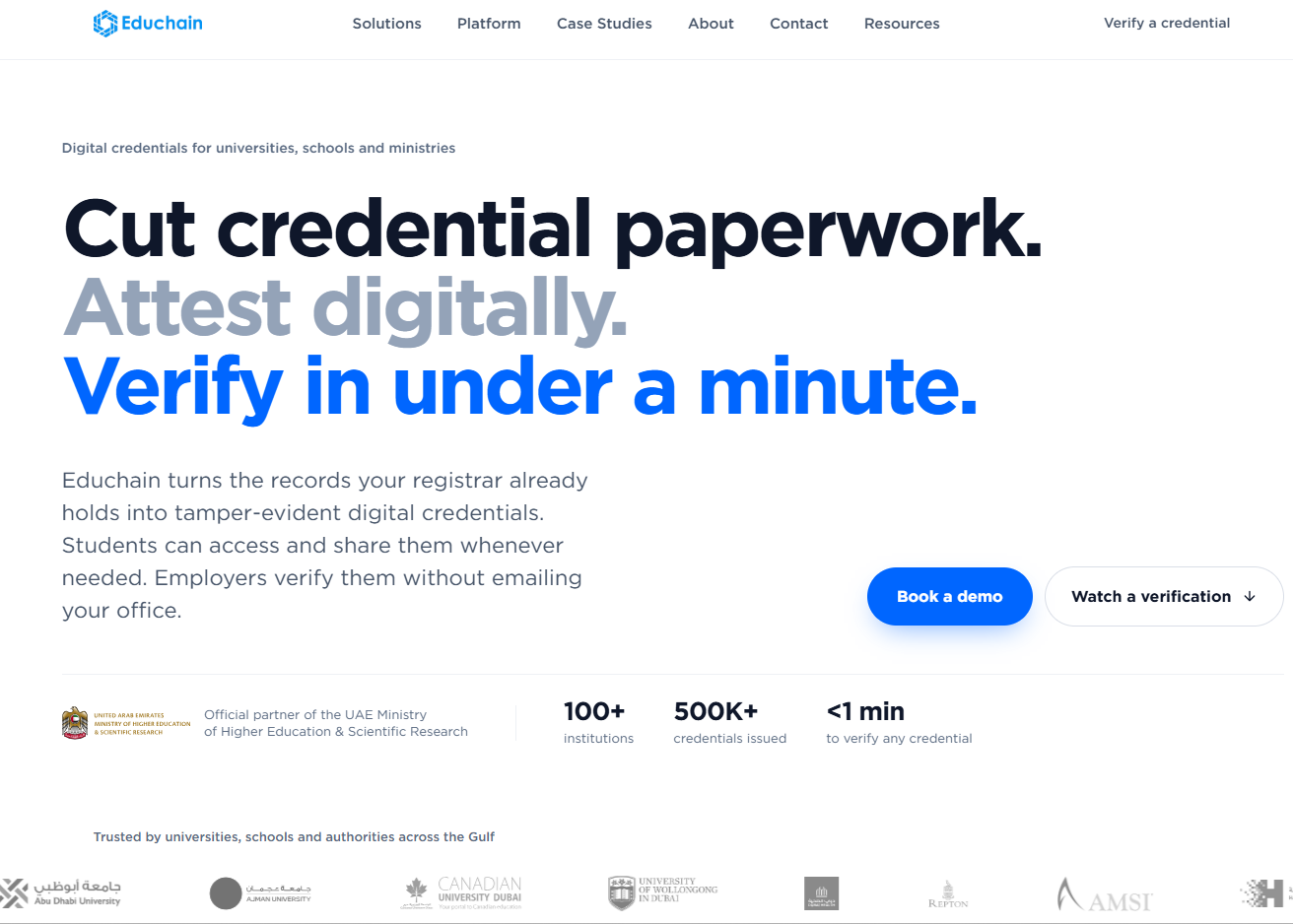
Educhain provides blockchain-based digital credential and academic record infrastructure for higher education institutions. Its platform enables universities to issue, manage and verify academic documents while integrating blockchain interfaces with existing student portals.
Educhain reports deployments with institutions including United Arab Emirates University, where more than 180,000 digital certificates have been issued, and the University of Sharjah, which has issued more than 60,000 digital certificates through its solution.
Its capabilities are particularly relevant to universities looking for academic records management, credential verification, digital wallets and blockchain integration without replacing their existing student systems.
POK – Proof of Knowledge
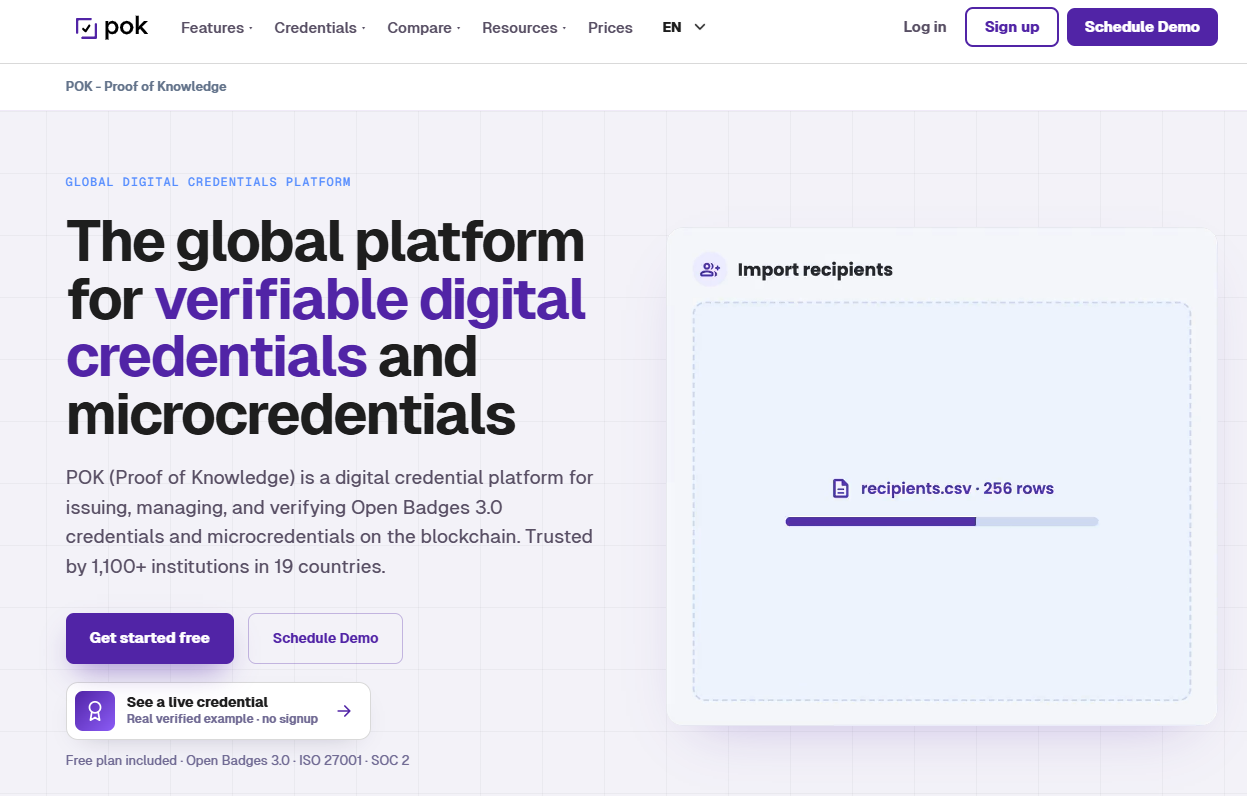
POK is a verifiable digital credential platform designed for universities, education providers, companies and public organizations.
Educational institutions can use the platform to issue blockchain-backed diplomas, certificates and microcredentials. POK also supports integrations with learning platforms including Moodle, Canvas and Blackboard and aligns with credential standards such as Open Badges 3.0.
Unlike a custom blockchain development company, POK primarily provides an existing credential infrastructure that institutions can integrate into their education technology ecosystems.
PARAMETA
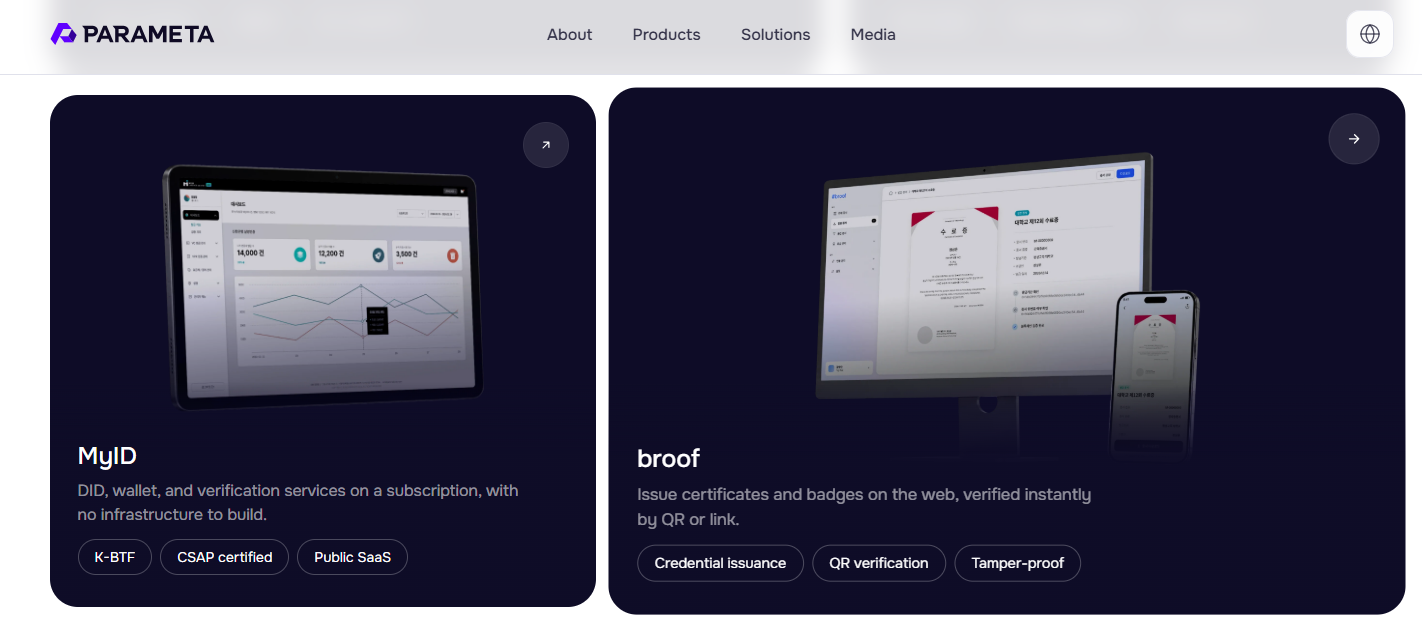
PARAMETA is a South Korean blockchain technology company providing digital asset, decentralized identity and blockchain infrastructure solutions.
PARAMETA’s broof platform enables organizations to issue and verify blockchain-based digital credentials through QR-based verification. According to PARAMETA, more than 90,000 credentials have been issued through broof across over 20 universities, government agencies and enterprises.
POSTECH uses broof to issue blockchain-based course completion certificates, allowing graduates to verify credentials digitally while reducing administrative work around certificate reissuance and authenticity checks.
Camport
Camport, developed by South Korea-based ANAM145, provides blockchain digital credential and identity infrastructure designed around universities and other credential-issuing organizations.
Its education offering covers mobile student IDs, enrollment and graduation credentials, digital certificates, DID-based authentication and credential wallets. Rather than placing sensitive student information directly on-chain, Camport describes an architecture where credentials remain with the holder while blockchain supports verification and integrity.
The company also supports PoC design and integration with existing institutional systems, making it relevant for universities that want to validate a blockchain credential use case before broader deployment.
Comparison of Top Blockchain Development Companies for Education
| Company | Main focus | Education deployment | Custom / Platform |
| SotaTek | Custom blockchain, AI & enterprise systems | National Qualifications Archive | Custom development & consulting |
| Educhain | Academic records & credentials | UAEU, University of Sharjah | Platform + integration |
| POK | Verifiable digital credentials | Multiple universities | SaaS/platform |
| PARAMETA | Enterprise blockchain & DID | POSTECH + public sector | Blockchain company + products |
| Camport | Credentials, DID, student identity | University-focused pilots | Platform + implementation |
The comparison shows why organizations should not select blockchain development companies for education based on rankings alone.
The first decision is whether the organization needs: a ready-made platform, a blockchain-specific product or a custom technology partner.
How AI and Blockchain Can Work Together in Education

AI and blockchain address different requirements.
Blockchain as the Trust and Verification Layer
Blockchain can support:
- provenance
- credential verification
- issuer validation
- transaction history
- shared records
- integrity checks
Sensitive information can remain outside the blockchain while cryptographic proofs provide verification.
AI for Automation and Data Intelligence
AI can support workflows around the verified information through:
- document extraction
- classification
- semantic search
- anomaly detection
- analytics
- workflow automation
For example, AI could extract information from a submitted academic document while the system validates associated credential evidence against the blockchain.
Building Intelligent Education Ecosystems With AI and Blockchain
A practical architecture can separate responsibilities:
Blockchain = trust and verification
AI = interpretation and automation
Enterprise applications = workflows and operational records
This creates a more realistic intelligent education ecosystem than attempting to move every application or dataset onto blockchain.
How to Choose the Right Blockchain Development Partner
Choosing among blockchain development companies for education should start with the business problem.
Define the Business Problem and Target Use Case
Common objectives include:
- reducing credential fraud
- improving verification speed
- connecting fragmented academic records
- supporting cross-institution data sharing
- enabling digital identity
- improving qualification portability
Define a measurable outcome before defining the technology.
Evaluate Whether Blockchain Is the Right Technology
Blockchain may be useful when several independent organizations require shared trust.
It may be unnecessary when:
- one institution controls the workflow
- conventional databases already provide sufficient trust
- independent verification is not required
- there is no multi-party governance requirement
A credible technology partner should be prepared to recommend against blockchain when appropriate.
Choose the Right Blockchain Architecture
Public blockchain
Suitable when broad independent verification is important, but organizations must consider privacy, transaction economics and governance.
Private or Permissioned Blockchain
A permissioned blockchain can be appropriate where participants are known organizations such as universities, government agencies or accreditation bodies.
Hybrid Architecture
A hybrid model can keep sensitive data inside controlled systems while using blockchain for verification proofs.
For many education projects, this offers a practical balance between trust and privacy.
Assess Integration Requirements
Map every relevant integration before development begins:
SIS → credential service → blockchain verification → learner application → employer or third-party verifier
Integration requirements may include:
- LMS
- ERP
- SIS
- APIs
- identity providers
- cloud infrastructure
- government systems
Evaluate Governance, Privacy and Data Ownership
Multi-party systems must define:
- who can join the network
- who can issue credentials
- who validates issuers
- who can revoke credentials
- which data is public
- which data remains private
- who governs technical standards
These decisions should precede large-scale blockchain implementation.
Start With a Scalable Implementation Roadmap
A practical roadmap can include:
Discovery → PoC → Pilot → Production → Scale
This allows institutions to validate feasibility, integrations and governance before expanding the solution.
Why SotaTek Is Your AI & Blockchain Innovation Partner

Organizations evaluating blockchain development companies for education may require broader capabilities than those offered by a standalone credential platform.
End-to-End Blockchain Development Capabilities
SotaTek's blockchain development services can support activities across the implementation lifecycle, including:
- blockchain consulting
- architecture
- application development
- smart contracts
- APIs
- blockchain integration
- testing
- deployment
This end to end development approach is relevant when blockchain needs to work within a wider enterprise architecture.
Experience With Education and Government Projects
Our experience also includes education and public-sector projects, where solutions often need to connect government systems, education institutions, learners and qualification frameworks.

Such environments can require coordination across government systems, education institutions, learners and qualification frameworks.
National Qualifications Archive Case Study
SotaTek and TomoChain worked with Vietnam's Ministry of Education and Training on implementation of the National Qualifications Archive using blockchain technology. The project is particularly relevant because national qualification infrastructure requires a broader perspective than a single-institution application, including:
- academic information
- credential verification
- institutional participation
- interoperability
- data integrity
For another example of how our education technology work, see Modernizing Education Operations with Technology – A Case Study with Smart Learn AI.
Combining Blockchain Infrastructure With AI-Powered Intelligence
Our positioning as an AI & Blockchain Innovation Partner supports projects where both technologies have clear roles.
Blockchain may provide verification, provenance, identity and trusted transactions; while AI may provide: document intelligence, semantic search, workflow automation and analytics. Together with APIs, cloud infrastructure and enterprise applications, these technologies can support broader digital transformation in education.
Conclusion
The right blockchain development companies for education do more than deploy distributed ledgers.
They determine whether blockchain is appropriate, design the right architecture, protect student information, integrate with existing education infrastructure and plan for production-scale governance.
Credential verification, academic record portability, student identity and cross-institution information sharing can all benefit from blockchain when several organizations need a shared trust layer.
But blockchain should remain a means to solve a business problem, not the goal itself.
If your organization is evaluating blockchain, AI or integrated education infrastructure, contact SotaTek to discuss your use case and implementation roadmap.

 https://www.sotatek.com/
 (+84)2466585248




