


NFT solutions in ecommerce are no longer interesting because they can turn an image into a tradeable token. The stronger business case in 2026 is much more practical: using blockchain-based ownership to unlock products, verify provenance, connect physical and digital goods, manage portable membership, or create new secondary-market models around collectibles.
That shift matters because the speculative NFT cycle is no longer a useful benchmark for commerce strategy. CoinGecko's Q2 2026 data shows how sharply part of the market has moved toward tokenized physical collectibles: Collector Crypt increased monthly volume from $97 million in January to $406 million in June 2026, capturing 62.8% of tokenized-collectibles volume, while OpenSea recorded $32.7 million in NFT sales in June.
The signal is not that every retailer should launch NFTs. It is that e-commerce NFT solutions become credible when the token performs a real operational role tied to access, provenance, membership, transferability, or an underlying asset.
Our position is straightforward: NFT solutions in e-commerce should sit beside the commerce stack as an ownership, access, or provenance layer. They should not replace checkout, CRM, inventory, fulfillment, or customer support simply because blockchain is involved. Let’s dive deeper into how NFT solutions in e-commerce work, where they create real business value, and what you should consider before implementation.
What Are NFT Solutions in ECommerce?

NFT solutions in e-commerce use non-fungible tokens and blockchain infrastructure to represent unique ownership, access rights, product provenance, digital benefits, or claims on physical and digital goods inside a commerce experience.
The NFT can act as a verifiable credential, but the commercial application still needs conventional infrastructure around it. A practical implementation may connect blockchain with:
- An e-commerce storefront and checkout
- A customer wallet or embedded wallet
- Token ownership verification
- Smart contracts for minting, transfer, redemption, or access
- Product, CRM, loyalty, and inventory systems
- Off-chain metadata, media, or product records
- APIs, webhooks, indexers, and blockchain nodes
- Analytics, customer support, and fraud controls
Shopify's current NFT documentation reflects this hybrid model: customers can purchase NFTs through familiar store flows, connect wallets for token-gated benefits, and use NFTs for membership, authenticity, exclusive offers, or digital collectibles while the core commerce experience remains inside the Shopify environment.
This distinction prevents a common architecture mistake. Owning an NFT proves control of the blockchain token; it does not automatically establish legal ownership of an underlying physical product unless the commercial agreement, product identity, custody, redemption process, and system design explicitly connect the token to that asset.
Read more: 6 Potential Applications of Blockchain in Retail Industry
The 2026 Reality: Utility Matters More Than NFT Hype

The useful question for 2026 is not whether “NFTs are coming back.” Retailers should ask whether NFT solutions in e-commerce create a capability that is difficult to reproduce with a normal customer account, coupon, membership database, or digital certificate. NFT solutions in e-commerce make the strongest case when ownership needs to be:
- Portable across applications or organizations
- Independently verifiable
- Programmable through smart contracts
- Transferable between customers
- Linked to product provenance or authenticity
- Connected to both physical and digital utility
- Active after the original checkout
They are much weaker when a conventional database can deliver exactly the same customer value with less friction.
That utility-first distinction matters. NFT architecture should be justified by what blockchain enables, not by the presence of a token.
Read more: The Future of NFT Blockchain and Decentralized Technology
How NFT Solutions in E-Commerce Work Technically
Most NFT solutions in e-commerce follow a hybrid architecture. Blockchain records or verifies the ownership state, while conventional commerce systems continue to manage catalog, pricing, customer relationships, payments, inventory, orders, and fulfillment.
Customer
│
▼
E-Commerce Storefront
│
├── Standard account / checkout
│
└── Wallet or Embedded Wallet
│
▼
Ownership Verification
│ │
│ └── Blockchain / Indexer
│
▼
Business Rules
│
├── Exclusive product
├── Discount / loyalty benefit
├── Membership access
├── Authenticity record
└── Redemption right
│
▼
E-Commerce Application Layer
│
├── CRM / Loyalty
├── Inventory
├── Payments
└── Fulfillment
The architecture should keep on-chain data deliberately small. Token ID, ownership, contract state, hashes, and immutable references are reasonable blockchain data. Large media files, customer PII, frequently changing inventory, pricing, support records, and most operational data generally belong in appropriate off-chain systems.
For product-linked NFTs, the design also needs a durable bridge between the token and the physical item. Depending on the product, that may involve:
- NFC tags
- Secure QR codes
- Serial numbers
- Manufacturer identifiers
- Vault custody records
- Tamper-resistant hardware
- Controlled redemption processes
Token standards matter, but they are rarely the hardest engineering problem. ERC-721 is a natural fit for individually unique assets, while ERC-1155 can be more efficient where applications combine unique and semi-fungible assets or require batch operations.
In production, wallet UX, entitlement logic, metadata durability, system integration, smart-contract security, key management, and post-launch operations usually matter more than choosing between ERC-721 and ERC-1155.
7 Practical NFT Solutions in E-Commerce

1. Token-Gated Products, Drops, and Pricing
Token gating turns an NFT into an access credential. When a customer connects a wallet, the application checks whether the required token is present and then unlocks a product, discount, price, collection, content area, or event.
This is one of the clearest NFT solutions in e-commerce because the NFT has an explicit job: prove eligibility.
A brand can use token gating for:
- Limited product drops
- Member-only SKUs
- Early-access windows
- VIP pricing
- Collaborative collections
- Private events
- Premium content
Real case: A0K1VERSE / Dim Mak

Steve Aoki's Dim Mak streetwear store used the A0K1VERSE passport as a token-gated commerce layer. Holders connected their wallets, the system verified the NFT tier, and eligible customers received merchandise discounts that were not visible to the public. Shopify presents the case as an example of using token ownership to unlock real retail utility rather than simply selling another collectible.
For retailers, the success metrics should be commercial rather than blockchain-specific. Measure wallet-connect completion, unlock rate, add-to-cart rate, checkout conversion, repeat purchasing, and incremental revenue from holders.
If the gate reduces conversion more than exclusivity increases value, the implementation is not working.
2. Tokenized Loyalty and Membership
Traditional loyalty programs are usually database records controlled by one company. NFT-based membership can make the credential portable and programmable while allowing the issuing brand to determine which benefits ownership unlocks.
This makes NFT solutions in e-commerce more interesting when membership itself has identity, status, community, or cross-channel utility.
Potential benefits include:
- Members-only pricing
- Priority product access
- Event admission
- Exclusive merchandise
- Partner benefits
- Digital rewards
- Tier-based perks
- Cross-channel recognition
Real case: ALTS by adidas
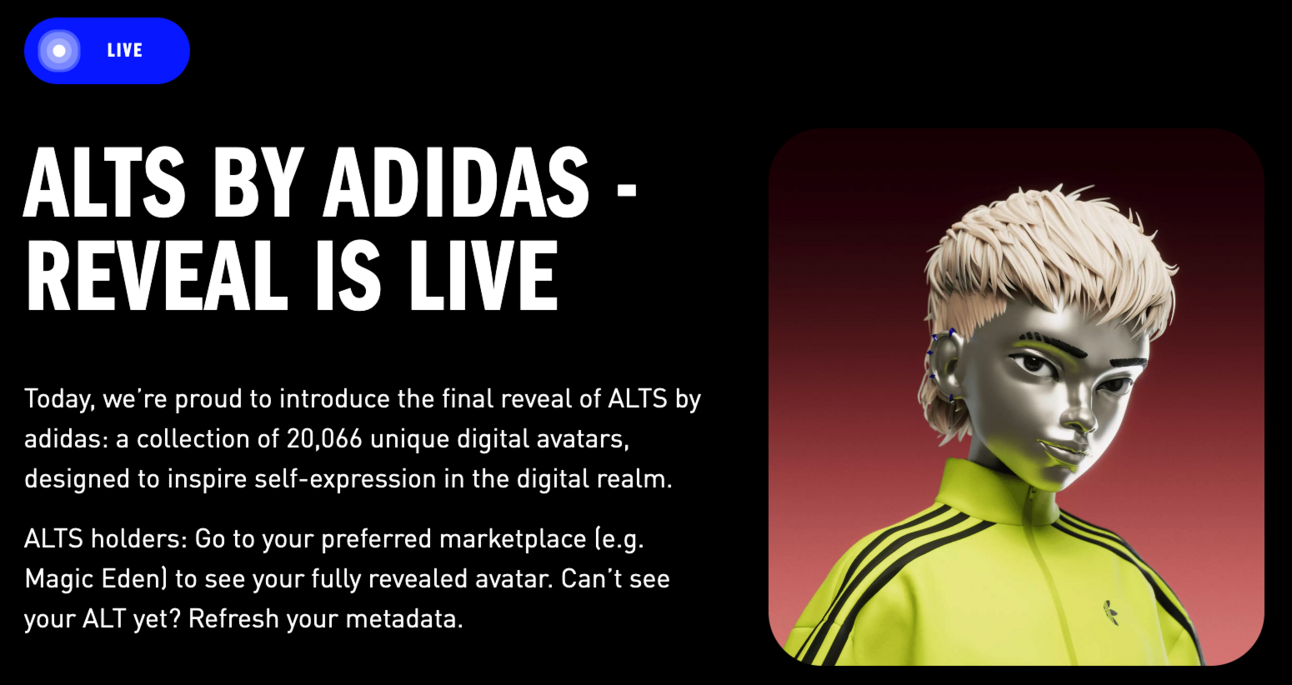
Aadidas has used its ALTS ecosystem for much more than digital avatars. Its public program history includes token-gated access inside the CONFIRMED ecosystem, exclusive footwear and apparel, event access, discounts, airdrops, and other holder benefits. adidas also integrated wallet functionality into adiClub, demonstrating how blockchain-based membership can sit inside an existing consumer application instead of forcing users into a separate Web3 environment.
The caveat is important: portability is useful only when customers understand and value the benefit. A loyalty program with complicated wallets, multiple tokens, speculative positioning, and vague utility will usually lose to a simple points system.
3. Product Authenticity and Provenance
For high-value goods, NFT solutions in e-commerce can connect a unique product identity to a tamper-resistant digital history. The business value is strongest where counterfeiting, resale, warranty, provenance, or service history materially affects trust.
The blockchain certificate should not be treated as magical proof that the physical product is genuine. The architecture still requires a trusted bridge between physical and digital identity.
Real case: Prada + Aura Blockchain Consortium

Prada uses the Aura Blockchain Consortium for digital authentication. During production, an NFC tag can be embedded into the product, allowing a customer to access a blockchain-backed Digital Certificate of Authenticity and related product services. Prada positions the system as a way to improve transparency, protect against counterfeiting, and strengthen customer trust.
This is where NFT solutions in e-commerce become infrastructure rather than campaign marketing. The customer does not necessarily need to care that blockchain is involved; what matters is being able to verify that a product record is authentic and connected to the physical object.
Read more: Zero-Knowledge Proof in Blockchain
4. Phygital Products and Digital Twins
A phygital product connects a physical object with a digital counterpart, entitlement, or collectible. NFT solutions in e-commerce are useful here because the token can coordinate digital ownership, physical redemption, transfer, and ongoing utility across both environments.
A retailer needs to define exactly what the NFT represents:
| Model | Meaning |
| Digital twin | NFT represents a digital counterpart of the physical item |
| Redemption token | NFT gives the holder the right to claim a physical product |
| Ownership certificate | NFT records product ownership or provenance |
| Companion asset | NFT accompanies the physical purchase but does not represent legal title |
These models should not be treated as interchangeable.
Real case: Louis Vuitton VIA

Louis Vuitton's VIA program provides a strong phygital example. Its VIA framework connects digital collectibles to physical twins, while the redemption process includes wallet verification, customer-account linkage, KYC/anti-fraud checks, defined redemption periods, and delivery requirements. Its terms explicitly describe how an eligible NFT holder may claim a corresponding physical twin.
Louis Vuitton also continues to merchandise VIA-linked physical products, including its VIA Shopper Tote line.
The engineering lesson is straightforward: minting is the easy part. Phygital commerce needs redemption state, customer identity, fulfillment, inventory reservation, fraud prevention, token-to-product mapping, and customer support.
5. Tokenized Physical Collectibles
One of the most interesting developments in 2026 is the tokenization of physical collectibles. A card, comic, watch, or other collectible can remain in secure custody while a blockchain representation becomes the transferable ownership rail used for trading.
This explains why NFT solutions in e-commerce increasingly overlap with real-world asset tokenization.
Real case: Collector Crypt

Collector Crypt lets users send physical collectibles to secure vaults where cards are authenticated, scanned, stored, and connected to the user's digital profile or wallet. Owners can then buy, sell, or transfer the collectible digitally while the physical item remains secured.
This architecture removes the need to physically ship the same collectible every time ownership changes. For asset classes where shipping, verification, fraud, and custody create significant friction, tokenization can make the market more liquid without pretending the physical asset has become “fully digital.”
NFT solutions in e-commerce therefore have an interesting role in collectible markets: blockchain can become the transaction rail while secure custody remains the physical source of truth.
6. Secondary-Market Commerce
NFTs are inherently transferable, making secondary-market design one of the more distinctive NFT solutions in e-commerce.
A product can potentially remain economically active after the original checkout through:
- Resale
- Ownership transfer
- Collectible trading
- Membership transfer
- Authentication services
- Post-purchase benefits
- New owner onboarding
Brands should be careful with royalty assumptions. A royalty field inside a smart contract does not guarantee that every marketplace or transfer method will enforce the same economics. Secondary-market strategy still needs clear marketplace rules, customer terms, tax treatment, identity logic, and post-transfer benefit design.
Real case: Courtyard

Courtyard tokenizes authenticated physical collectibles stored inside secured, insured vaults. Its marketplace allows users to buy and sell those vaulted assets without repeatedly shipping them, provides historical ownership information, and lets the owner request physical delivery when desired.
For commerce teams, the important idea is not “NFT resale” itself. It is the ability to keep an asset commercially active after the first purchase and potentially connect subsequent ownership changes to new services, authentication, community engagement, or customer acquisition.
7. Digital Collectibles and Community Engagement
Digital collectibles still make sense when the collectible itself has a reason to exist: fandom, game utility, status, completion mechanics, exclusive rewards, or community participation.
Scarcity by itself is not a durable product strategy.
Real case: NBA Top Shot

NBA Top Shot continues to run collectible packs and set-based rewards in its 2025–26 series. Collectors who complete and lock sets can receive exclusive reward packs, demonstrating how ownership can feed into continuing engagement rather than ending after the primary sale.
There is also a useful technical lesson. In June 2026, NBA Top Shot announced that Moment videos, thumbnails, and metadata had been migrated to IPFS, allowing owners to independently verify and retrieve the associated media without relying solely on a centralized content server.
That matters because blockchain ownership is only one part of NFT durability. If media or metadata disappears from an ordinary server, the token may remain on-chain while the customer experience around it becomes useless.
NFT solutions in e-commerce therefore need an explicit strategy for metadata persistence, content-addressed storage, and long-term media availability.
When NFT Solutions in E-Commerce Make Sense

NFT solutions in e-commerce make sense when blockchain provides a capability the business genuinely needs. Strong candidates generally involve one or more of these conditions:
- Ownership must be transferable between users.
- Eligibility needs to be verified independently of a normal login.
- Provenance or authenticity materially affects product value.
- Physical and digital ownership need to be linked.
- Secondary-market activity is part of the business model.
- Benefits need to work across brands, channels, or communities.
- The tokenized asset should remain useful after the original checkout.
The opposite test is equally important. Do not add NFTs when a standard database can provide the same business result more cheaply and with a better customer experience.
A normal loyalty account is often superior if benefits are non-transferable, controlled entirely by one merchant, and valuable only inside that merchant's application.
This is the decision discipline retailers need. Blockchain is useful when portable verification matters. Otherwise, centralized software may remain the better architecture.
Technical Checklist for NFT Solutions in E-Commerce
Before development starts, the team should make the following architecture decisions explicitly.
| Layer | Key decisions |
| Blockchain | Public vs permissioned network, fees, throughput, finality, L2 |
| Token | ERC-721, ERC-1155 or equivalent; transferability; mint/burn rules |
| Smart contracts | Ownership, gating, redemption, upgradeability, royalties |
| Wallet UX | External wallet, embedded wallet, social login, recovery |
| Physical identity | NFC, QR, serial number, vault custody, anti-tamper mechanism |
| Metadata | On-chain reference, IPFS/decentralized storage, mutable product records |
| Commerce integration | Storefront, checkout, CRM, loyalty, inventory, ERP |
| Payments | Fiat checkout, crypto, gas abstraction, taxation |
| Indexing | RPC provider, blockchain indexer, event synchronization |
| Security | Contract audit, key management, permissions, monitoring |
| Operations | Support, failed transactions, chain outages, migration strategy |
NFT solutions in e-commerce should also be built around blockchain abstraction. Most customers care about the product or benefit, not which chain processes the entitlement.
Embedded wallets, gas sponsorship, fiat payments, and familiar account-recovery flows can reduce unnecessary Web3 friction. The goal is to preserve useful blockchain properties without forcing every customer to become a crypto expert.
Read more: Hybrid Cloud: A Complete Guide for Enterprises
Key Risks Retailers Should Design For

The largest risks around NFT solutions in e-commerce usually exist outside the token standard itself.
- Wallet and onboarding friction: Requiring an unfamiliar wallet flow can damage conversion before customers ever experience the benefit.
- Smart-contract risk: Minting, transfer, redemption, upgrade, or authorization bugs can create irreversible ownership and financial problems.
- Metadata dependency: An on-chain token can still point to media or metadata stored on infrastructure that later disappears.
- Token-to-product mismatch: Blockchain cannot prove a physical asset is genuine if the physical/digital identity link is weak.
- Key management: Compromised administrator, treasury, or contract-owner keys can undermine an otherwise secure platform.
- Regulation and tax: NFTs can represent very different economic rights, so treatment varies by product design and jurisdiction.
- Fraud and phishing: Wallet-based customer journeys introduce additional social-engineering attack surfaces.
- Utility decay: A tokenized membership rapidly loses value when the brand stops maintaining the benefits attached to it.
The right security question is therefore not “Is blockchain immutable?” It is where trust can still fail across the complete system.
How to Measure ROI From NFT Solutions in E-Commerce

Do not evaluate NFT solutions in e-commerce mainly through mint count, Discord membership, floor price, or token trading volume. Those metrics can look impressive while the underlying commerce program creates little durable value. Measure the business outcome the NFT layer is supposed to improve. Depending on the use case, useful KPIs include:
- Token-gated offer conversion
- Wallet-connect completion
- Repeat purchase rate among holders
- Member revenue and retention
- Authentication disputes
- Counterfeit claims
- Secondary-market transaction volume
- Physical-twin redemption
- New customers acquired through resale
- Support cost per wallet user
- Cost per verified product
- Incremental margin from the NFT program
The correct comparison is also not NFT versus “doing nothing.” Compare NFT solutions in e-commerce with the simplest conventional architecture capable of solving the same problem. If a centralized loyalty program produces the same retention at lower acquisition, engineering, security, and support cost, use the centralized program.
Read more: Digital Transformation in Banking: Redefining the Future of Finance
How SotaTek Builds NFT Solutions in E-Commerce
We approach NFT solutions in e-commerce as commerce and systems-integration projects first, blockchain projects second.
The product needs a clear transaction model, user journey, ownership policy, integration boundary, and measurable business case before the team selects a blockchain or token standard.
A typical technical scope may include:
- NFT and token architecture
- ERC-721/1155 or chain-specific smart contracts
- NFT marketplace development
- Secondary-market functionality
- Minting, transfer, burn, and redemption logic
- Token-gated storefront experiences
- External and embedded wallets
- Fiat and cryptocurrency payments
- Storefront, CRM, ERP, loyalty, and inventory integrations
- Metadata and decentralized-storage architecture
- Smart-contract testing and security review
- Cloud deployment and monitoring
- Ongoing blockchain and marketplace maintenance
Our current blockchain capabilities include NFT marketplaces, NFT smart contracts and audits, NFT minting and tokenization, e-wallets, asset tokenization, digital-asset platforms, smart contracts, and integration with ERP, CRM, payment systems, APIs, and databases.
Read more: 10 Blockchain Providers Helping Singapore's Banks Go Digital
For teams that still need to validate whether blockchain creates enough value to justify the architecture, a focused PoC or MVP is a better starting point than a full NFT ecosystem. One commercial flow—such as token-gated access for an existing premium customer segment or authentication for one high-value product line—is usually enough to test the economics, customer friction, and integration assumptions.
NFT solutions in e-commerce should expand only after the first use case proves both customer value and operational viability.
Conclusion
NFT solutions in e-commerce have a more credible role in 2026 than the “launch a collection and wait for demand” model ever did. The useful applications are increasingly specific: access, loyalty, authenticity, phygital ownership, tokenized physical collectibles, secondary commerce, and digital community products.
The strongest implementations share the same principle: blockchain acts as a verification and ownership layer integrated into normal commerce infrastructure. The customer journey still needs reliable checkout, fulfillment, support, security, and product value. If the NFT does not improve those economics or enable a capability that conventional software cannot reproduce efficiently, the retailer should not build it.
NFT solutions in e-commerce are best treated as an architecture choice, not a marketing trend. Start with the ownership, access, or provenance problem; prove the customer value; choose the simplest token model that supports it; and hide as much unnecessary blockchain complexity from the shopper as possible.
If you are evaluating NFT solutions in e-commerce for loyalty, authentication, phygital products, tokenized assets, or secondary-market commerce, contact our blockchain team to discuss the right architecture, integration approach, and MVP scope for your use case.

 https://www.sotatek.com/
 (+84)2466585248




