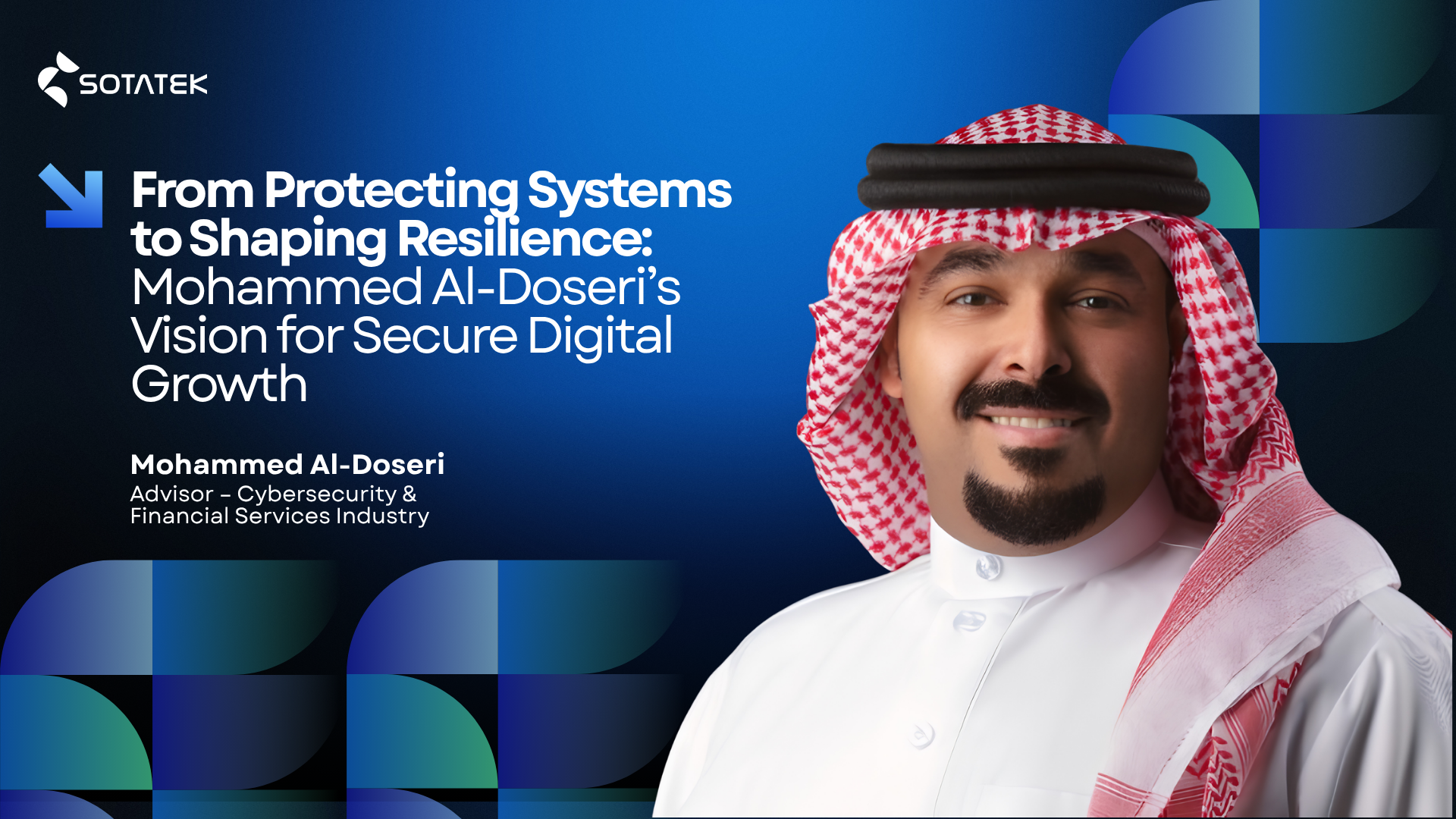
As artificial intelligence, cloud platforms, and connected financial services transform how organizations operate, cybersecurity leadership is taking on a much broader role. It is no longer limited to protecting systems or responding to threats. Today, it must also enable innovation, strengthen business resilience, and build trust into every stage of digital transformation.
This is the space in which Mohammed Al-Doseri has built his career - and continues to make an active contribution.
With 20 years of experience across banking, financial services, and telecommunications, Mohammed currently serves as Group Chief Information Security Officer and Chief Data Officer at Tasheel Finance and Procco Financial Services. He is also a member of SotaTek’s Board of Advisors, advising on cybersecurity, financial services, digital services, AI governance, and secure digital transformation.
A cybersecurity leader who remains close to the conversation
What distinguishes Mohammed is not only the depth of his executive experience, but also his continued engagement with the wider technology and cybersecurity community.
In July 2026, he joined government, healthcare, and industry leaders at the CIS Forward Summit in Dammam for a panel discussion titled “From Protection to Resilience: Building Critical Infrastructure That Can Withstand Disruption.” The conversation addressed an increasingly urgent question: how can organizations maintain continuity and resilience as AI-driven risks and digital dependencies continue to grow?
He has also participated in specialist discussions on internet intelligence, external attack-surface visibility, threat intelligence, and the real-time identification of exposed infrastructure. Through conferences, professional forums, advisory positions, and frequent knowledge sharing, Mohammed consistently connects technical developments with the concerns facing executives and boards.
His message is clear: cybersecurity can no longer be treated as an isolated IT function. It is a strategic business responsibility.
Turning regulation into practical resilience
Throughout his career, Mohammed has led major initiatives involving cybersecurity strategy, enterprise risk management, regulatory compliance, data governance, privacy, and business continuity.
His experience includes achieving PCI DSS certification, implementing the Saudi Central Bank Cybersecurity Framework, enabling secure Open Banking, and aligning organizations with frameworks and requirements such as NCA, PDPL, NDMO, SWIFT CSP, and ISO/IEC 27001.
However, effective cybersecurity leadership goes beyond meeting regulatory requirements.
For Mohammed, frameworks provide the governance foundation - but real resilience depends on how well security is embedded into daily operations, leadership decisions, technology architecture, and organizational culture. Policies, controls, data classification, identity management, employee awareness, incident preparedness, and executive accountability must work together as one operating discipline.
Asking the difficult questions about AI
Mohammed has also emerged as an active voice in discussions surrounding AI security and governance.
As enterprises introduce AI into regulated and business-critical workflows, he emphasizes that the risk does not exist only within the model. It also lies in the data that AI systems access, the context used to make decisions, the permissions granted to autonomous agents, and the ability of organizations to explain and audit their outputs.
This leads to questions that every leadership team must now confront:
Who is accountable when an AI system acts autonomously? How can organizations prevent outdated, manipulated, or unauthorized data from influencing machine-led decisions? And how should cybersecurity, compliance, legal, data, and business teams share responsibility for AI governance?
These are not distant theoretical concerns. They are becoming immediate governance priorities for financial institutions and other regulated organizations.
Extending his impact through SotaTek
As Advisor for Cybersecurity, Financial Services, and Digital Services at SotaTek, Mohammed brings a combination of regional understanding, regulatory expertise, and executive-level cybersecurity experience to the company’s technology capabilities.
His guidance supports SotaTek in designing solutions that are not only innovative, but also secure, compliant, resilient, and suitable for the realities of highly regulated industries.
The collaboration is particularly relevant as organizations across the Middle East accelerate investment in AI, cloud computing, fintech, data platforms, and connected digital services. Moving quickly remains important - but so does establishing the trust, governance, and resilience required to sustain that progress.
For SotaTek, Mohammed’s appointment represents more than the addition of an experienced advisor. It strengthens the connection between technology delivery and the strategic priorities of the organizations adopting it.
Leadership beyond the job title
Mohammed’s professional presence reflects a broader view of leadership: one built not only through organizational responsibility, but also through continued learning, industry engagement, and the willingness to share practical perspectives with others.
Whether contributing to a boardroom discussion, speaking at an industry summit, examining the risks of agentic AI, or highlighting emerging approaches to data protection, he remains closely involved in the conversations shaping the future of cybersecurity.
In a field that changes almost daily, that active engagement matters.
Because the next generation of cybersecurity leadership will not be defined only by how well organizations prevent attacks. It will be defined by how confidently they can innovate, recover, adapt, and grow—even in an environment of constant change.
And that is the kind of resilience Mohammed Al-Doseri is helping organizations build.


 https://www.sotatek.com/
 (+84)2466585248