


The global business and technology landscape is currently navigating an unprecedented gold rush, driven almost entirely by the rapid proliferation of Generative Artificial Intelligence (GenAI). In boardrooms across the world, executives are demanding rapid, sweeping initiatives focused on digital transformation with AI to slash operational costs, modernize legacy systems, and appease digital-first consumers. However, as the initial, breathless euphoria surrounding Large Language Models (LLMs) and conversational interfaces begins to settle, a harsh, undeniable reality is coming into sharp focus: an intelligent conversation does not equal a resolved problem.
For enterprise customer service, IT support, and back-office operational teams, simply deploying a sophisticated conversational bot is proving to be radically insufficient. Organizations are quickly discovering that the most profound bottlenecks they face do not stem from a lack of conversational fluency or natural language understanding. Instead, their failures stem from a distinct lack of backend integration. In essence, companies are putting a brilliant, highly articulate AI interface on top of broken, disconnected, and highly manual operational processes.
This disconnect is acutely visible in the rapidly expanding and fiercely competitive Southeast Asian (SEA) market. Here, high digital penetration collides with incredibly complex, highly localized business environments. In this dynamic region, attempting to replace human operational teams with standalone AI is a losing strategy that rapidly alienates consumers. Instead, true thought leadership requires a fundamental paradigm shift. We must stop viewing AI as an autonomous, standalone replacement for human workers and start viewing it as an intelligent orchestration layer.

To achieve actual operational excellence, enterprise leaders must pivot their focus toward developing a comprehensive workflow automation strategy. SotaTek, your AI & Blockchain Innovation Partner, will help you explore why a deeply integrated workflow automation strategy is the unsung hero of the AI revolution, how disconnected systems create insurmountable hurdles, and how bridging the gap between intelligent AI and robust operational workflows is the only viable path to sustainable business growth.
The Southeast Asian Context: High Digital Expectations and Operational Complexities
To truly understand why a meticulous workflow automation strategy trumps superficial AI hype, we must first contextualize the unique operational landscape of Southeast Asia. The SEA region is not a monolith; it is a hyper-diverse ecosystem comprising varied languages, distinct cultural nuances, rapidly evolving regulatory frameworks, and vastly different levels of technological maturity.

According to the comprehensive e-Conomy SEA 2023 report published by Google, Temasek, and Bain & Company, the region's digital economy continues to hit massive revenue milestones, driven by highly engaged, mobile-first consumers. These consumers have "leapfrogged" traditional desktop computing, going straight to mobile applications. Consequently, they demand instant gratification, highly personalized service, and seamless omnichannel experiences across platforms like WhatsApp, Zalo, and LINE.
However, beneath the sleek surface of these high expectations lies a labyrinth of operational complexity. Customer support centers, BPO (Business Process Outsourcing) hubs, and shared service centers operating within SEA—serving major economic hubs like Singapore, Vietnam, Indonesia, and Thailand—often rely on a fragmented patchwork of legacy software. An individual customer service agent might need to access a localized CRM, a global inventory database, a third-party payment gateway, and an internal IT ticketing system just to process a single, routine customer return.
When businesses inject a standard, "off-the-shelf" AI chatbot into this incredibly fragmented environment without a broader workflow automation strategy, the results are predictably disastrous. The AI bot can speak to the customer in fluent Indonesian or Vietnamese, perfectly understanding their frustration. But if it does not have the backend workflow integrations to actually process a refund in the payment gateway or update the CRM, it becomes nothing more than a conversational roadblock. In this context, an AI without an underlying workflow automation strategy is the equivalent of hiring a brilliant hotel concierge who doesn't have the keys to any of the actual hotel rooms. It creates an illusion of service without the capability of execution.
The Core Problem: Why AI Hype Fails Without a Workflow Foundation
The technology industry has, over the past several years, heavily over-indexed on the "intelligence" of AI while severely under-indexing on its actual "capability." To unlock genuine, measurable AI ROI, enterprise architects and business leaders must conceptually separate the conversational layer (what the AI says) from the execution layer (what the system does).

The "Lipstick on a Pig" Dilemma
Many organizations fall into the dangerous trap of using artificial intelligence to mask highly inefficient, manual operational processes. If your standard operating procedure (SOP) for handling a customer complaint requires four manual managerial approvals, three separate database updates, and a cross-departmental email thread, putting a generative AI bot at the front door does not fix the underlying inefficiency.
The bot simply tells the customer, "I have escalated your issue to the relevant department in a matter of seconds," while the manual, sluggish, error-prone workflow continues to drag on behind the scenes for days. True efficiency requires re-engineering the workflow itself. A proper workflow automation strategy dictates that the AI should be able to trigger those database updates directly and bypass unnecessary manual approvals autonomously based on pre-set business logic.
The Execution Gap and Hidden Costs
A landmark study by McKinsey & Company on the economic potential of generative AI highlighted a crucial caveat: while generative AI excels immensely at summarizing information and generating text, its true, transformative value is only realized when it is deeply integrated into core business workflows. Without this deep integration, companies face a massive "execution gap."
An AI model might correctly read an incoming email and identify that a high-value customer's shipment is lost. But if it lacks the automated workflow parameters to immediately authorize a replacement shipment via an API with the logistics provider, the interaction still fundamentally requires manual human intervention. This execution gap is precisely why organizations so frequently experience ballooning, unexpected AI development costs. They spend heavily on training the NLP (Natural Language Processing) models but fail to budget for the complex API (Application Programming Interface) integrations, middleware, and Robotic Process Automation (RPA) required to let the AI actually do the work.
Deep Dive: Building a Workflow Automation Strategy Across Industries
To truly grasp the strategic necessity of looking beyond the chatbot, we must examine how a robust workflow automation strategy solves critical bottlenecks in real-world, industry-specific scenarios across the diverse SEA market. In every successful enterprise case study, the victory is rarely the AI's ability to understand the user; rather, the victory is the seamless execution of a complex backend workflow.

The Retail and E-commerce Sector
In the hyper-competitive, fast-paced world of Southeast Asian digital commerce, consumer loyalty is fleeting. Customers expect rapid, zero-friction resolutions for order tracking, size exchanges, and loyalty program inquiries. When implementing AI in retail, a common operational failure occurs during multi-step processes like a product exchange.
A basic, conversational AI bot can easily ask the customer what size they want to exchange an item for. However, without a comprehensive workflow automation strategy, the bot hits a wall. A strategically engineered automated workflow, conversely, allows the AI to instantly cross-reference real-time warehouse inventory across multiple distribution centers, place a temporary hold on the requested item, issue a return shipping QR code to the customer's mobile device, and apply a store credit difference—all simultaneously. Without these workflows orchestrated seamlessly on the backend, the AI simply creates a support ticket for a human agent to do the manual labor hours later, completely negating the speed benefits of the technology.
Banking, Financial Services, and Insurance (BFSI)
The financial sector is inherently governed by strict compliance laws, rigorous security protocols, and complex, multi-tiered authorization matrices. Implementing artificial intelligence in BFSI is notoriously difficult precisely because "close enough" is never an acceptable standard for financial transactions or data handling.
Consider a customer who is traveling abroad and is trying to urgently dispute a fraudulent credit card charge via their banking app. An LLM-powered assistant can easily and politely collect the date, amount, and merchant name. However, the actual workflow required to safely resolve a dispute is monumental: it requires freezing the current card, communicating with the internal fraud detection unit, checking geolocation data, issuing a temporary line of credit, and ordering a new physical card to be printed and mailed.
If your workflow automation strategy has not meticulously integrated the AI into these secure, isolated backend systems via robust, encrypted APIs, the AI poses a massive security risk. It ultimately frustrates a customer who is already in a state of high anxiety, forcing them to call a human agent and repeat the entire story.
The Healthcare and Telemedicine Space
The integration of AI in healthcare is perhaps the most critical arena where a bulletproof workflow automation strategy absolutely supersedes conversational hype. In medical scenarios, operational delays can have dire consequences.
Imagine a scenario where a patient uses a clinic's AI-driven patient portal to report severe post-operative symptoms. The AI might correctly categorize the symptoms as "highly urgent" based on its medical training data. However, what happens next is what truly matters. Does the system automatically trigger an integrated workflow that pages the specific on-call doctor, pulls the patient's comprehensive Electronic Health Record (EHR) directly into the doctor's secure mobile dashboard, and simultaneously sends an automated SMS to the patient with immediate triage care instructions? If the AI only logs the urgent data into a static, siloed database waiting for a triage nurse to manually check it four hours later, the AI has fundamentally failed to improve the operational outcome, regardless of how smart the conversation was.
Empowering the Operational Workforce: The Human Element
The ultimate, strategic goal of enterprise workflow automation should never be the complete, dystopian elimination of human operations teams. In the heavily relationship-driven business cultures of Southeast Asia, the human touch remains an absolute premium differentiator. Empathy, complex negotiation, and nuanced judgment cannot be coded. Therefore, the strategic mandate for modern executives is to deploy a workflow automation strategy to empower the operational workforce, shifting them from exhausted data-entry clerks to high-level, strategic problem solvers.

The Shift from Doers to Reviewers
When robust workflow automation is seamlessly paired with AI, the very nature of human work changes for the better. Modern AI agent platforms act as intelligent orchestration engines for the human worker.
When a highly complex, edge-case customer issue arises that requires human empathy, the AI has already executed the automated preliminary workflows. It has gathered data from five different legacy systems, verified the user's secure identity, and pre-filled the necessary resolution forms. The human agent receives a comprehensive, unified dashboard presenting the problem, the context, the customer's lifetime value, and a suggested "Next Best Action." The human is no longer doing the manual, frustrating digging; they are simply reviewing the AI's orchestrated work and applying emotional intelligence to finalize the interaction.
Mitigating Burnout and Driving CSAT
This operational shift directly addresses the massive problem of employee burnout in the BPO sector. Customer service representatives in SEA often face staggering turnover rates due to the sheer, daily stress of navigating clunky, disconnected legacy systems while a customer yells at them on the phone.
By automating the tedious workflows behind the scenes, you completely remove the friction from the employee's daily experience. An extensive report by Gartner on customer service technology trends consistently indicates that organizations that invest heavily in agent-empowering automation technologies see significantly higher employee retention. Happy, supported employees directly correlate to dramatic increases in customer satisfaction (CSAT) and Net Promoter Scores (NPS).
Intelligent Routing and Automated Triage
A successful workflow automation strategy is also the master key to intelligent routing. A major, persistent challenge in massive support centers is ensuring the right query gets to the right specialized agent at the exact right time. An AI, backed by strict workflow rules, can instantly analyze an incoming enterprise email. It can determine the sentiment (e.g., highly agitated), identify the technical subject matter, check the client's SLA (Service Level Agreement) in the CRM, and instantly route the ticket to a Tier 3 technical specialist, bypassing the general Tier 1 queue entirely. This invisible, automated workflow saves thousands of hours of manual triage per month and dramatically reduces Average Handling Time (AHT).
Introducing SotaAgent: Executing Your Workflow Automation Strategy
To successfully navigate this complex, fragmented technological landscape, businesses cannot rely on superficial chatbot vendors selling mere conversational scripts. They require deep, structural engineering expertise capable of marrying advanced AI models with highly intricate, customized enterprise workflows. Recognized globally as one of the top AI outsourcing companies in Vietnam and serving the broader SEA region and beyond, SotaTek provides the engineering muscle required to make AI actually execute meaningful work.
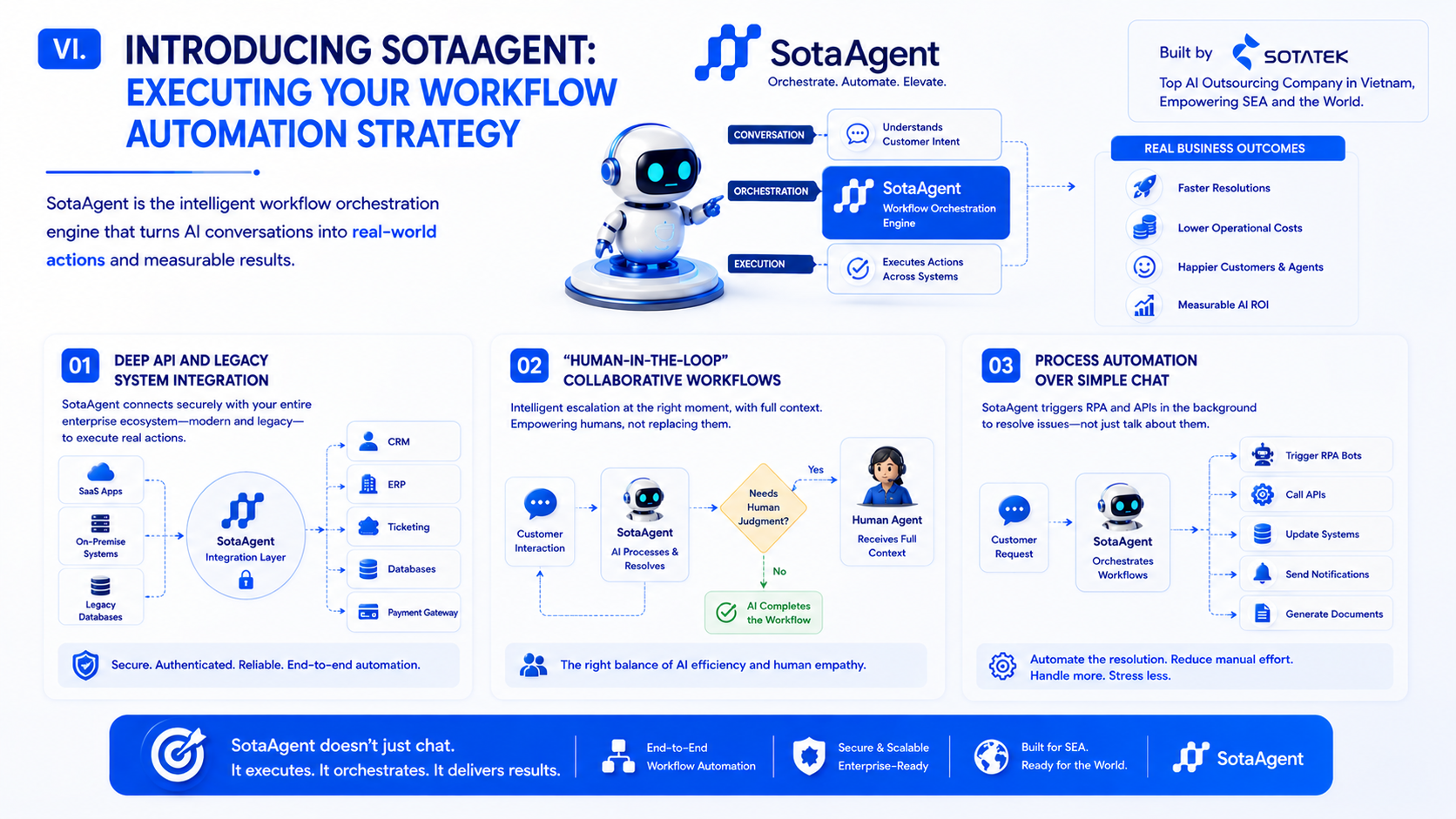
Leveraging our extensive, proven experience in comprehensive AI development service, we have engineered SotaAgent—an enterprise-grade platform designed to be the beating heart of your workflow automation strategy. SotaAgent is not merely a conversational frontend designed to chat; it is an intelligent workflow orchestration engine designed to act.
Why SotaAgent Excels in Operational Execution:
- Deep API and Legacy System Integration: We understand that SEA enterprises run on a mix of modern SaaS and legacy on-premise servers. SotaAgent is specifically designed to connect securely with your existing CRMs, ERPs, and legacy databases. It doesn't just talk to your customers; it takes authorized, authenticated actions within your backend systems to genuinely automate multi-step processes from end to end.
- "Human-in-the-Loop" Collaborative Workflows: We believe fundamentally in empowering your workforce. SotaAgent features highly sophisticated escalation workflows. It seamlessly transfers context-rich interactions to human agents exactly when human empathy, moral judgment, or complex manual authorization is required, ensuring your team is always in control.
- Process Automation over Simple Chat: SotaAgent focuses relentlessly on automating the resolution, not just facilitating the conversation. By triggering robotic process automation (RPA) scripts and API calls in the background, SotaAgent reduces the manual data entry burden on your operational teams, allowing them to handle significantly higher volumes of complex issues with far less operational stress.
Conclusion: Moving Beyond the Generative Hype
The current generative AI hype cycle has convinced many well-meaning business leaders that a smart chatbot is the ultimate silver bullet for operational efficiency and cost reduction. However, a deeper look at the operational realities of the modern enterprise reveals a very different truth: without a deeply integrated, expertly engineered workflow automation strategy, AI is just a shiny conversational facade hiding a broken, sluggish operational backend.
For businesses operating in the fast-paced digital economy of Southeast Asia—looking to scale rapidly while maintaining the high standards of personalized customer care the region demands—the strategic path forward is undeniably clear. Stop investing exclusively in standalone AI toys and start investing in comprehensive AI-driven workflow engines that empower your human workforce to perform at their absolute best. By shifting the corporate focus from "how well does the bot talk?" to "how well does our system execute?", organizations can finally unlock true operational excellence.
Are you ready to move past the superficial AI hype and build robust, automated workflows that actually drive measurable business value and empower your teams? Partner with the enterprise engineering experts who understand the deep intersection of artificial intelligence and operational architecture. Contact SotaTek today to schedule a comprehensive, technical demonstration of SotaAgent and discover how we can transform your operational landscape for the future.

 https://www.sotatek.com/
 (+84)2466585248




