


For decades, the healthcare industry has been battling a chronic condition. Doctors and nurses, armed with incredible skill, find themselves buried under mountains of administrative work. Patients navigate a complex system, often feeling like a number in a long queue. Critical medical data sits in disconnected silos, and care is often reactive, treating diseases only after they appear. This is the reality of a system stretched to its limits.
But a powerful new treatment is beginning to transform the very heart of the medical industry. Artificial intelligence is stepping in, not as a replacement for human expertise, but as a powerful partner. It serves as a tireless analyst for medical imaging, a brilliant assistant in drug discovery, and a hyper-efficient manager for hospital operations. Projections from Gartner indicate that by 2026, over 30% of new drugs and materials will be systematically discovered using generative AI techniques, a testament to its transformative potential.
In this article, SotaTek, your AI & Blockchain Innovation Partner, will pull back the curtain on the strategic role of AI in healthcare. We'll explore its real-world applications, its profound benefits, and how your organization can strategically implement AI healthcare solutions.
What is AI in Healthcare?
Before we explore its impact, let's clarify what we mean by artificial intelligence in healthcare.
Definition of AI in Healthcare
AI in healthcare refers to the use of complex algorithms and software to emulate human cognition in the analysis of complicated medical data. Essentially, it's about teaching machines to process information, learn from it, and then make accurate, data-driven predictions or recommendations to support healthcare professionals and improve patient outcomes.
Key Technologies Used

This isn't a single technology but a suite of powerful tools working in concert:
- Machine Learning (ML): The core of most AI-powered healthcare systems, ML algorithms are trained on vast datasets to identify patterns and make predictions, such as forecasting disease risk based on patient history.
- Natural Language Processing (NLP): This gives AI the ability to understand and interpret human language. NLP in healthcare is used to extract critical information from unstructured doctors' notes, patient records, and scientific literature.
- Computer Vision: This technology enables AI to "see" and interpret images. The role of computer vision in medical imaging is a game-changer for analyzing X-rays, CT scans, and MRIs with superhuman speed and accuracy.
AI vs. Traditional Healthcare Systems
| Feature | Traditional Healthcare Systems | AI-Powered Healthcare Systems |
| Data Analysis | Manual review by clinicians; often siloed. | Automated, large-scale analysis across multiple data sources. |
| Decision-Making | Based on clinician's experience and established guidelines. | Augmented by data-driven insights and predictive analytics. |
| Patient Care | Generally reactive; treats symptoms as they appear. | Proactive and personalized; predicts risks and suggests preventative care. |
| Core Function | To store and display information for human use. | To interpret information and generate actionable intelligence. |
(For a deeper look at how data integrity is secured in modern systems, explore our guide to Blockchain in Healthcare.)
Why AI Is Transforming the Healthcare Industry
AI is not just another tech trend; it's a fundamental paradigm shift because it directly addresses the industry's deepest challenges: cost, quality, and accessibility. Its transformative power comes from its proven ability to augment human capabilities, often performing specific, complex tasks with superhuman speed and accuracy.
A landmark example of this is Google Health's project on diabetic retinopathy, a leading cause of blindness. In many parts of the world, there aren't enough trained ophthalmologists to screen for the condition. Google developed an AI model trained on hundreds of thousands of retinal scans. As published in the prestigious journal Nature Medicine, the AI system was able to detect the condition with an accuracy rate on par with human retinal specialists. This wasn't a lab experiment; the technology was deployed in clinics in India and Thailand, allowing healthcare workers to screen at-risk patients in minutes, providing early, sight-saving interventions where none were previously possible.
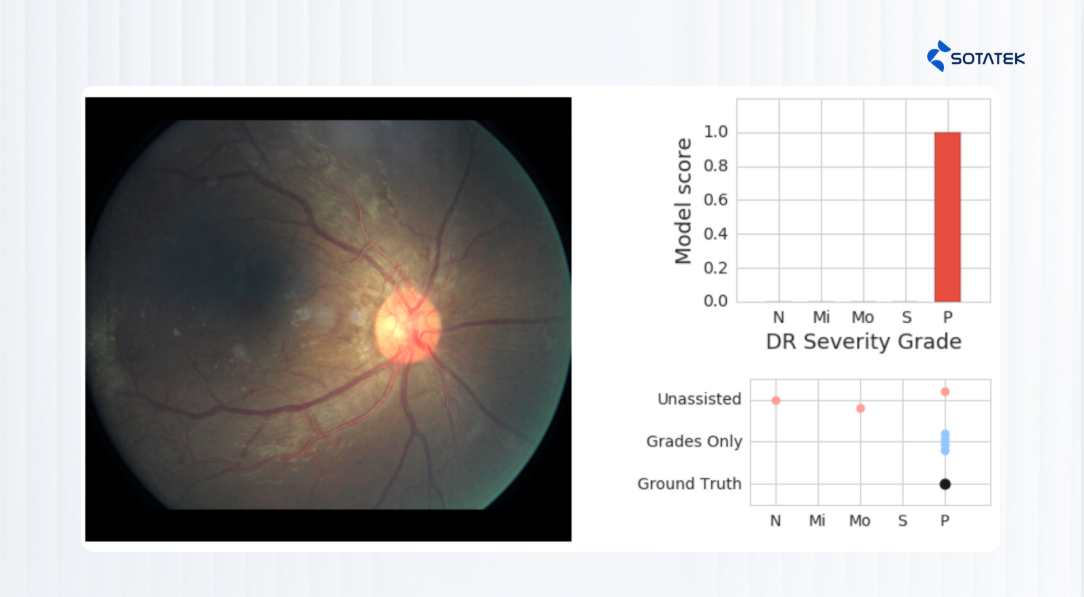
This case perfectly illustrates why AI is so transformative. It doesn't replace the specialist; it scales their expertise, allowing one doctor's knowledge to serve thousands of patients, democratizing access to high-quality care.
Key Use Cases of AI in Healthcare
The applications of AI in healthcare are expanding daily. Here are some of the most impactful use cases in action today.
- AI in Medical Diagnosis: AI algorithms can analyze symptoms, lab results, and patient history to suggest potential diagnoses with a high degree of accuracy. This acts as a powerful "second opinion" for doctors, helping to catch rare conditions or subtle patterns that might otherwise be missed.
- AI in Medical Imaging: This is one of the most mature applications. AI can scan thousands of images (like MRIs, CT scans, and X-rays) in minutes, flagging anomalies such as tumors or signs of diabetic retinopathy with a level of precision that can match or even exceed the human eye.
- AI in Drug Discovery: Traditionally, discovering a new drug can take over a decade and cost billions. AI in drug discovery dramatically accelerates this by analyzing complex biological data to predict how different compounds will behave, identifying promising candidates for new treatments much faster.
- AI in Patient Data Management: AI systems can automatically organize and prioritize patient data, creating unified records and flagging critical information for clinical staff. This ensures that doctors have the most relevant information at their fingertips at the point of care.
- Healthcare Workflow Automation: From patient scheduling and billing to managing hospital bed allocation, AI in healthcare operations automates administrative tasks. This reduces the burden on staff, minimizes errors, and allows more resources to be focused on direct patient care.
- AI Clinical Decision Support: Integrated into electronic health records (EHRs), AI clinical decision support systems provide real-time alerts and recommendations to clinicians during their workflow. This could be an alert about a potential drug interaction or a recommendation for a specific care protocol based on the latest patient data and medical evidence.
How AI Is Transforming Healthcare Operations
Beyond clinical diagnosis, AI is profoundly reshaping the business and operational backbone of healthcare, turning overwhelmed facilities into models of efficiency. This is where hospital management with AI moves from theory to reality.
Instead of just automating single tasks, AI is orchestrating entire operational workflows. For example, predictive analytics in healthcare is used to forecast patient admission rates based on seasonal trends and local health data, allowing hospitals to optimize staff schedules and prevent understaffing during peak times.
A powerful, real-world example of this is SotaTek's PACS-AI solution, which transforms radiology departments. Implemented at the Đức Thọ Medical Center, this AI in medical imaging solution integrates directly with the hospital's existing imaging archives. It automatically analyzes images before they even reach the radiologist, flagging suspicious areas and providing preliminary findings. This operational shift resulted in a 40% reduction in image review time for radiologists and, critically, a 15% increase in the detection rate of small, hard-to-spot nodules. It’s a perfect case of AI augmenting experts to improve both efficiency and quality of care.

Another major operational drain is clinical documentation, a primary driver of physician burnout. This is where a tool like SotaTek's ChartX comes in. ChartX is an AI assistant for healthcare that uses advanced NLP in healthcare to listen to a natural doctor-patient conversation. It transcribes the dialogue and intelligently populates the electronic health record (EHR) in the correct format, all in real-time. By eliminating the need for manual note-taking, ChartX can save doctors up to 2 hours of administrative work per day. This operational transformation gives time back to doctors, allowing them to focus on their patients rather than their keyboards.

Benefits of AI in Healthcare

When implemented effectively, AI-driven healthcare systems deliver profound, measurable benefits.
- Improved Diagnostic Accuracy: AI's ability to analyze complex data from thousands of cases reduces diagnostic errors. For example, a 2020 study published in The Lancet found that deep learning AI models could correctly detect diseases from medical images with a level of accuracy comparable to human healthcare professionals.
- Massive Efficiency Gains: Automating administrative and diagnostic tasks frees up clinicians for patient care. Research from Accenture estimates that AI applications could save the U.S. healthcare economy $150 billion annually by 2026 by automating workflows and reducing the administrative burden.
- Accelerated Drug Discovery & Reduced Costs: AI dramatically shortens the research and development timeline. By analyzing complex biological data to predict molecule efficacy, AI in drug discovery can accelerate the initial screening process. A report from Morgan Stanley suggests that AI could lead to the development of 50 novel therapies over the next decade, a process that would have taken much longer with traditional methods.
- Personalized Medicine at Scale: AI enables treatment plans tailored to an individual's unique genetic makeup and lifestyle. By analyzing a patient's genomic data alongside population health trends, AI can help predict their specific risk for certain diseases and suggest personalized preventative strategies, moving away from a one-size-fits-all approach.
Challenges of AI in Healthcare
The path to AI adoption is not without significant hurdles that have been observed globally.
- Data Quality and "Data Deserts": AI is only as good as the data it's trained on. A major challenge is the prevalence of "data deserts" for underrepresented populations. For instance, a 2019 study revealed that a widely used algorithm to predict which patients need extra care was significantly biased against Black patients because the historical data used "proxy" metrics for health needs that were skewed by race. Correcting for such biases is a massive undertaking.
- The "Black Box" and Integration Problem: Many advanced AI models are "black boxes," meaning even their creators can't fully explain how they reached a specific conclusion. This creates trust issues with clinicians. This was a major factor in the struggles of IBM Watson Health, which, despite its immense power, faced pushback from doctors who found its recommendations difficult to interpret and integrate into their trusted clinical workflows.
- Governance and Ethical Concerns: Navigating data privacy regulations like HIPAA in the US and GDPR in Europe is immensely complex. Furthermore, who is liable when an AI-assisted diagnosis is wrong? In 2018, a project between the UK's Royal Free London NHS Foundation Trust and Google's DeepMind faced a formal investigation and public outcry for failing to be fully transparent with patients about how their data was being used, highlighting the critical need for a robust AI governance framework.
AI Solutions for Healthcare Organizations

For organizations ready to begin their AI automation implementation, there are several pathways.
AI Automation Solutions
These are often targeted applications designed to solve a specific problem, such as automated medical coding or patient scheduling. They are a great starting point for any organization looking to get started with healthcare automation solutions.
(To see how these solutions are applied across industries, explore our in-depth article on AI Automation Use Cases.)
AI Platforms for Healthcare
These are more comprehensive systems that provide a foundation for building and managing multiple AI applications. A robust AI-powered automation platform allows a hospital system to develop and deploy various solutions while maintaining centralized governance and control.
Custom AI Development
Sometimes, the most powerful solution is one that is built specifically for you. Custom development allows you to create an AI in healthcare solution that is perfectly tailored to your unique workflows, patient populations, and strategic goals. At SotaTek, we specialize in building these bespoke solutions. Two examples from our portfolio include:
- PACS-AI: This is an advanced AI in medical imaging solution designed to integrate directly with a hospital's Picture Archiving and Communication System (PACS). It uses AI to automatically analyze medical images, providing radiologists with highlighted areas of interest and preliminary findings. A case study at a regional hospital showed that PACS-AI reduced image review time by 40% while increasing the detection rate of small nodules by 15%.
- ChartX: This is an AI assistant for healthcare professionals that uses NLP in healthcare to transform clinical documentation. Instead of spending hours typing notes, doctors can have a natural conversation with a patient while ChartX listens, transcribes, and automatically populates the electronic health record in the correct format. This has been shown to save doctors up to 2 hours of administrative work per day, directly combating burnout and improving the quality of patient interaction.
How to Choose the Right AI Partner for Healthcare
Selecting a partner is the most critical step in your implementation journey. Look for a team that demonstrates:
- Deep Healthcare Expertise: They must understand the nuances of clinical workflows, data privacy (HIPAA), and medical regulations.
- Proven Technical Excellence: They should have a portfolio of successful AI for hospitals and clinics, showcasing their ability to handle complex data and integrations.
- A Collaborative Approach: A great partner works with your clinical and IT teams, acting as a true innovation partner, not just a vendor.
- A Focus on Ethics and Governance: They should have a strong framework for ensuring AI models are fair, transparent, and secure.
The Future of AI in Healthcare
The future role of AI is not just to assist, but to proactively anticipate and act. We are moving from reactive medicine to a model of predictive, autonomous healthcare. The industry's most respected leaders share this vision.
Dr. Eric Topol, a renowned cardiologist and author of "Deep Medicine," predicts a future where AI handles the "scut work" of medicine, freeing doctors for more humanistic care. Topol shared his belief that AI systems will increasingly be used to serially evaluate layers of data over the course of patients’ lives, assessing everything from their DNA and RNA, to their anatomy, physiology, epigenomics, microbiome, metabolome and exposome. This will eventually free clinicians from the outsize burden of computer time to document patient notes, schedule tests and request insurance preauthorization.

"The gift of time from AI,” Topol stated, can help restore the human dimension of medicine." This vision sees AI taking over data analysis and administrative tasks, allowing doctors to focus on empathy, communication, and complex problem-solving.
Furthermore, Fei-Fei Li, the “godmother of AI”, a leading AI scientist and Co-Director of Stanford's Human-Centered AI Institute, envisions AI as a tool for ambient intelligence. She has spoken about a future where "smart sensors" in hospitals and homes can monitor patients non-intrusively, predicting falls in the elderly or alerting doctors to early signs of distress.

Her vision is an AI-native enterprise where the environment itself becomes a part of the care team, creating a safety net that is always on. This points to a future of truly autonomous business systems managing patient well-being.
Conclusion
Artificial intelligence in healthcare is no longer a futuristic concept; it is a present-day reality and a powerful force for positive change. From the diagnostic lab to the hospital front desk, its strategic role is to augment human expertise, streamline complex processes, and unlock a new era of personalized, proactive, and efficient care. The journey requires careful planning and the right partner, but the destination—a healthier future for all—is well worth the effort.
With 11+ years of experience and deep expertise in AI Development Services, SotaTek helps organizations harness the full strategic potential of AI in healthcare. We build and implement solutions that don't just automate tasks but fundamentally improve how your business operates. Contact us today to discover how your new strategic partner can transform your business.

 https://www.sotatek.com/
 (+84)2466585248




