


Across Southeast Asia, enterprise leaders are moving quickly from AI curiosity to active investment. Companies are testing generative AI, computer vision, intelligent automation, and AI agents across customer service, manufacturing, sales, finance, logistics, and internal operations.
Yet the hardest question is no longer, “Can this model perform the task?”
The harder question is, “Can our organization use this capability reliably every day?”
That distinction matters. A model can generate an accurate answer, identify a defect, summarize a document, or recommend a next action. None of those outputs creates value by itself. Value appears only when the output is connected to a real workflow, used by the right people, governed with clear rules, integrated with existing systems, and measured against a business outcome.
This is why enterprise AI implementation is more about operations than technology.
At SotaTek, we see AI as an operating capability, not a standalone feature. The goal is not to add AI somewhere in the business. The goal is to redesign how work gets done so that people, data, software, and AI can produce better results together.
What Enterprise AI Implementation Really Means

Enterprise AI implementation is the process of integrating artificial intelligence into an organization’s workflows, systems, decision-making, governance, and workforce practices.
It includes technology choices, but it also requires answers to operational questions:
- Which business result should improve?
- Which workflow will change?
- What data will the AI use?
- Which actions can the system take?
- When must a human review the output?
- Who owns the process after launch?
- How will performance, risk, and cost be monitored?
Many companies stop at the first layer. They buy an AI platform, connect a model to internal documents, or run a proof-of-concept. That is experimentation, not full implementation.
This is where many promising pilots lose momentum. The technology works, but the operating model around it does not.
Why Southeast Asia Needs an Operations-First AI Strategy
Southeast Asia has strong AI momentum, but it is not a uniform market. Digital maturity, infrastructure, regulation, language, labor models, and enterprise systems vary significantly across the region.
Recent regional research reports AI adoption momentum above the global average, while ASEAN guidance emphasizes responsible deployment and interoperability across jurisdictions.
A regional company may have a cloud-based ERP in Singapore, a locally customized platform in Vietnam, spreadsheet-based reporting in the Philippines, and different approval processes in Thailand or Indonesia. The same customer policy may be interpreted differently across markets. Product names, operational terminology, and communication styles may also change between countries.
This fragmentation creates a specific implementation challenge. An AI system cannot produce consistent results if the workflows, definitions, and data around it remain inconsistent.
SotaTek’s guide to digital transformation with AI explores how individual AI initiatives can support wider business change without becoming disconnected experiments.
The Most Common Misunderstanding: AI Does Not Fix a Broken Process

AI can multiply the speed and consistency of a well-designed process. It can also multiply confusion, errors, and risk when the original process is unclear.
Consider a customer support team. An AI assistant may produce strong draft responses, but the deployment can still fail when customer records are spread across multiple systems, refund rules differ by country, and agents do not know when to trust the answer. If the AI cannot access the correct policy or recognize a sensitive case, faster response generation may simply lead to more mistakes.
The same problem appears in manufacturing. A vision model may detect a potential defect, but its value is limited unless the company defines what happens next. Should the line stop? Should the product be isolated? Who verifies the image? Where is the result recorded? Does the event trigger maintenance, quality review, or supplier investigation?
This gap between AI output and operational action is a central challenge in AI support automation. The objective should not be to automate an isolated response. It should be to improve the complete service process.
Seven Operational Foundations of Enterprise AI Implementation

1. Begin With a Measurable Business Outcome
Weak AI projects often start with technology language:
“We need a chatbot.”
“We should use computer vision.”
“We want an AI agent.”
But strong projects start with an operational result:
“We need to reduce average support handling time by 25 percent.”
“We need to detect production defects before final packaging.”
“We need to reduce manual invoice review.”
“We need to identify stock shortages faster.”
A measurable outcome creates focus. It helps teams choose the right use case, define acceptable performance, estimate value, and determine whether the solution is worth scaling.
Before approving an AI initiative, leaders should ask:
- What business metric must change?
- Who owns that metric today?
- What is the current baseline?
- What is the cost of the existing problem?
- What level of improvement would justify the investment?
Without these answers, teams may optimize model accuracy while failing to improve the business.
2. Map the Workflow Before Building the AI
AI usually performs one part of a larger process. Implementation teams must understand the complete sequence of that task.
A workflow map should document:
- The event that starts the process
- Required inputs
- Systems and data sources
- Decision points
- Responsible employees
- Approvals
- Exceptions
- Escalations
- Outputs
- Performance indicators
In manufacturing, for example, AI can support quality inspection, maintenance, safety, and production monitoring. However, the value depends on how these capabilities connect to the full operational process.
A deeper look at manufacturing workflow automation can help teams identify where automation should begin and where human control should remain.
3. Make Data Operationally Usable
Organizations often hear that they must “clean their data” before adopting AI. That advice is correct but incomplete.
Operationally usable data must be accessible, current, correctly defined, permissioned, traceable, and representative of real conditions.
An enterprise AI solution may need four types of data:
Grounding or training data: Policies, documents, images, historical cases, knowledge articles, or examples used to guide the system.
Live operational data: Customer details, inventory levels, production signals, ticket history, transaction status, or other information required at the moment of action.
Feedback data: Human corrections, rejected outputs, confirmed defects, escalations, and user ratings.
Monitoring data: Accuracy, response time, cost, failure patterns, usage, security events, and business outcomes.
The goal is not perfect data across the entire company. The goal is sufficient, reliable data for the selected workflow.
This distinction is particularly important in Southeast Asia. Enterprise data may be distributed across local software, spreadsheets, chat applications, paper records, and systems built at different stages of the company’s growth.
Records may also contain several languages, inconsistent product identifiers, locally defined abbreviations, and different formats for customer or supplier information.
Trying to solve every data problem before starting an AI project can delay progress indefinitely. A more practical approach is to define the minimum reliable data foundation required for one high-value workflow, then improve and expand it as the implementation scales.
4. Design Human Accountability Into the System
Human-in-the-loop design should not be an emergency measure added after errors appear. It should be part of the operating model from the beginning.
Different situations require different levels of human control:
- Automatic execution for low-risk, high-confidence cases
- Human approval before sensitive actions
- Review of low-confidence outputs
- Escalation for policy exceptions
- Random quality audits
- Dual approval for high-impact decisions
- Human correction used for future improvement
For example, an AI agent may automatically categorize routine support requests but require human approval before processing refunds. A computer vision system may automatically count products while sending potential safety violations to a supervisor for review.
The organization should also determine who is responsible when the AI produces an incorrect or inappropriate result.
An executive sponsor may approve the investment, but the relevant business leader should own the operational outcome. Data teams should manage access and quality. Technical teams should maintain reliability and integration. Risk teams should define acceptable boundaries. Frontline employees should help identify cases that were overlooked during design.
Without this accountability, AI problems can remain unresolved because every department assumes that another team owns them.
5. Build Governance Into the Workflow
Governance cannot exist only in a policy document. It must appear in system permissions, approval rules, logs, evaluation processes, and escalation paths.
An enterprise AI governance model should define:
- What the system is allowed to do
- Which data it can access
- Which outputs require review
- How changes are tested and approved
- How actions are logged
- How incidents are reported
- How bias and quality are evaluated
- How third-party models are managed
- When a model or workflow should be suspended
The level of governance should match the authority given to the AI.
A system that summarizes documents creates a different risk profile from an AI agent that updates customer records, approves a transaction, creates a purchase order, or sends an external message.
Companies should not avoid valuable automation because risk exists. They should design controls that allow automation to operate within defined boundaries.
6. Integrate AI Where Work Already Happens
Standalone AI tools often struggle with adoption because they create another destination for employees to visit.
A more effective approach is to embed AI into existing systems such as CRM, ERP, customer support platforms, manufacturing systems, document management tools, internal portals, email, and collaboration software.
Integration enables AI to receive the right context and return results that users can act on. It also reduces manual copying, improves traceability, and makes adoption easier.
For instance, a sales AI agent becomes more useful when it can review CRM history, identify account activity, prepare a follow-up message, and create a task for the account manager. A support assistant becomes more valuable when it can access product documentation, customer history, order status, and country-specific policies in one workflow.
SotaTek’s AI development services connect AI engineering with data, application development, infrastructure, and enterprise integration.
7. Create a Continuous Improvement Loop
AI implementation does not end at launch.
A production AI operating loop should include:
- Input and output monitoring
- Quality evaluation
- User feedback
- Error categorization
- Data, prompt, model, or rule updates
- Controlled testing
- Release management
- Business KPI review
Without this loop, performance can decline quietly while usage continues.
An AI system may produce good results during its first month, then become less effective as products, policies, customer behavior, or operating conditions change.
Organizations need a regular process for identifying the causes of errors. The cause may be the model, outdated company knowledge, an integration failure, an unclear business rule, or a new type of exception.
Continuous improvement helps the team identify the correct cause rather than repeatedly replacing models without solving the operational problem.
A Practical Enterprise AI Implementation Roadmap

Phase 1: Assess Readiness and Select the Right Opportunity
Start by identifying workflows with high business value and realistic implementation conditions.
Evaluate process stability, data availability, integration complexity, risk, executive sponsorship, and employee readiness. A structured AI readiness checklist can help leaders identify gaps before committing significant budget.
The first use case should be meaningful enough to demonstrate value but focused enough to control risk. It should have an identifiable owner, accessible data, a measurable baseline, and employees who are willing to participate in testing.
Phase 2: Design the Future Workflow
Define:
- The future process
- AI responsibilities
- Human responsibilities
- System integrations
- Data requirements
- Exception rules
- Security controls
- Success metrics
This stage turns a technology concept into an operating design.
It also helps teams identify steps that should be removed or simplified before any automation is introduced. Automating unnecessary steps does not create transformation. It only makes an inefficient process move faster.
Phase 3: Test the Riskiest Assumptions
A useful prototype should answer difficult questions early:
- Can the system handle actual company data?
- Does it work across required languages?
- Is the output accurate enough for the intended action?
- Can it connect to the legacy environment?
- Can users understand and correct errors?
- Is the response time acceptable?
- Are operating costs sustainable?
A prototype should test uncertain assumptions rather than demonstrate functions that the team already knows are possible.
For a multilingual support system, language performance may be the main risk. For computer vision, environmental conditions may be more important. For an AI agent, securing access to enterprise tools is the most difficult challenge.
Phase 4: Run a Production Pilot
A production pilot should use real users and real workflow data. It should include access controls, monitoring, support procedures, and a clear business owner.
Compare performance with the pre-AI baseline. Measure time, cost, accuracy, exception rates, human review, user adoption, and the target business KPI.
Do not judge the pilot only by the number of people who use the system. High usage does not necessarily mean the business is receiving value.
The more important question is whether the AI has improved the workflow.
Phase 5: Scale Reusable Capabilities
Once value is proven, scale the capabilities that can support multiple use cases:
- Data connectors
- Identity and permissions
- Evaluation frameworks
- Audit logs
- Monitoring dashboards
- Human review interfaces
- Model and prompt management
- Governance templates
This approach makes later enterprise AI implementation faster and more consistent. It also reduces the risk of different departments building isolated systems with incompatible security, data, and governance practices.
Operational AI in Practice: SotaAgents

An enterprise AI agent should do more than answer questions. It may retrieve information, interpret intent, apply business rules, call tools, update records, request approval, escalate exceptions, and document the action.
This requires orchestration, secure tool access, memory, monitoring, and governance. SotaTek’s overview of AI agent platforms explains the capabilities enterprises should assess when comparing solutions.
SotaAgents is designed as a customizable platform for enterprise conversational and workflow use cases, including customer support, internal assistance, sales engagement, knowledge retrieval, and multi-step administrative processes.
A customer support agent, for example, could identify a customer’s request, retrieve the relevant account and order information, consult the approved policy, prepare a response, and suggest the next action.
However, the implementation still needs clear operating rules. The organization must decide which systems the agent can access, what it can change, when approval is required, how actions are recorded, and how recurring errors are reviewed.
The value of SotaAgents does not come from conversation alone. It comes from connecting conversation to enterprise knowledge, business tools, workflow logic, and human accountability.
Operational AI in Practice: SotaVision
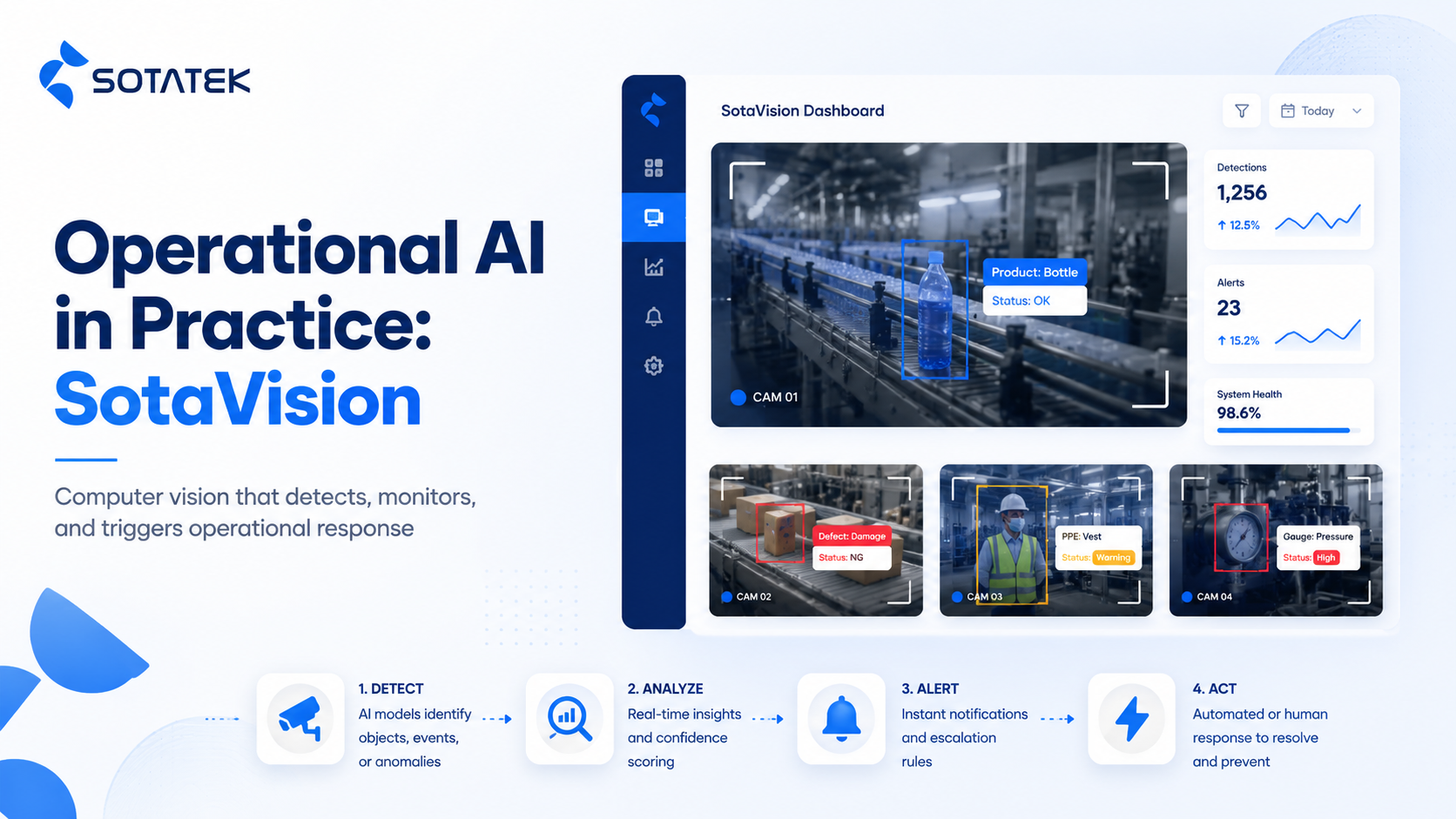
Computer vision follows the same principle. A detection is not yet a business outcome.
SotaVision can support use cases such as defect inspection, safety monitoring, PPE compliance, object counting, shelf monitoring, restricted-area alerts, and production observation.
A complete implementation must consider camera placement, lighting, image quality, processing architecture, alert thresholds, false positives, human verification, and the action triggered after detection.
In a manufacturing case highlighted by SotaTek, SotaVision was used with LG Innotek to improve defect detection accuracy from approximately 70 percent to 99.99 percent.
The important lesson is not only that the model achieved higher accuracy. The system created value by implementing a defined quality process in a real production environment.
Companies exploring this field can review the practical applications of vision AI in manufacturing before selecting a deployment scope.
The Real Cost of Enterprise AI Implementation

The model is only one cost category.
A complete budget may include discovery, workflow analysis, data engineering, application development, integration, cloud or edge infrastructure, security, testing, governance, user training, monitoring, maintenance, and human review.
Companies must also consider hidden costs. Employees may need to verify low-quality outputs. Teams may duplicate work during the transition period. False alerts may consume operational time. Uncontrolled model usage may increase cloud or API expenses. Low adoption may prevent the company from receiving the expected return.
SotaTek’s guide to AI development costs provides a useful foundation for planning, but leaders should also calculate the total operating costs of the solution after launch.
A practical value model is:
Annual AI value = labor capacity released + error reduction + revenue impact + risk reduction - implementation and operating cost
This keeps the business case connected to real outcomes rather than technical activity.
Choosing the Right Enterprise AI Implementation Partner

Enterprises can build internally, buy a platform, or work with an external partner.
Building internally may be suitable when AI is central to competitive advantage and the company already has strong product, data, engineering, security, and AI operations capabilities.
A ready-made platform may be appropriate for standardized processes that require limited customization.
A development partner is often the better fit when the workflow is unique, legacy integration is complex, regional language support matters, or the company needs to turn a prototype into a production system.
When assessing providers, look beyond model expertise. Ask whether the partner can understand operations, design workflows, engineer data pipelines, build applications, integrate enterprise systems, implement security controls, and support post-launch improvement.
A strong implementation partner should ask about business outcomes, current processes, exceptions, employee roles, data access, and operating constraints before recommending a particular model.
Organizations evaluating regional options may find this overview of AI outsourcing companies in Vietnam helpful for assessing engineering depth, domain experience, delivery models, and long-term support.
A Founder’s Checklist Before Approving an AI Project
Before approving an enterprise AI implementation, confirm that:
- The business problem is measurable.
- A process owner is accountable.
- The current workflow is documented.
- Baseline performance is known.
- Required data is accessible.
- Exceptions have been identified.
- Human responsibilities are clear.
- Security and governance controls are defined.
- Existing systems can be integrated.
- Real users are involved in testing.
- Operating cost has been estimated.
- Post-launch ownership is funded.
- Scaling criteria are agreed in advance.
Do not approve an AI project simply because the demonstration looks intelligent.
Approve it when the organization can explain how the system will change a workflow, who will own the outcome, how risk will be controlled, and how value will be measured.
Conclusion: The Competitive Advantage Is Operational AI
The AI model matters, but it is rarely the deciding factor in enterprise success.
The organizations that gain lasting value will be those that can redesign workflows, connect fragmented data, give AI-controlled access to business systems, define human accountability, build user trust, and improve performance continuously.
This is particularly important in Southeast Asia, where organizations may operate across different languages, markets, regulations, systems, and levels of digital maturity.
Enterprise AI implementation should therefore begin with operations. Technology should serve the workflow, not lead it.
SotaTek supports enterprises through AI readiness assessment, workflow and solution design, custom development, system integration, deployment, and continuous optimization. With solutions such as SotaAgents and SotaVision, businesses can move beyond isolated pilots and build AI capabilities that produce measurable operational value.
Ready to turn an AI opportunity into a production-ready business solution? Contact SotaTek to discuss your enterprise AI implementation roadmap.

 https://www.sotatek.com/
 (+84)2466585248




