


The global Business Process Outsourcing (BPO) and customer service industry is currently undergoing a massive, unprecedented technological shift. For decades, the industry relied on human capital to scale. Today, the rapid emergence of Generative Pre-trained Transformers (GPT), Large Language Models (LLMs), and highly advanced conversational chatbots has sparked both immense excitement and a profound wave of anxiety across the global workforce. The elephant in the room is impossible to ignore, and the question on the minds of executives and frontline workers alike is this: Will Artificial Intelligence completely replace human customer service representatives (CSRs)?
The short, emphatic answer is no. Attempting to completely replace human agents with autonomous AI systems is a fundamentally flawed, high-risk strategy. As businesses globally push for comprehensive digital transformation with AI, industry leaders are beginning to realize that the true, sustainable value of these emerging technologies lies in augmentation, not absolute substitution.
Historically, we have seen this pattern before. When Automatic Teller Machines (ATMs) were introduced, people predicted the death of the bank teller. Instead, the number of bank branches expanded, and the role of the teller developed into a more complex, relationship-driven advisory position. The AI revolution in customer service is following a similar trajectory.

Realizing this potential, however, requires a hard, objective look at the critical AI support automation challenges that currently exist in the market. In this comprehensive guide, SotaTek, your Blockchain & AI Innovation Partner, will explore why autonomous AI fails when left unchecked, the operational hurdles of AI deployment, and how a synergistic relationship between human intelligence and artificial intelligence is the only viable path forward.
Most Common AI Support Automation Challenges
Despite the relentless marketing hype surrounding self-resolving AI agents, standalone AI systems pDespite growing investment in customer service automation, many organizations continue to face significant AI support automation challenges that limit the effectiveness of fully autonomous support systems. While AI can handle repetitive inquiries at scale, standalone AI agents still struggle with complex customer issues, emotional interactions, and exception handling. Without appropriate human oversight, these AI support automation challenges can lead to lower customer satisfaction, inconsistent support experiences, and increased customer churn. Understanding these limitations is essential for businesses looking to scale support automation without compromising service quality.

The Empathy Gap and Escalating Customer Frustration
At its core, customer service is about human connection. When customers reach out to a support line, they are often already experiencing friction, frustration, or anxiety. AI, no matter how advanced its Natural Language Processing (NLP) capabilities are, cannot genuinely empathize. It can output phrases like, "I understand your frustration," but it cannot feel it, nor can it intuitively adjust its tone based on the subtle emotional cues of a distressed user.
Consider a panicked patient trying to understand why a critical medical procedure was denied by their provider. This is a common, high-stakes scenario involving AI in healthcare, and it strictly requires a human touch, a compassionate tone, and nuanced understanding that an algorithm simply cannot replicate.
The data firmly supports this consumer sentiment. According to a comprehensive July 2024 customer service survey conducted by Gartner, 64% of customers prefer that companies do not use AI for customer service, with 53% stating they would consider switching to a competitor if they were forced into an inescapable AI-only support loop. Customers want the efficiency of AI for simple tasks, but they fiercely demand the right to speak to a human when things go wrong.
Contextual Misunderstandings and the Danger of "Hallucinations"
One of the most common AI support automation challenges is the inability of AI systems to fully understand context. Because generative AI predicts responses based on patterns rather than true reasoning, it can sometimes generate inaccurate information, misinterpret customer intent, or provide answers that do not align with company policies.
In customer support environments, these errors can damage customer trust, increase escalation rates, and create inconsistent service experiences, making human oversight essential for high-stakes interactions.
Furthermore, AI models frequently misinterpret cultural nuances, regional dialects, sarcasm, or complex multi-part queries. For example, a customer navigating complex, multi-item return policies utilizing AI in retail might ask a highly specific question combining shipping delays, partial refunds, and loyalty points. This often confuses standalone bots, leading to disastrous policy violations, incorrect financial promises made on behalf of the brand, and intensely angry shoppers.
The Escalation Bottleneck and the "Doom Loop"
One of the most universally despised customer experiences is getting trapped in an automated "doom loop." This occurs when an AI chatbot or voice both fails to resolve a nuanced issue but lacks a smooth, intelligent routing protocol to pass the full context of the interaction to a human agent. The customer is inevitably forced to repeat their account numbers, their security questions, and their entire problem to a live agent, completely negating any efficiency gained by the AI.
This broken handoff process is a massive operational failure. A recent CX Trends Report published by Zendesk highlighted that a staggering 78% of customers who interact with chatbots report they still need to reach out to a human agent afterward. If the AI acts as a rigid barrier rather than a helpful bridge to a human agent, it damages the Customer Effort Score (CES) and severely hurts brand loyalty.
Data Privacy, Compliance Risks, and Trust Deficits
Handling sensitive Personally Identifiable Information (PII) such as social security numbers, credit card details, or medical records requires stringent security protocols and human judgment to ensure compliance with global data privacy laws like GDPR or CCPA.
This is particularly critical when deploying AI in BFSI (Banking, Financial Services, and Insurance). In these heavily regulated industries, an AI system that accidentally leaks data into its training model or falls victim to a "prompt injection" attack (where a malicious user tricks the AI into revealing confidential data) can result in massive regulatory fines and irreparable brand damage.
Consumers are acutely aware of these risks. Research from the Salesforce State of the Connected Customer report found that consumer trust in businesses using AI ethically plummeted from 58% in 2023 to just 42% in 2024. Rebuilding that trust requires transparent, human-overseen AI implementations.
Legacy Systems Create Significant AI Support Automation Challenges
Another common AI support automation challenge is integrating AI solutions with existing enterprise systems. Many support teams still rely on fragmented CRM platforms, legacy billing software, and disconnected knowledge bases. When AI systems cannot access accurate and up-to-date information, response quality quickly declines.
Without proper data governance and system integration, AI may deliver incomplete, outdated, or inconsistent answers. This makes legacy infrastructure one of the biggest barriers to successful customer support automation and highlights the need for human oversight throughout the implementation process.
Why AI Fails Without "Human-in-the-Loop" (HITL) Oversight
Understanding why these widespread challenges exist requires looking deeply at the operational architecture and lifecycle of AI models. It is not enough to simply purchase software; companies must understand the philosophy of "Human-in-the-Loop" (HITL). HITL is a strategic framework where human intelligence and machine intelligence work collaboratively.

The Automation Paradox
There is a well-documented concept in systems engineering known as the "Ironies of Automation" or the Automation Paradox. It states that the more reliable and advanced an automated system becomes, the more crucial the human operator becomes when the system inevitably encounters an edge case it cannot handle.
In a customer service context, this means that as AI successfully deflects and automates 40% to 60% of simple, routine tasks (like "Where is my order?" or "How do I reset my password?"), the remaining issues that actually reach human agents become significantly more complex, emotionally charged, and convoluted. Bots strip away the easy work; humans are left with the highly complex, multi-tiered problems requiring critical thinking and high cognitive effort. If a company fires its human staff thinking the AI has solved everything, the entire system collapses the moment a unique edge-case arises.
Quality Assurance and Model Drifting
AI models are not "set-it-and-forget-it" tools. They learn and adapt from continuous data inputs. Without human Quality Assurance (QA) teams constantly monitoring, correcting, and providing Reinforcement Learning from Human Feedback (RLHF), the AI's accuracy degrades over time—a phenomenon known as "model drift."
An AI might slowly learn bad habits from angry customer inputs or start misinterpreting newly updated company policies. Organizations often face hidden, skyrocketing AI development costs without proper, continuous oversight because they try to fix, retrain, and patch "rogue" models months after deploying them.
Brand Protection and Ethical AI
A single viral incident of an automated chatbot providing disastrously bad advice, using inappropriate language, or demonstrating systemic bias can cause severe reputational damage. We have already seen headlines of airline chatbots promising fake refunds, or delivery bots cursing at customers. Humans are the ultimate safety net, the moral compass, and the final quality control mechanism for any brand.
The New Paradigm: AI as the Ultimate BPO Co-Pilot
The narrative in the customer operations and outsourcing sector must decisively shift from a narrative of fear to one of empowerment. AI is not the enemy of the worker; it is the ultimate co-pilot designed to supercharge human productivity, reduce workplace burnout, and elevate the standard of service.

Supercharging Agent Productivity
By offloading mundane, repetitive queries to an intelligent front-line bot, human agents are freed from the grueling monotony of copy-pasting the same answers hundreds of times a day. Instead, they can focus their energy on complex problem-solving and building genuine brand loyalty.
The economic and operational benefits of this synergy are staggering. In a landmark study on the economic potential of generative AI by McKinsey & Company, researchers observed that organizations deploying AI-enabled tools in customer care experienced a 14% increase in issue resolution per hour and a 9% reduction in average handling time (AHT). Crucially, the study noted that these AI tools disproportionately helped less-experienced agents get up to speed faster, effectively democratizing top-tier performance across the entire team.
Real-time Assistance (Agent Assist)
The most exciting advancement in customer support technology is not the customer-facing chatbot, but the inward-facing "Agent Assist" tools. Modern AI agent platforms act as silent digital assistants for the human worker.
During a live phone call or live chat, the AI listens in real-time, instantly transcribing the conversation. It automatically pulls up relevant knowledge base articles, analyzes the customer's sentiment, summarizes the customer's entire lifetime interaction history in bullet points, and even drafts suggested email responses for the agent to review and approve. The agent no longer has to wildly search through five different databases while putting the customer on hold; the information is served directly to them.
Because of this reduced cognitive load, agents are significantly happier. They feel supported rather than replaced. Consequently, businesses deploying these co-pilot systems report dramatically positive AI ROI due to lower employee turnover and higher customer retention.
Upskilling the Workforce
The traditional Customer Service Representative role is rapidly evolving. As routine tasks are automated, agents are being upskilled into "AI Managers," "Prompt Engineers," or "CX Strategists." They are tasked with managing the AI's outputs, handling complex escalations, and auditing the system for quality. This technological shift paves the way for higher-value, more intellectually stimulating, and higher-paying roles within the industry.
Elevate Your Support Operations with SotaAgent
To safely navigate these massive technological shifts, avoid the pitfalls of AI hallucinations, and protect your brand reputation, partnering with experienced, enterprise-grade technology providers is absolutely critical. Recognized globally as one of the top AI outsourcing companies in Vietnam, SotaTek designs sophisticated enterprise solutions that respect, protect, and elevate the human workforce.
Backed by our deep-rooted AI development expertise and a proven track record of successful enterprise integrations, SotaAgent is a premier, highly customizable AI solution built by SotaTek, strictly on the human-in-the-loop philosophy. SotaAgent is not just another chatbot; it is a comprehensive CX operating system designed to bridge the gap between machine efficiency and human empathy.
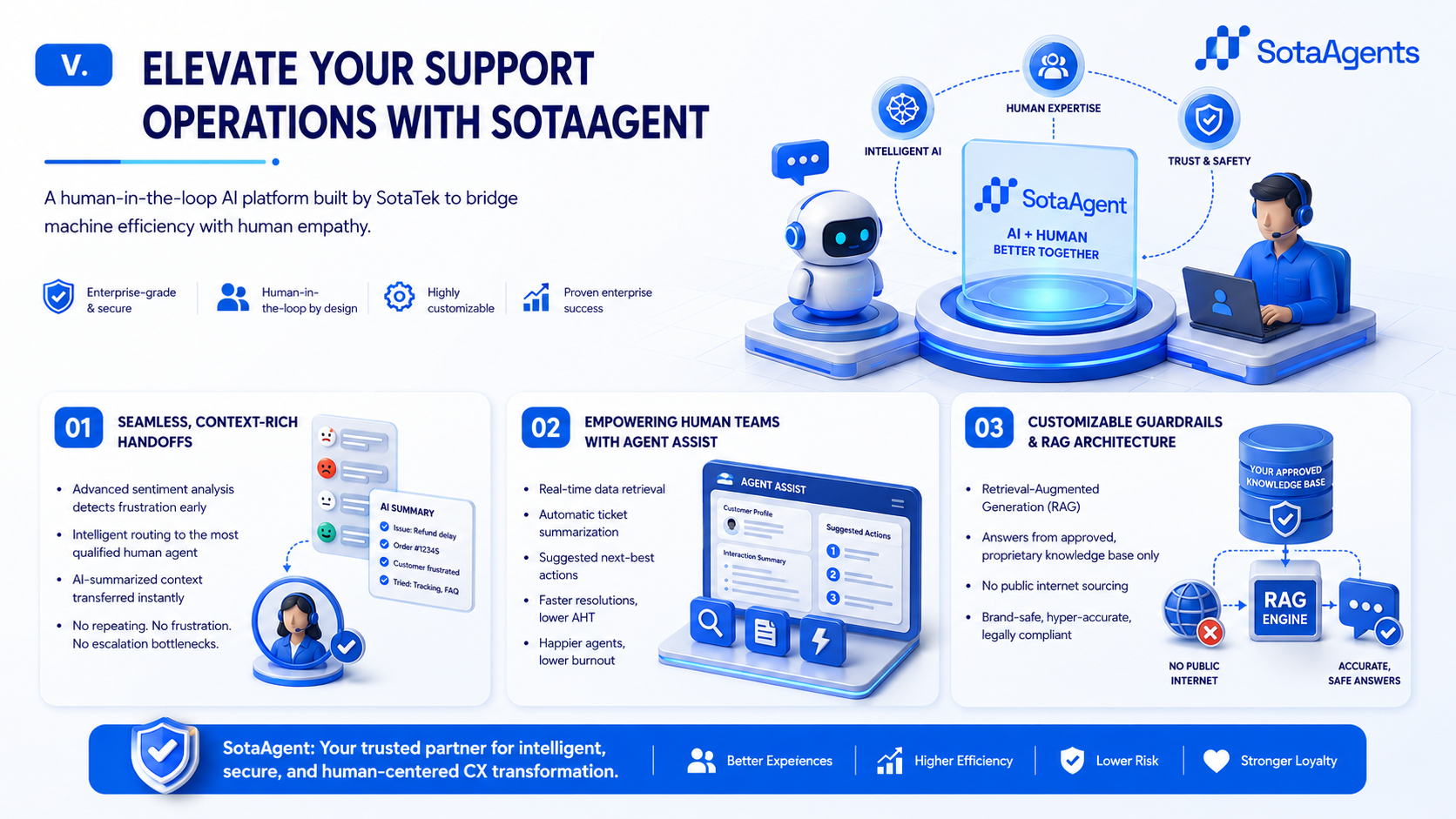
How SotaAgent Solves the Industry Challenges:
- Seamless, Context-Rich Handoffs: SotaAgent utilizes advanced sentiment analysis to detect customer frustration, confusion, or anger early in the interaction. The moment a negative sentiment threshold is breached, the system executes an intelligent routing protocol. It transfers the customer to the most qualified human agent, along with a complete, AI-summarized context of the interaction. The customer never has to repeat themselves, effectively eliminating the dreaded escalation bottleneck.
- Empowering Human Teams with Agent Assist: SotaAgent doesn't just talk to customers; it works for your employees. With built-in Agent Assist features, the platform equips your human team with real-time data retrieval, automatic ticket summarization, and suggested next-best actions. This directly drives faster resolutions, dramatically lowers Average Handling Time (AHT), and reduces agent burnout.
- Customizable Guardrails and RAG Architecture: To combat hallucinations and data privacy risks, SotaAgent is built using Retrieval-Augmented Generation (RAG) frameworks. We implement strict operational parameters, meaning the AI can only pull answers from your company's explicitly approved, proprietary knowledge base and never from the open, public internet. This ensures brand-safe, hyper-accurate, and legally compliant interactions every single time.
Conclusion
The rush to adopt artificial intelligence in customer service has led many organizations down a dangerous path. The biggest AI support automation challenges arise when short-sighted companies try to cut human beings out of the equation entirely to save a quick dollar on labor costs.
However, customer service is, at its very core, a fundamentally human-centric endeavor. Empathy, complex problem solving, and ethical judgment cannot be coded into a microchip. The future of the customer service and BPO industry is not a dystopian battle of Human vs. AI; rather, it is a collaborative powerhouse of Human + AI vs. the Competition. Organizations that recognize AI as a tool to empower their workforce rather to replace will ultimately win the war for customer loyalty.
Ready to elevate your customer experience, eliminate AI hallucinations, and empower your customer service team with intelligent, human-centric automation? Contact SotaTek today to schedule a comprehensive, personalized demo of SotaAgent and discover exactly how our engineering teams can help you future-proof your support operations.

 https://www.sotatek.com/
 (+84)2466585248




