


In 2026, blockchain technology will no longer be evaluated by experimentation or proof-of-concept success. For enterprises, the real challenge is whether blockchain can operate reliably at scale, support regulatory compliance, and integrate seamlessly into complex, multi-system environments.
This shift has positioned Hyperledger in a new role. Originally known as an open-source enterprise blockchain initiative, Hyperledger is increasingly becoming a foundational trust infrastructure, a layer that enables verifiable data integrity, auditable workflows, and cryptographic trust across organizations and partners.
As enterprises deploy AI-driven systems, expand global supply chains, and face stricter data governance requirements, traditional centralized architectures struggle with silent data manipulation, fragmented audit trails, and cross-party trust issues. Hyperledger addresses these challenges through permissioned, modular, and regulation-ready blockchain frameworks designed specifically for enterprise use.
From an enterprise delivery perspective, these challenges are no longer theoretical. Across real-world blockchain programs, the most difficult problems are rarely about blockchain technology itself, but about governance, integration, and long-term operational trust. At SotaTek, we work with enterprises across finance, retail, logistics, and digital platforms to design and deploy permissioned blockchain systems where auditability, access control, and operational reliability are non-negotiable. This hands-on experience reinforces why Hyperledger remains highly relevant in 2026 not as a trend, but as an enterprise trust layer.
What Is Hyperledger?
Hyperledger is an open-source blockchain initiative launched by the Linux Foundation in 2015. Unlike public blockchains built for cryptocurrencies, Hyperledger focuses on developing enterprise-grade, permissioned blockchain frameworks that prioritize security, privacy, and governance.
Importantly, Hyperledger is not a single blockchain. It is an umbrella project that includes multiple specialized frameworks, such as:

In 2026, Hyperledger refers to a family of permissioned blockchain frameworks designed to serve as a trust infrastructure for enterprise systems, enabling verifiable data, auditable workflows, and cryptographic governance across organizations.
How Hyperledger Differs from Public Blockchains
Key differences include:
- Permissioned access: Only authorized participants can join the network
- No native cryptocurrency: Transactions do not rely on tokens or mining
- Modular architecture: Components can be customized and replaced over time
- Enterprise governance: Built-in support for auditability and compliance
These characteristics make Hyperledger particularly suitable for regulated industries such as finance, healthcare, supply chain, government, and large enterprise IT environments
| Criteria | Hyperledger | Public Blockchains |
| Network access | Permissioned | Open / permissionless |
| Native token | No | Yes |
| Governance | Enterprise-defined | Community-based |
| Compliance readiness | High | Limited |
| Performance predictability | Deterministic | Probabilistic |
| Enterprise adoption | Core systems | Selective use cases |
Why Hyperledger Still Matters in 2026
Enterprise environments in 2026 are defined by complexity. Organizations operate across cloud platforms, legacy systems, AI services, and partner ecosystems. Trust is no longer implicit, it must be verifiable by design.
Across enterprise blockchain initiatives, a consistent pattern has emerged: organizations that treat blockchain as a standalone technology struggle to scale, while those that position it as a shared trust layer achieve more sustainable results. This perspective aligns with how Hyperledger is increasingly adopted as infrastructure that supports verification, auditability, and cross-system coordination rather than isolated applications.
Based on enterprise programs delivered by SotaTek, Hyperledger-based architectures are most effective when they are embedded into broader digital transformation strategies, including zero-trust security models, data governance frameworks, and compliance-driven system design.

Rather than competing with public blockchains, Hyperledger solves a different problem: how enterprises establish trust across systems and organizations without relying on a single central authority.
Key Features That Make Hyperledger Future-Ready

Permissioned Blockchain Architecture
Hyperledger networks restrict participation to verified entities. This enables strong identity management, fine-grained access control, and data privacy across organizational boundaries. In 2026, as zero-trust security becomes a standard enterprise model, permissioned blockchain architectures align naturally with risk management and compliance requirements.
Modular and Cryptographically Agile Design
Hyperledger’s modular architecture allows enterprises to select or replace key components such as consensus mechanisms, membership services, and cryptographic algorithms.
In practice, cryptographic agility is not a theoretical benefit. Enterprises must assume that cryptographic standards will evolve over the lifespan of their systems. In multiple enterprise blockchain implementations, the ability to upgrade cryptographic components without redesigning the entire network has proven critical in reducing long-term security and compliance risk.
At SotaTek, our blockchain architects evaluate cryptographic flexibility, consensus upgrade paths, and identity models early in solution design to ensure systems remain secure and adaptable beyond initial deployment.
Scalability and Deterministic Performance
Unlike public blockchains that rely on probabilistic mining, Hyperledger provides deterministic transaction processing. This allows enterprises to achieve higher throughput, predictable latency, and stable performance during peak workloads, requirements that are essential for mission-critical systems.
Interoperability with Enterprise Systems
In 2026, enterprises will rarely operate on a single blockchain. Hyperledger increasingly functions as an interoperability hub, connecting ERP systems, cloud platforms, partner networks, and even public blockchains. This positioning allows Hyperledger to serve as an integration layer rather than a standalone system.
Hyperledger and AI Governance in 2026
One of the most important trends in 2026 is the convergence of AI and blockchain. As enterprises deploy autonomous AI agents and decision-making systems, new risks emerge from untraceable decisions, manipulated training data, and opaque model updates.
Hyperledger addresses these risks by providing immutable audit trails for AI-related events, including training data provenance, model versioning, and high-risk automated decisions. Anchoring AI governance records on a permissioned blockchain enables enterprises to achieve verifiable accountability without exposing sensitive data.
Based on implementation experience, SotaTek sees growing demand for blockchain-supported AI governance, where Hyperledger acts as a verifiable layer for decision logs, access control, and compliance review, an emerging requirement as AI regulation accelerates globally.
Hyperledger Frameworks and Their 2026 Use Cases

Hyperledger Fabric
Hyperledger Fabric remains the most widely adopted framework in 2026. It is commonly used for supply chain tracking, financial reconciliation, and secure data sharing between organizations. Its channel-based privacy model and pluggable components make it well suited for complex enterprise workflows.
Hyperledger Indy
Hyperledger Indy enables decentralized identity and self-sovereign identity use cases, including secure onboarding, credential verification, and identity management without centralized databases. As identity theft and data breaches increase, decentralized identity becomes a strategic priority.
Hyperledger Sawtooth
Sawtooth focuses on scalability and flexibility, supporting high-volume enterprise event recording and experimentation with alternative consensus mechanisms.
Hyperledger Iroha
Iroha is optimized for simplicity and mobile environments. Typical use cases include loyalty platforms, mobile-first enterprise applications, and embedded or IoT-related scenarios.
Real-World Enterprise Use Cases Powered by Hyperledger
Supply Chain Transparency
Platforms such as IBM Food Trust, built on Hyperledger Fabric, enable end-to-end traceability across global supply chains. Enterprises benefit from faster recall management, regulatory compliance, and increased consumer trust.
Trade Finance and Settlement
Hyperledger supports automated trade workflows that reduce paperwork, reconciliation delays, and fraud risk. Smart contracts enable rule-based settlement while maintaining clear audit trails.
Digital Identity and Access Management
Using Hyperledger Indy, organizations reduce reliance on centralized identity stores, lowering breach risk and improving user privacy while supporting compliance requirements.
Travel, Loyalty, and Platform Ecosystems
In travel and hospitality, Hyperledger supports tokenized loyalty programs, secure identity verification, and high-performance transaction processing across partner ecosystems.
Challenges and Limitations of Hyperledger in 2026
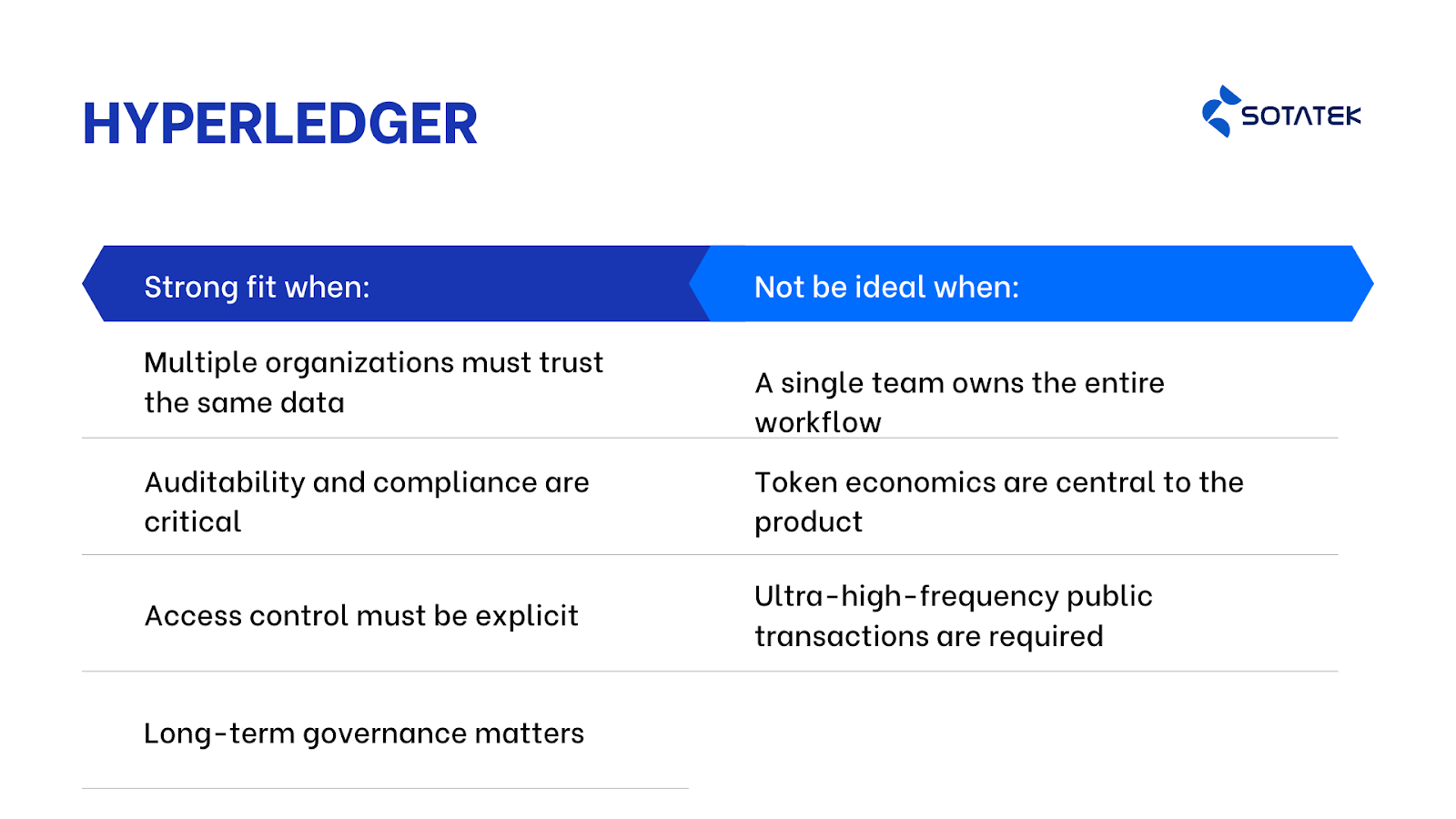
Hyperledger is a strong fit when:
- Multiple organizations must trust the same data
- Auditability and compliance are critical
- Access control must be explicit
- Long-term governance matters
Hyperledger may not be ideal when:
- A single team owns the entire workflow
- Token economics are central to the product
- Ultra-high-frequency public transactions are required
It is important to be explicit about limitations. Hyperledger does not automatically reduce complexity, nor does it eliminate the need for strong governance. Permissioned networks introduce operational responsibilities around identity management, onboarding, rule changes, and incident response.
In our delivery experience at SotaTek, successful Hyperledger programs invest early in governance models, audit processes, and operational playbooks. Without these foundations, even technically sound blockchain implementations may struggle to earn long-term stakeholder trust.
| Use Case | Business Value | Why Hyperledger Fits |
| Supply chain | Traceability, compliance | Shared ledger, audit trails |
| Trade finance | Faster settlement | Smart contracts, permissioned access |
| Digital identity | Reduced breach risk | SSI, no central database |
| Loyalty platforms | Partner coordination | Deterministic performance |
The Future of Hyperledger Beyond 2026
Looking ahead, Hyperledger is expected to play a central role in zero-trust enterprise architectures, post-quantum-ready systems, government platforms, and IoT ecosystems. Its long-term value lies in providing verifiable trust at scale as digital systems become more autonomous and interconnected.
Conclusion
In 2026, Hyperledger is no longer just an enterprise blockchain framework, it is becoming a core trust infrastructure for modern digital systems. By combining permissioned access, modular cryptography, and enterprise-grade governance, Hyperledger enables organizations to build systems that are secure, auditable, and resilient by design.
At SotaTek, we help enterprises design and deploy Hyperledger-based blockchain solutions that align technology with governance, compliance, and long-term operational goals. As organizations navigate AI governance, regulatory pressure, and cross-organization collaboration, Hyperledger provides a practical foundation for trusted digital operations, making trust measurable, verifiable, and scalable across the enterprise landscape.

 https://www.sotatek.com/
 (+84)2466585248




