


Key Takeaways
- The market has narrowed. CoinGecko's Q2 2026 data shows tokenized collectibles platforms now out-sell OpenSea, so pick a focused model before you pick a chain.78
- A marketplace has five layers. Token contracts, an exchange contract, an off-chain order book, an indexer, and metadata storage. Most delivery risk sits in the exchange contract and the order book.
- Royalties are a policy decision. ERC-2981 signals a royalty but does not enforce it, so your exchange contract has to pay it.
- Seven steps cover the build. Scope, chain, contracts, backend, front end, audit, and launch.
- Custom, fork, or white-label? Choose by how unique your trading logic is, not by price alone.
- Plan for liquidity. Audits and admin key controls protect users, but launch collections and creator onboarding decide whether anyone trades.
Introduction
NFT marketplaces are no longer one-size-fits-all. In June 2026, CoinGecko reported that OpenSea recorded $32.7 million in NFT sales, while tokenized collectibles platform Collector Crypt reached $406 million in monthly volume. On average, more than 98% of these platforms' volume came from gacha-style randomized purchases rather than secondary sales. Meanwhile, Deloitte predicts that $4 trillion of real estate could be tokenized by 2035, up from under $0.3 trillion in 2024.
Demand is moving from generic art trading toward specific assets, clear utility, and new revenue models. That changes how teams should approach NFT marketplace development. This guide covers the main marketplace models, core features, architecture, token standards and royalties, the build process, security, and the build-versus-white-label decision.
SotaTek, an AI and Blockchain Innovation Partner, supports NFT marketplace development from model selection and smart contract design to audit, launch, and ongoing maintenance.

What Is NFT Marketplace Development?
NFT marketplace development is the process of building a platform where users can mint, list, buy, sell, and auction non-fungible tokens. It combines smart contracts, a backend that tracks orders and users, and a web or mobile front end connected to crypto wallets.
A marketplace does not hold NFTs the way a store holds stock. Ownership stays on the blockchain, and the platform coordinates discovery, pricing, and settlement. That is why NFT marketplace development is part blockchain engineering and part product design.
Choosing a Model for NFT Marketplace Development in 2026

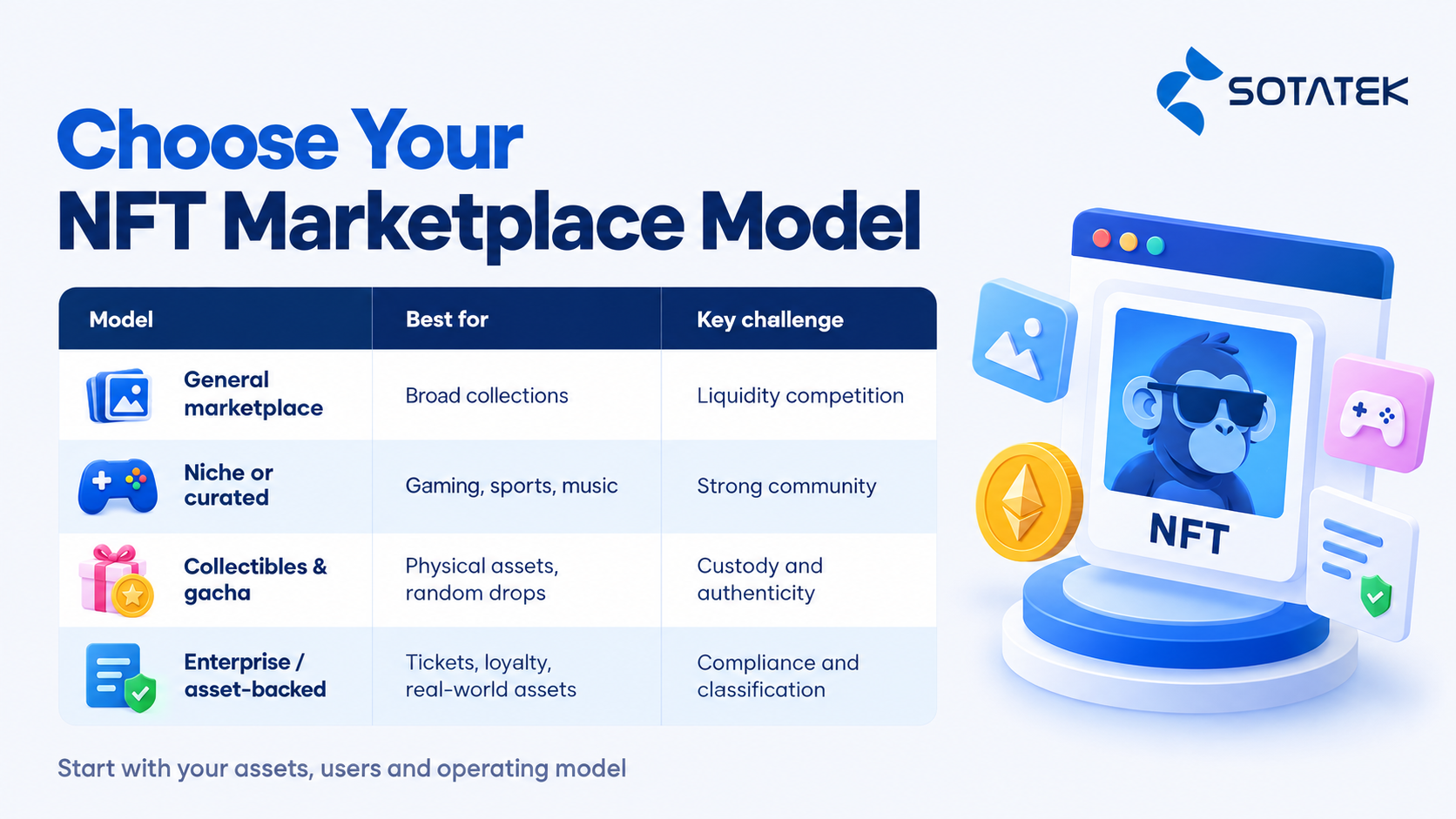
General marketplaces compete with venues that already own the liquidity. The CoinGecko figures above suggest that growth sits in focused models, so start by choosing one.
| Model | Best for | Main risk |
| General open marketplace | Broad collections and creators of any kind | Competing for liquidity with established venues |
| Niche or curated marketplace | Gaming items, sports, music, brand collections | Needs a strong community or content source |
| Tokenized collectibles and gacha platform | Physical collectibles with custody, randomized drops | Authenticity, custody, and consumer-protection rules |
| Enterprise or asset-backed marketplace | Tickets, loyalty, credentials, real-world assets | Compliance, KYC, and legal classification |
In the enterprise row, the NFT often acts as a ticket, pass, or ownership record instead of a collectible. SotaTek's NFT token development guide covers these use cases in more detail. Fractional or yield-bearing tokens can be treated as investment products in some jurisdictions, so involve legal counsel before you design them.
Three questions help you choose. Who supplies the assets? Who handles custody and payments? What brings people back after the first trade? If you cannot answer all three, the model is not ready.
Core Features in NFT Marketplace Development

Every marketplace needs a small set of features done well. Extras come later.
| Feature | What it does | Main users |
| Storefront and collection pages | Show collections, traits, and activity | Buyers |
| Search and filters | Narrow by trait, price, rarity, or chain | Buyers |
| Wallet connection | Sign-in and transaction signing via MetaMask or WalletConnect | All users |
| Minting, including lazy minting | Creates NFTs; lazy minting delays the on-chain mint until the first sale | Creators |
| Listings, auctions, and offers | Core trading logic | Buyers and sellers |
| Fee and royalty engine | Splits sale proceeds between seller, creator, and platform | Creators, operators |
| Admin dashboard | Moderation, delisting, fee settings, analytics | Operators |
| Notifications | Bids, sales, and expiring offers | All users |
Add KYC, fiat on-ramps, or cross-chain support only when your model needs them. Each one adds testing and compliance work.
NFT Marketplace Development Architecture: How the Layers Fit

Most guides say "front end, back end, smart contract." Real systems split into five layers, and each has its own trade-off.
| Layer | Job | Common choice | Trade-off |
| Token contracts | Define NFTs and ownership | ERC-721 or ERC-1155 | The standard must match the asset |
| Exchange contract | Settles trades in one transaction | Custom contract or a Seaport-style protocol | Custom logic widens audit scope |
| Order book | Stores signed listings and offers | Database plus API | Fast and gas-free, but depends on your service |
| Indexer | Turns chain events into searchable data | Custom indexer or subgraph | Sync delays and chain reorganizations |
| Metadata storage | Holds images and traits | IPFS or Arweave, referenced by tokenURI | Pinning cost and availability |
Seaport shows the pattern in practice. OpenSea built it in 2022, and its documentation calls it the most used protocol for NFT transactions. Each order lists what the seller offers and what they want in return. A typical buy flow looks like this:
- The seller signs a listing with their wallet. No gas is spent.
- The backend validates the signature and stores the order.
- The buyer connects a wallet and submits the order to the exchange contract.
- The contract moves the NFT, pays the seller, and splits fees in one transaction.
- The indexer reads the event and updates the storefront.
Lazy minting reuses the same signature idea. The creator signs a voucher, and the NFT is minted on-chain only at the first sale, so creators avoid upfront gas costs. In the indexer, plan for chain reorganizations: wait for enough confirmations before showing a sale as final, and treat the chain as the source of truth when the database disagrees.
One design choice deserves early attention. OpenSea's documentation notes that off-chain cancellation costs no gas but relies on the operator's order book. Decide up front which cancellations must also work on-chain. For a developer-level view of the minting step, see What Actually Happens When You Mint an NFT?
Token Standards and Royalties in NFT Marketplace Development

ERC-721 gives every token a unique ID, which suits one-of-one items. ERC-1155 manages many token types in a single contract, which lowers gas for large drops and game items. SotaTek's guide to NFT smart contract development covers the build and audit process for both.
Royalties need more care than most teams expect. ERC-2981 adds a royaltyInfo function that returns a receiver and an amount for a given sale price. However, OpenZeppelin's documentation states that the standard only signals royalty information and does not enforce payment. Marketplaces are expected to pay voluntarily. It also returns a single recipient, so split payouts need extra logic.
A practical rule: the token contract declares the royalty, and your exchange contract pays it on every sale made through your platform. You cannot control other venues, so tell creators that up front.
NFT Marketplace Development Process in 7 Steps

- Define the model and users. Pick one model from the table above, one primary user group, and the first collections to list.
- Choose the blockchain. Weigh fees, wallet support, liquidity, and tooling. Ethereum has the deepest tooling, while Polygon, BNB Chain, and Solana suit lower fees.
- Design tokens and contracts. Set standards, the mint flow, royalty logic, and admin roles.
- Build the backend and indexer. Create the order book API, event indexer, wallet-signature login, and metadata pipeline.
- Build the front end. Cover wallet connection, browsing, listing, checkout, and clear errors for failed transactions.
- Test and audit. Run unit tests, a testnet trial, and a third-party audit before mainnet. Test failure paths too, such as rejected signatures, expired orders, and stuck transactions.
- Launch and operate. Set up monitoring, moderation, support, and a safe upgrade path.
On timing, SotaTek's token guide notes that a full custom marketplace with wallet integration, admin tools, and an audit generally takes a few months. Its white-label NFT marketplace solution can launch in about three months, depending on customization.
Security and Compliance in NFT Marketplace Development
Marketplace contracts hold approvals over user assets, so small bugs become expensive.
| Risk | How it happens | Control |
| Broad approvals | Users grant blanket approval to a contract that later fails or is upgraded | Narrow approval scope, clear signing prompts, audit |
| Reentrancy | ERC-721 safe transfers call back into the receiving contract | Reentrancy guards, checks-effects-interactions |
| Signature replay | A signed order is reused after cancellation or on another chain | Nonces or counters, chain ID, expiry, typed signatures |
| Admin key abuse | One key can change fees or pause trading | Multisig wallet and timelock |
| Mutable metadata | Off-chain files change after purchase | IPFS or Arweave, plus a published freeze policy |
| Wash trading | Fake volume inflates rankings | Monitoring and anomaly flags |
Compliance depends on your model. Check KYC and AML duties, consumer-protection rules for randomized drops, and how regulators in your target market treat fractional tokens. Minting also does not transfer copyright by itself, so your terms should state exactly what buyers receive.
NFT Marketplace Development: Build, Fork, or White-Label?

| Option | Best when | Trade-off |
| Custom build | You have unique trading logic or strict compliance needs | Longest timeline and full audit scope |
| Fork or protocol-based | Your trading rules are standard and you want proven contracts | Inherited limits; check license terms |
| White-label | You need a fast launch with standard features | Less room for unique logic |
A quick test: if your trading rules fit a standard offer-and-consideration order, a fork or white-label base is usually enough. If you need custom settlement, such as split payouts to many parties or fractional shares, plan for a custom exchange contract.
Cost follows scope. Chain choice, contract complexity, wallet support, audits, and admin tooling are the main drivers. SotaTek's NFT marketplace development cost breakdown walks through them, and its white-label NFT marketplace guide explains when a ready-made base makes sense.
Liquidity is a business problem, not a code problem. Plan launch collections, creator onboarding, and fee incentives before you lock the feature list.
SotaTek's Approach to NFT Marketplace Development
Now that you understand how an NFT marketplace works and which features it needs, the next step is to find an NFT blockchain development company that can turn your idea into a marketplace that earns revenue.
SotaTek has supported many blockchain companies, and its experience in blockchain opens up new opportunities. We aim to give crypto-related companies a dependable solution at every stage.
With SotaTek's specialists, you get an efficient build model. We develop NFT marketplaces like OpenSea, following current trends and your own business standards. Our product development also includes marketing strategies to kickstart your marketplace, so you can compete with established players and become a new trendsetter. Whatever your business idea is, SotaTek can help turn it into a revenue-friendly reality, from the marketplace itself to the NFT tokens behind it.
Conclusion
NFT marketplace development in 2026 rewards focus. Choose a clear model, design the order flow and royalty policy early, audit every contract that moves assets, and plan liquidity from day one.
Talk to SotaTek about scoping your NFT marketplace development project, from model and chain selection to audit and launch.

 https://www.sotatek.com/
 (+84)2466585248




