


Key Takeaways
- Owning an NFT means owning the token, not the copyright to the underlying work, unless rights are explicitly transferred in writing.
- The global NFT market is projected to reach $211.7 billion by 2030, making copyright clarity a growing business priority, not just a legal footnote.
- Anyone can mint an NFT of any image, which makes unauthorized minting (copyfraud) one of the most common copyright risks in the space.
- Blockchain proves who holds a token and its transaction history; it cannot verify that the minter legitimately owns the copyright.
- Smart contracts can automate creator royalties on resales, but enforcement depends on the marketplace and does not always carry over across platforms.
- Strong NFT projects verify rights before minting, define licensing terms clearly, and build royalty logic directly into smart contracts.
Introduction
NFT development has moved well beyond digital collectibles into serious infrastructure territory, with the global NFT market projected to reach $211.7 billion by 2030, growing at a compound annual rate above 34 percent as more businesses tokenize art, collectibles, and other digital assets on the blockchain. At the center of this growth sits a question that trips up even experienced buyers and creators: what does owning an NFT actually give you?
Blockchain technology lets NFT development teams record a unique, verifiable token tied to a digital asset, creating a transparent history of who holds it and when it changed hands. But that transaction record is not the same thing as copyright. A joint 2024 report from the USPTO and U.S. Copyright Office found that widespread confusion over the scope of rights an NFT actually conveys remains one of the most persistent problems in the space, often leading buyers to assume they own intellectual property they never acquired.
That confusion opens the door to real risk: unauthorized minting of other people's artwork, disputes over who legitimately owns a copyright, and royalty mechanisms that do not always hold up once an NFT moves across marketplaces. Understanding where ownership ends and copyright begins is now a baseline requirement for any serious NFT project.
SotaTek, an AI and Blockchain Innovation Partner, works with teams across Southeast Asia to build NFT and blockchain solutions that account for these copyright realities from day one, not as an afterthought.
NFT Development and Digital Ownership
Blockchain technology lets NFT development teams record a unique, verifiable token tied to a digital asset, creating a transparent history of who holds it and when it changed hands. This transparency is part of a broader shift in how blockchain is reshaping business transformation across industries, not just NFTs specifically.
That certificate proves something specific: possession of the token. It does not automatically prove or transfer copyright in the underlying work. These are two separate layers:
- NFT ownership covers the token itself, tracked on-chain, transferable through a wallet-to-wallet transaction.
- Copyright ownership covers the legal rights to reproduce, distribute, display, and create derivative works from the original creation, governed by copyright law, not by blockchain code.
Buying an NFT of a digital painting means you own that specific token. It does not mean you can legally reprint the artwork on merchandise or license it to a third party, unless the creator explicitly transferred those rights as part of the sale.
Where blockchain genuinely helps is provenance. Every transaction, from minting to resale, is recorded permanently and can be traced back to the original wallet. That transparency supports authenticity claims and helps buyers verify an asset's history before purchase. It just cannot, on its own, confirm that the minter had the legal right to tokenize the work in the first place.
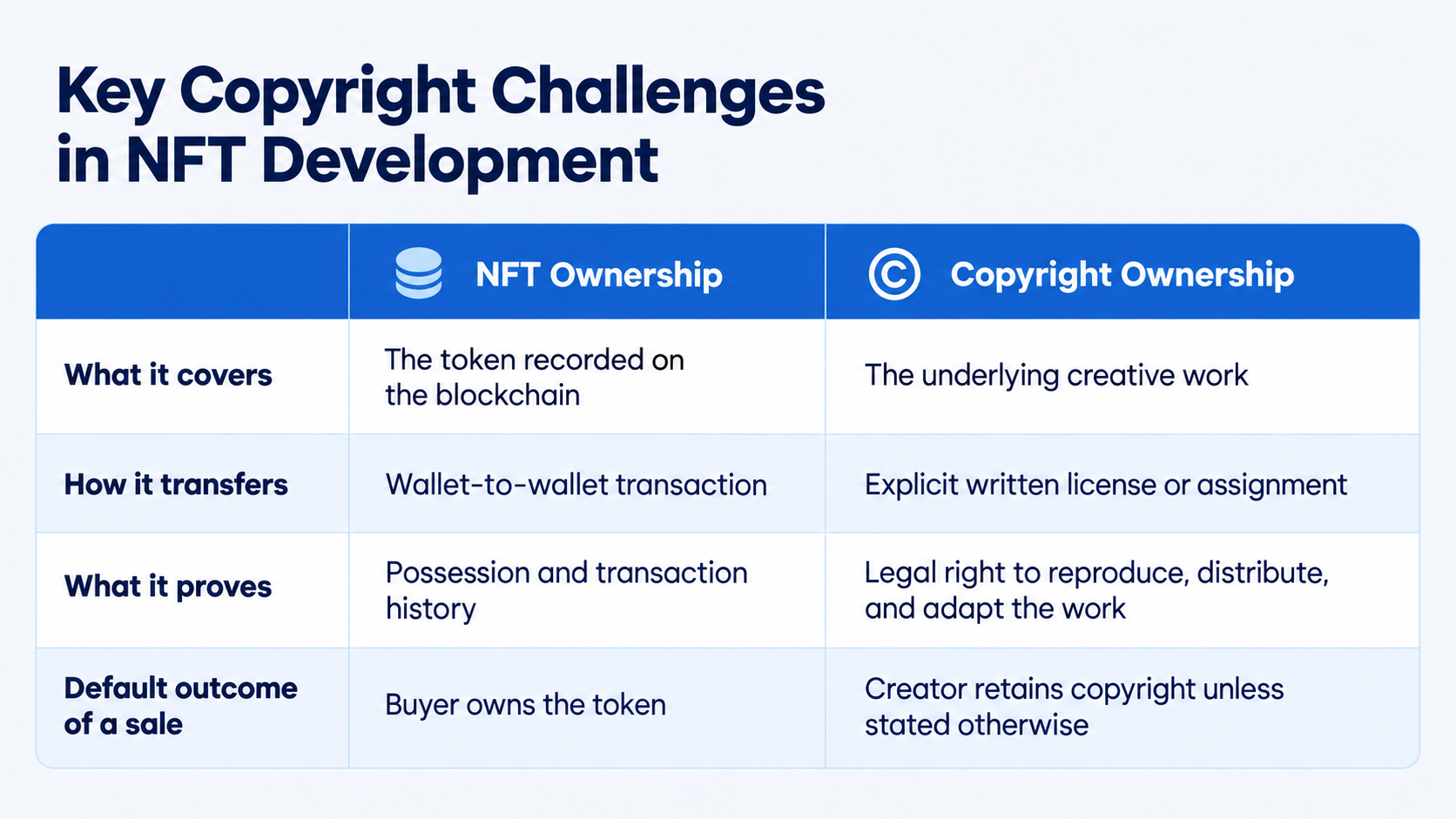
Key Copyright Challenges in NFT Development
NFT Ownership vs Copyright Ownership
This is the single most common point of confusion in NFT development, and it is worth spelling out clearly.

| NFT Ownership | Copyright Ownership | |
| What it covers | The token recorded on the blockchain | The underlying creative work |
| How it transfers | Wallet-to-wallet transaction | Explicit written license or assignment |
| What it proves | Possession and transaction history | Legal right to reproduce, distribute, and adapt the work |
| Default outcome of a sale | Buyer owns the token | Creator retains copyright unless stated otherwise |
Unless a smart contract or accompanying license explicitly grants reproduction, distribution, or derivative rights, the creator keeps the copyright even after the NFT sells. This default mirrors how physical art sales work: buying a painting does not give you the right to print posters of it.
Copyright Infringement and Unauthorized NFT Minting
Because minting an NFT requires no proof of authorship, anyone can tokenize an image, song, or video they do not own. This has led to a recurring problem often described as copyfraud, where bad actors mint and sell NFTs of artwork lifted from artists who never consented.
The blockchain records the minting transaction accurately, but it does not verify that the minter was the actual creator. That verification step happens off-chain, through licensing agreements, platform moderation, or legal claims after the fact. For NFT development teams, this makes rights verification before minting a critical, non-negotiable step rather than a nice-to-have.
NFT Royalties and Secondary Sales
One of the more genuinely useful features NFT development brings to creators is programmable royalties. Smart contracts can be coded to automatically pay a percentage of every resale back to the original creator, something traditional art markets have never been able to guarantee at scale.
In practice, though, this mechanism has limits:
- Royalty enforcement depends on the marketplace honoring the smart contract's rules; not all platforms do.
- When NFTs move across different blockchains or marketplaces, royalty terms do not always carry over automatically. This is closely tied to the broader multi-chain vs cross-chain interoperability challenge that affects any asset moving between blockchain networks.
- Royalties are a contractual convention, not a guaranteed legal right, which means enforcement can vary by jurisdiction and platform policy.
Creators and NFT development teams need to treat royalty smart contracts as one part of a broader rights strategy, not a complete substitute for clear licensing terms.
How Blockchain and Smart Contracts Can Support NFT Copyright Management
Blockchain is genuinely useful for two things in this context: recording provenance and automating rules. As explored in SotaTek's overview of how AI is transforming Web3, blockchain on its own is fundamentally a record-keeping technology, and combining it with intelligent automation is where much of the real value now comes from.
What blockchain cannot do is confirm that the person minting a token actually holds the copyright to the underlying work. It is a system of record, not a system of legal verification. Overstating what blockchain proves is one of the more common mistakes in NFT development, and it is worth being direct about the limitation rather than marketing around it.
Used correctly, blockchain and smart contracts are supporting tools for copyright management, working alongside licensing agreements and rights verification rather than replacing them.
Best Practices for NFT Development With Copyright in Mind

Teams building NFT projects with copyright protection in mind generally follow a consistent set of practices:
- Verify creator and ownership rights before minting. Confirm the minter actually holds or has been licensed the copyright to the asset.
- Define copyright and licensing terms clearly. State explicitly what the buyer receives: the token only, or specific reproduction and commercial rights.
- Design royalty rules directly into smart contracts. Automate resale payments where the marketplace supports it, and document the terms for platforms that do not.
- Maintain provenance and transaction records. Use the blockchain's transparency as a verification tool, not a legal substitute.
- Consider marketplace and cross-platform compatibility. Royalty and licensing terms should be documented in a way that survives a token moving to a different platform.
These practices are not just legal safeguards. They also build buyer trust, which matters directly to adoption and resale value in an NFT project.
Why SotaTek for NFT Development
SotaTek is an AI and Blockchain Innovation Partner with a track record of delivering full-cycle blockchain solutions across Southeast Asia and beyond. For teams building NFT projects, that expertise translates into practical support across the entire development lifecycle:

- NFT smart contract development, built with royalty and licensing logic coded in from the start, not bolted on afterward.
- NFT marketplace development, designed with rights verification workflows to reduce the risk of unauthorized minting.
- Custom NFT-based solutions, tailored to specific industries such as gaming, digital art, or loyalty programs.
- Security and scalability, backed by enterprise-grade blockchain architecture built to handle high transaction volumes.
Because copyright issues in NFT development are as much a process problem as a technical one, having a development partner that understands both sides makes a meaningful difference in reducing legal exposure down the line.
If you are planning an NFT project and want copyright considerations built into the architecture from day one, SotaTek's blockchain team can help you scope a solution that fits your rights model and target market.
Conclusion
NFT development offers real advantages: verifiable ownership records, automated royalty mechanisms, and new ways for creators to monetize digital work. But none of that replaces the need for clear copyright practices. Owning an NFT is not the same as owning the copyright to the work behind it, and blockchain, while excellent at recording transactions, cannot verify who legitimately holds the rights to a piece of content.
Teams that build copyright verification, clear licensing terms, and royalty logic into their NFT projects from the outset avoid the legal disputes and buyer confusion that have plagued the space since its earliest days. As the market matures toward that projected $211.7 billion valuation by 2030, the projects that treat copyright seriously will be the ones that last.
Planning an NFT project and want copyright protection built into the architecture from the start? Consult with SotaTek's blockchain team to scope a solution that fits your rights model, royalty structure, and target market.

 https://www.sotatek.com/
 (+84)2466585248




