


Artificial Intelligence (AI) and blockchain are two of the most disruptive technologies of our time. On their own, they are already transforming industries, but when combined, they create a synergy that promises to unlock unprecedented levels of intelligence, security, and automation. This powerful fusion is paving the way for a new generation of decentralized, data-driven applications that are smarter, more transparent, and more trustworthy than ever before. In this post, SotaTek will explore the exciting world of AI in blockchain, diving deep into its use cases, benefits, real-world applications, and future potential.
What Is AI in Blockchain?
The integration of Artificial Intelligence and blockchain represents a pivotal technological convergence, where the analytical power of AI meets the structural integrity of the blockchain. At its core, AI in blockchain involves embedding AI's analytical and decision-making capabilities into the very fabric of decentralized networks. This creates systems that are not just secure and transparent by design, but also intelligent and adaptive in their function.
Think of blockchain as an unchangeable, hyper-secure history book that records every transaction with perfect accuracy. However, the book itself cannot understand the story it contains. That’s where AI comes in.
The Role of Artificial Intelligence in Blockchain

The primary role of AI in the blockchain is to serve as an intelligent cognitive layer, capable of analyzing and interpreting the vast amounts of data stored on the chain. While blockchain excels at providing a secure and immutable ledger, it is an inherently passive technology; it records transactions without any capacity for interpretation. AI provides this missing cognitive function, enabling the system to learn from data, identify complex patterns, and automate sophisticated decisions with a degree of intelligence that blockchain alone cannot achieve. This turns the static ledger into a dynamic, learning ecosystem.
How AI and Blockchain Work Together
AI and blockchain work together in a powerful, symbiotic relationship. Blockchain offers a secure, transparent, and tamper-proof environment for data, which AI can then leverage to generate reliable insights and automate processes. For instance, a blockchain can securely and permanently record every movement of a product in a supply chain. An AI solution can then analyze this trustworthy data to forecast demand with greater accuracy, identify logistical inefficiencies, and even predict potential disruptions before they occur. This combination ensures that the data fueling the AI models is pristine and the actions triggered by AI are recorded on an immutable ledger for all participants to audit and verify.
AI vs. Blockchain: Key Differences
While they are often discussed in the same breath, AI and blockchain are fundamentally different technologies with distinct, yet complementary, purposes:
- Artificial Intelligence (AI): A broad field of computer science focused on creating machines capable of performing tasks that typically require human intelligence. This includes learning from experience, reasoning through problems, understanding language, and making complex decisions. AI is the "brains" of the operation, processing vast amounts of information to make predictions and trigger intelligent actions.
- Blockchain: A decentralized, distributed, and immutable digital ledger designed to record transactions in a secure and transparent manner. It is the "trust layer" of the operation, ensuring that data, once recorded, cannot be altered or deleted. Its core strength lies in providing unparalleled integrity and security through decentralization and cryptographic principles.
In essence, AI provides the intelligence that drives action, while blockchain provides the secure foundation that ensures those actions are based on trustworthy data and recorded with complete transparency.
Why Combine AI and Blockchain?
Combining AI and blockchain creates a powerful synergy that addresses the inherent limitations of each technology when used in isolation. This integration results in systems that are not just intelligent and secure but also transparent and autonomous, unlocking a new frontier of possibilities for businesses and entire industries.

AI Brings Intelligence to Blockchain Data
AI in blockchain enables organizations to turn large volumes of on-chain data into actionable insights. Public blockchains generate millions of transactions and data points that are difficult to analyze manually, making it challenging to identify meaningful patterns in real time.
By applying AI and machine learning to blockchain data, businesses can detect unusual transaction behavior, identify potential market manipulation, uncover emerging trends, and generate predictive insights. For example, AI can analyze transaction patterns across decentralized exchanges to identify anomalies or changing market activity.
This added intelligence transforms blockchain from a passive record of transactions into a more dynamic data layer that supports faster analysis, risk detection, and data-driven decision-making.
Blockchain Improves Data Transparency and Trust
For any AI system, the maxim "garbage in, garbage out" holds true: its output is only as reliable as its input data. Blockchain provides a transparent and immutable source of data, which is crucial for building trust in AI-driven decisions, especially in sensitive sectors like finance and healthcare. When data is stored on a blockchain, every participant can be certain it has not been tampered with. A 2020 report from Capgemini noted that poor data quality can cost organizations as much as 15% of their revenue. Blockchain mitigates this by ensuring data integrity, making AI systems more auditable, accountable, and ultimately, more reliable.
Combining Automation With Decentralization
AI in blockchain enables a more advanced level of automation by combining AI-driven decision-making with the transparency and programmability of decentralized systems. While traditional smart contracts execute predefined rules, AI can analyze external data, identify patterns, and provide additional intelligence to support more complex automated workflows.
For example, an insurance workflow could combine smart contracts with AI analysis of verified data sources, such as weather records or satellite imagery, to assess predefined conditions and trigger the appropriate next steps. This can reduce manual intervention while improving the speed and efficiency of decentralized processes.
The combination of AI, smart contracts, and automated workflows is also creating new opportunities across financial services. Learn more about how AI automation is being applied in fintech in SotaTek's guide to AI automation in fintech.
Creating More Secure and Autonomous Systems
AI in blockchain can strengthen security and enable more autonomous monitoring across decentralized systems. By analyzing transaction patterns and network activity in real time, AI can help identify anomalies, detect potential threats, and trigger predefined responses when suspicious behavior is detected.
For example, an AI system could flag unusual transaction activity, alert security teams, or initiate predefined smart contract actions based on approved risk conditions. This reduces the time required to detect and respond to potential threats while maintaining transparent and auditable processes.
By combining AI-driven threat detection with blockchain's decentralized infrastructure, organizations can build systems that are more resilient, responsive, and capable of operating with reduced manual intervention.
10 AI in Blockchain Use Cases
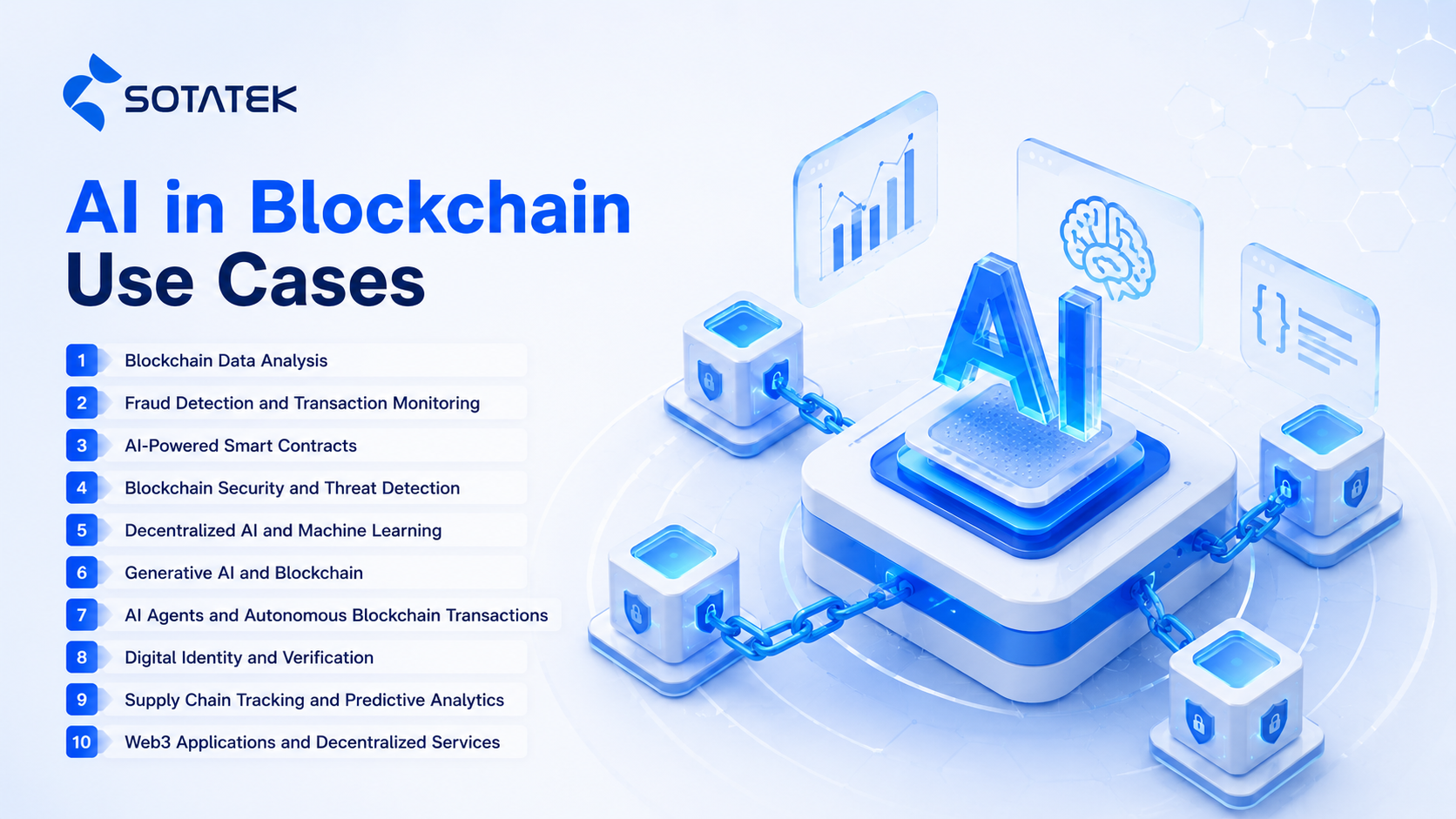
The combination of AI and blockchain is already unlocking a wide array of innovative use cases across various industries. Here are ten of the most promising applications today.
1. Blockchain Data Analysis
AI algorithms are being used to analyze the vast datasets on blockchain networks to extract actionable insights. This includes everything from tracking cryptocurrency market trends and predicting price movements to understanding user behavior on decentralized applications.
2. Fraud Detection and Transaction Monitoring
One of the most powerful use cases for AI in blockchain is fraud detection. AI systems can monitor blockchain transactions in real time, identifying and flagging suspicious activities that may indicate fraud, money laundering, or other illicit behaviors. According to a report from Coindesk, AI-enhanced systems can improve financial threat detection accuracy by significant margins.
3. AI-Powered Smart Contracts
AI is transforming smart contracts from static, rule-based agreements into dynamic, "intelligent" contracts. These contracts can analyze real-time data from various sources (known as oracles) and execute decisions based on that information, making them far more flexible and powerful.
4. Blockchain Security and Threat Detection
AI in blockchain can strengthen security by analyzing network activity and transaction patterns to identify anomalies and potential threats in real time. AI models can support the detection of suspicious behavior, including unusual transaction activity, phishing-related patterns, or potential vulnerabilities associated with smart contract interactions.
When integrated with existing security workflows, AI can trigger predefined alerts or automated responses based on established risk rules. This helps security teams detect and investigate threats faster while reducing the amount of manual monitoring required across complex blockchain networks.
5. Decentralized AI and Machine Learning
AI in blockchain is also enabling decentralized approaches to AI and machine learning, where data, computing resources, or model operations can be distributed across multiple participants rather than controlled by a single centralized system. This creates new opportunities to improve transparency, reduce reliance on centralized infrastructure, and give participants greater control over how data is used.
In some decentralized AI architectures, privacy-preserving techniques can allow organizations or users to contribute to model development without directly exposing sensitive data. Combined with blockchain's ability to provide transparent and auditable records, this approach can support more collaborative AI ecosystems while strengthening trust in how models and data are managed.
6. Generative AI and Blockchain
AI in blockchain is also creating new opportunities for generative AI applications. Generative models can create digital content and assets, while blockchain can provide a transparent and verifiable record of their ownership, origin, and transaction history.
For example, blockchain can help establish provenance for AI-generated content and support the creation and management of unique digital assets, including NFTs. This combination can make it easier to verify authenticity, track ownership, and build greater trust around how AI-generated assets are created and exchanged.
7. AI Agents and Autonomous Blockchain Transactions
AI agents are autonomous software programs that can execute tasks and transactions on the blockchain without human intervention. These agents can manage cryptocurrency portfolios, execute trades based on market signals, and even participate in decentralized governance by voting on proposals. The AI agent economy is projected to manage billions in on-chain assets by 2027.
8. Digital Identity and Verification
AI and blockchain are being used to create more secure and user-centric digital identity solutions. Blockchain provides a decentralized and tamper-proof way to store identity credentials, while AI can be used for biometric verification, such as facial recognition or liveness detection, to ensure that only the rightful owner can access their digital identity.
9. Supply Chain Tracking and Predictive Analytics
In supply chain management, blockchain provides a transparent and immutable record of every transaction and movement of goods. AI can then analyze this data to provide predictive analytics, such as forecasting demand, identifying potential disruptions, and optimizing logistics in real time.
10. Web3 Applications and Decentralized Services
AI in blockchain is helping make Web3 applications and decentralized services more intelligent, adaptive, and easier to use. By combining AI-driven analysis and automation with blockchain-based infrastructure, developers can build decentralized applications that respond more effectively to user behavior and changing conditions.
For example, AI can support personalized experiences in DeFi platforms, automate content moderation in decentralized social networks, and help optimize interactions across dApps. Combined with blockchain's transparency and decentralized architecture, AI can enable Web3 services that are more responsive, automated, and scalable
Real-World Applications of AI and Blockchain Across Industries

The convergence of AI and blockchain is already delivering tangible value across a diverse range of industries.
Finance and BFSI
In the BFSI sector, AI and blockchain are being used to enhance security, reduce fraud, and streamline processes. Banks are leveraging AI to analyze blockchain transactions in real time to detect and prevent money laundering. For example, PayPal was able to improve its real-time fraud detection by 10% by implementing AI systems. In decentralized finance (DeFi), AI-powered trading bots are executing complex strategies across multiple platforms, optimizing returns for investors while managing risk.
Read more: AI in BFSI Industry: Applications and Business Impact
Supply Chain and Logistics
Companies are using blockchain to create a transparent, immutable record of their supply chains, and AI to analyze that data for actionable insights. This combination helps to ensure product authenticity, prevent counterfeiting, and optimize logistics. For instance, Walmart has famously used blockchain to track produce from farm to store, reducing food-sourcing lookup times from 7 days to just 2.2 seconds. Adding AI to this data can predict spoilage and optimize delivery routes, which is critical in a world where supply chain disruptions can cost companies millions.
Healthcare
AI in blockchain can support more secure, transparent, and efficient healthcare data workflows. Blockchain can provide an auditable infrastructure for managing and sharing medical records with appropriate patient consent, while AI can analyze authorized data to identify patterns, support clinical research, and assist healthcare professionals in decision-making.
Together, AI and blockchain can also support applications such as clinical trial data management, disease pattern analysis, and more personalized treatment approaches. By combining AI-driven insights with transparent and traceable data management, healthcare organizations can improve how sensitive medical information is accessed, analyzed, and shared.
Read more: AI in Healthcare: Use Cases, Benefits & Solutions Explained
Retail and E-commerce
Retailers are using AI and blockchain to create more personalized and secure shopping experiences. For example, a luxury brand could use blockchain to verify the authenticity of its goods via an NFT, and AI could then provide personalized recommendations to customers based on their purchase history and browsing behavior. This enhances trust and improves customer engagement.
Read more: AI in Retail: Use Cases, Benefits, and Solutions for Modern Businesses
Web3 and Digital Assets
In the world of Web3 and digital assets, AI is playing a central role. From creating unique, AI-generated art for NFTs to powering intelligent decentralized applications, AI is driving innovation and creating new opportunities for creators and users alike. The formation of decentralized AI alliances highlights the growing importance of this trend.
Benefits of Using AI in Blockchain

The benefits of AI in blockchain include improved data analysis, stronger security, greater process automation, and more intelligent decentralized applications. By combining AI's analytical capabilities with blockchain's transparency and traceability, organizations can create systems that are more efficient, responsive, and easier to audit.
- Improved Data Analysis and Decision-Making: AI's ability to analyze vast amounts of on-chain data provides businesses with deeper insights and enables more informed decision-making. This data-driven approach allows companies to identify trends, predict outcomes, and optimize their strategies with a level of accuracy that was previously unattainable.
- Enhanced Security and Fraud Detection: By monitoring blockchain networks in real time, AI can detect and mitigate security threats and fraudulent activities with remarkable speed and precision. This enhanced security is critical for building trust in decentralized systems, especially in high-stakes environments like finance and supply chain management. AI-powered systems have been shown to improve threat detection accuracy by up to 60%.
- Greater Process Automation: AI-powered smart contracts can automate complex processes and adapt to real-world events, reducing manual intervention and minimizing the risk of human error, which is a major challenge when implementing AI.
- More Transparent AI Systems: By recording the data and logic used by an AI on a blockchain, we can create a transparent and auditable trail of its decision-making process, helping to solve the "black box" problem of AI.
- Scalable and Intelligent Decentralized Applications: AI is helping to make dApps more scalable, user-friendly, and intelligent, driving broader adoption of blockchain technology by creating more compelling and personalized user experiences.
Challenges of AI and Blockchain Integration
The challenges of AI in blockchain extend beyond technical implementation. Combining AI models with decentralized infrastructure can create issues around data quality, scalability, privacy, model transparency, integration complexity, and regulatory governance. Addressing these challenges early is essential for building AI and blockchain solutions that are secure, scalable, and reliable.
- Data Quality and Data Availability: AI models are only as good as their data. Ensuring data quality in a decentralized environment can be difficult. If flawed data is immutably recorded on a blockchain, it can lead to flawed AI-driven decisions.
- Scalability and Performance: Blockchain networks can be slow and have low transaction throughput compared to centralized systems. The computational demands of running complex AI algorithms on-chain can exacerbate this issue, making real-time applications challenging.
- Privacy and Security Concerns: Storing data on a public blockchain, even if encrypted, raises privacy concerns. Furthermore, AI models themselves can be vulnerable to adversarial attacks, where malicious actors manipulate input data to trick the AI.
- AI Model Transparency: While blockchain can improve transparency, the inner workings of complex deep learning models can still be opaque, making it difficult to fully audit and trust their decisions.
- Integration Complexity: Integrating AI and blockchain is a complex technical undertaking that requires niche expertise in both fields. There is a global shortage of developers with the skills needed to build and maintain these integrated systems.
- Regulatory and Governance Challenges: The regulatory landscape for both AI and blockchain is still evolving. This lack of legal clarity can create uncertainty for businesses and stifle innovation.
How Businesses Can Start Integrating AI With Blockchain

For businesses looking to explore the potential of AI and blockchain, a strategic and phased approach is essential for successful enterprise AI implementation.
1. Identify the Right Business Problem: Start by identifying a specific, high-value business problem that could be uniquely solved by the combination of AI and blockchain. Focus on areas where trust, transparency, and intelligent automation are critical.
2. Determine Whether Blockchain Adds Real Value: Not every problem needs a blockchain. Carefully assess whether features like decentralization, immutability, and transparency are essential. Sometimes, a traditional database with an AI layer is sufficient and more cost-effective.
3. Assess Data and Infrastructure Readiness: Evaluate your existing data governance and IT infrastructure. Use an AI readiness checklist to assess your data quality, availability, and your team's technical capabilities.
4. Start With a Focused Proof of Concept (PoC): Instead of a large-scale implementation, begin with a small, focused PoC. This allows you to test the technology, validate your business case, and understand the AI development cost and ROI without a significant upfront investment.
5. Plan for Security, Governance, and Scalability: From the very beginning, it is crucial to plan for the security, governance, and scalability of your system. Develop a robust security strategy, establish a clear governance framework, and design an architecture that can scale to meet future demand.
The Future of AI and Blockchain
The future of AI and blockchain is poised to be transformative, with several key trends shaping the evolution of these technologies.
The Rise of Decentralized AI
We are moving towards a future where AI models are developed and operated in a decentralized manner. This will foster a more open, collaborative, and transparent AI ecosystem, where individuals have greater control over their data and the AI systems they interact with.
AI Agents and Autonomous Transactions
AI agents will become increasingly prevalent, acting as autonomous economic actors on the blockchain. These agents will manage assets, execute complex trades, and perform a wide range of tasks without human intervention, creating a new machine-to-machine (M2M) economy.
Blockchain for AI Data and Model Provenance
Blockchain will become the gold standard for ensuring the integrity and provenance of AI models. By creating an immutable record of a model's training data, version history, and performance, blockchain will enhance trust and accountability in AI systems, providing crucial AI support.
From Smart Contracts to Intelligent Contracts
The evolution from smart contracts to "intelligent contracts" will continue to accelerate. AI will enable contracts that are more adaptive, autonomous, and capable of handling complex, real-world scenarios, unlocking a new wave of innovation across industries.
Conclusion
The convergence of AI and blockchain is more than just a technological trend; it is a paradigm shift that is reshaping industries and creating new possibilities for a more intelligent, secure, and decentralized world. While there are still significant challenges to overcome, the potential benefits in efficiency, transparency, and security are immense. By understanding the unique strengths of each technology and taking a strategic approach to integration, businesses can unlock new opportunities and gain a significant competitive advantage. For those considering this journey, working with expert AI companies in Vietnam can provide the necessary expertise to navigate the complexities and ensure success.
Ready to unlock the transformative power of AI and blockchain for your business? Contact SotaTek today to schedule a consultation with our experts and discover how we can help you build the intelligent, decentralized solutions of the

 https://www.sotatek.com/
 (+84)2466585248




