Customer support is one of the most attractive entry points for enterprise AI. The work is high-volume, data-rich, measurable, and closely tied to customer satisfaction.
It also looks easier to automate than it really is.
A company can launch a chatbot in a matter of weeks. Scaling that chatbot into a reliable AI support operation is a different challenge. At scale, the system must understand customer intent, retrieve accurate information, access business systems, follow company policies, protect personal data, escalate difficult cases, and support human agents without creating more work.
The model is only one part of that system.
This distinction is especially important in the Philippines. The country has one of the world’s largest IT and business process management industries. In 2024, the sector was projected to employ approximately 1.82 million people and generate about $38 billion in revenue. Industry leaders are also pushing the sector toward higher-value services, including data analytics, cybersecurity, IT support, and AI-enabled operations.
For Philippine companies, AI should not be framed simply as a way to reduce support headcount. The more strategic opportunity is to increase service capacity, improve consistency, shorten resolution time, and enable employees to handle more valuable customer interactions.
At SotaTek, our view is straightforward: successful AI support operations are built around service workflows, not around chat interfaces.
What Is an AI Support Operation?

An AI support operation is a customer service model in which artificial intelligence assists with or executes defined parts of the support workflow.
This may include:
- Identifying customer intent
- Searching approved company knowledge
- Drafting or sending responses
- Classifying and routing tickets
- Summarizing conversations
- Retrieving account or order information
- Recommending solutions
- Updating support systems
- Requesting approval
- Escalating complex cases
- Monitoring service quality
A chatbot usually focuses on conversation. An AI support operation covers the entire path from a customer’s first message to the final resolution of the issue.
That path may involve a website, a mobile application, a messaging channel, an email inbox, a contact center, a customer relationship management platform, a billing system, a logistics platform, and a human support team.
The objective is not to make an AI sound intelligent. The objective is to help customers reach the correct outcome with less effort.
Why the Philippines Is a Critical Market for AI Support Operations
The Philippines combines a large service workforce with rapidly expanding digital customer behavior.
Internet penetration was estimated at approximately 73.6 percent in early 2024, with mobile devices playing a central role in Filipinos' access to online services. This creates growing demand for immediate support across digital commerce, banking, telecommunications, travel, healthcare, education, logistics, and government services.
Customers may begin an interaction on a mobile website, continue through a messaging channel, and later contact a human agent. They expect the company to remember the issue throughout that journey.
This creates several operating requirements.
First, support must be available beyond traditional office hours. Second, responses must work well on mobile devices and unstable connections. Third, the system must handle English, Filipino, Taglish, abbreviations, and informal expressions. Fourth, it must know when a customer requires empathy, negotiation, or human judgment.
The Philippines also has a highly experienced customer service workforce. That is an advantage, not an obstacle. Philippine enterprises can combine AI speed with human communication skills to build support models that are more capable than either full automation or fully manual service.
The strategic question is therefore not, “How many agents can AI replace?”
A better question is, “How can AI help every support employee resolve more cases accurately while improving the customer experience?”
Lesson 1: Scaling Begins With the Support Workflow, Not the Model

One of the first lessons from AI support projects is that a strong demonstration does not prove that a system is ready for production.
During a demonstration, the AI receives a clear question, a well-prepared document, and a predictable path to the answer.
Real customer support is rarely so clean.
Customers provide incomplete information. They describe several problems at once. They use old product names. They misunderstand policies. They may be angry, anxious, or in a hurry. A case can involve payments, shipping, account access, promotions, refunds, and technical issues simultaneously.
Before selecting an AI model, map the full support workflow:
- Where does the customer contact the company?
- How is the customer identified?
- What information is required?
- Which systems contain that information?
- Which rules determine the response?
- What can the AI do automatically?
- What requires employee approval?
- What triggers escalation?
- How is the case closed?
- How is the result measured?
The same operational principle applies outside customer support. SotaTek’s guide to manufacturing workflow automation shows why technology must be integrated into the entire process rather than a single isolated task.
An AI support project should begin with a service blueprint, not a model comparison spreadsheet.
Lesson 2: Automate Customer Intents, Not Entire Relationships

A common mistake is trying to automate all support conversations from the beginning.
This creates an unnecessarily large project scope and exposes the system to too many exceptions.
A better strategy is to identify high-volume customer intents with clear rules and measurable outcomes. Examples include:
- Order status
- Appointment confirmation
- Password reset guidance
- Basic product questions
- Store or branch information
- Account document requirements
- Billing explanation
- Delivery rescheduling
- Ticket status
- Standard troubleshooting
These cases are good starting points because the expected response and resolution path can be defined.
Complex complaints, fraud reports, unusual refund requests, vulnerable customers, and cases with legal or financial consequences should usually be handled by stronger human oversight.
The goal is not maximum automation. It is appropriate automation.
A successful system may automate 40 percent of cases and assist employees with another 40 percent. The remaining cases may require full human handling. That can produce more value than a system that claims to automate 90 percent but frequently frustrates customers or requires expensive corrections.
SotaTek has explored this gap between basic chat automation and reliable service delivery in its analysis of the AI support automation challenge.
Lesson 3: The Knowledge Base Is More Important Than the Chat Interface

When support AI provides an incorrect answer, teams often blame the model.
The real problem is frequently the knowledge environment.
Company information may be scattered across:
- Policy documents
- Training materials
- Shared drives
- Product manuals
- Internal emails
- Spreadsheets
- Old website pages
- Individual agent notes
- Unwritten team practices
Different departments may also maintain conflicting versions of the same policy.
An AI system cannot consistently answer questions when the company itself has not established a reliable source of truth.
Before scaling AI support, organizations should create a knowledge management process that defines:
- Which sources are approved
- Who owns each source
- How updates are reviewed
- When old content is removed
- Which policies apply to each product or location
- How the system cites or identifies its source
- How employees report missing or incorrect information
Knowledge should also be organized around real customer questions, not only around internal document structures.
A customer does not ask, “What does policy document CX-04, section 3.2 say?”
The customer asks, “Why was I charged twice?”
The AI must connect that question to the correct billing policy, account information, transaction status, and next action.
Lesson 4: Human Handoffs Must Be Designed Before Launch

Many AI support systems perform well until they encounter a question they cannot answer.
Then they fail in one of two ways. They continue responding with increasing confidence, or they tell the customer to contact support without transferring any useful context.
A good escalation should feel like a continuation of the same conversation.
When transferring a case, the AI should provide the human agent with:
- Customer identity, when appropriately verified
- Contact reason
- Conversation summary
- Relevant account or order data
- Actions already attempted
- Knowledge sources consulted
- Reason for escalation
- Customer sentiment or urgency
- Recommended next action
The customer should not have to repeat everything.
Escalations should also be triggered by defined conditions, such as:
- Low confidence
- Repeated customer dissatisfaction
- Identity verification failure
- Sensitive personal information
- Refunds above a defined amount
- Possible fraud
- Threats or safety concerns
- Legal complaints
- Service outages
- Exceptions not covered by policy
Human-in-the-loop design is not evidence that the AI has failed. It is evidence that the company understands operational risk.
Lesson 5: Filipino Language Use Requires More Than Translation

Support in the Philippines is often multilingual even within a single sentence.
A customer may write primarily in English but insert Filipino expressions. Another may use Taglish, abbreviations, spelling variations, or words that have different meanings depending on context and tone.
Literal translation is not enough.
The system should be tested on actual customer language from the target business, including:
- English
- Filipino
- Taglish
- Industry-specific expressions
- Common misspellings
- Regional terms
- Informal mobile messages
- Code-switching
- Polite and confrontational language
- Indirect requests
Tone also matters.
A response can be factually correct but still feel cold, dismissive, or overly formal. In our experience, Philippine customers often respond better when support communication is respectful, clear, warm, and direct without sounding scripted.
This does not mean the AI should pretend to be human. Companies should be transparent about AI use while maintaining a service tone that fits the brand.
Testing should include Philippine support employees who understand local language and customer expectations. Generic global evaluation datasets will not reveal all local failures.
Lesson 6: AI Must Connect to Business Systems

A support AI that can only answer questions from documents has limited operational value.
Customers often need the company to take action:
- Check an order
- Change an address
- Reschedule a delivery
- Create a ticket
- Update contact information
- Verify a payment
- Cancel a booking
- Request a refund
- Send a document
- Escalate a technical issue
To complete these tasks, AI must interact securely with enterprise systems.
This is where AI agents become more useful than standalone chatbots. An agent can interpret a request, retrieve information, call approved tools, apply business rules, request confirmation, and record the outcome.
However, every tool connection introduces operational and security questions.
What records can the agent read? What fields can it update? Which transactions require approval? Can the action be reversed? What should happen when a system is unavailable? How will the company audit what the agent did?
SotaTek’s guide to AI agent platforms explains the orchestration, integration, memory, governance, and monitoring capabilities required for enterprise-grade agents.
Lesson 7: Measure Resolution, Not Just Deflection

Many AI support projects are evaluated primarily by containment or deflection rate.
These metrics show how many interactions were handled without reaching a human agent. They do not show whether the customer’s problem was solved.
A chatbot can achieve a high deflection rate by making it difficult to contact a person. That may reduce contact center volume while increasing customer frustration, repeat contacts, complaints, and churn.
A more useful measurement framework includes:
Resolution rate: Was the customer’s problem actually resolved?
First-contact resolution: Did the customer need to contact the company again?
Average resolution time: How long did the complete case take?
Escalation accuracy: Did the AI escalate the right cases?
Human review rate: How often did an employee need to correct the output?
Customer satisfaction: How did customers rate the completed interaction?
Cost per resolved case: What was the total cost, including AI usage and human work?
Repeat-contact rate: Did the customer return with the same issue?
Policy compliance: Did the response and action follow approved rules?
A large 2026 field experiment in e-commerce support found that generative AI assistance improved service speed and customer-rated quality, but the effects varied between employee groups. Top-performing agents could experience quality declines when the technology encouraged excessive multitasking. This reinforces an important lesson: AI changes employee behavior, so operational design and measurement must extend beyond model performance.
Lesson 8: Reliability Matters More as Volume Grows

An AI support operation may work well at 500 conversations per month and behave very differently at 500,000.
Scaling introduces issues such as:
- Higher model usage costs
- API rate limits
- Longer response times
- Integration failures
- Duplicate actions
- Inconsistent memory
- Monitoring overload
- Peak-period capacity
- Knowledge synchronization
- Vendor outages
Philippine businesses may experience strong volume spikes during holidays, promotions, weather disruptions, major service outages, and payment deadlines.
The AI architecture should therefore include:
- Fallback models or responses
- Queue management
- Retry logic
- Tool-call validation
- Transaction safeguards
- Duplicate-action prevention
- Response caching where appropriate
- Usage limits
- Cost alerts
- Human takeover procedures
Cost planning must include more than the initial software build. It should cover model consumption, infrastructure, integration maintenance, monitoring, quality review, knowledge management, security, and continuous improvement.
SotaTek’s overview of AI development cost provides a useful starting point for budgeting beyond the proof-of-concept stage.
Lesson 9: AI Changes the Support Workforce Rather Than Removing the Need for It
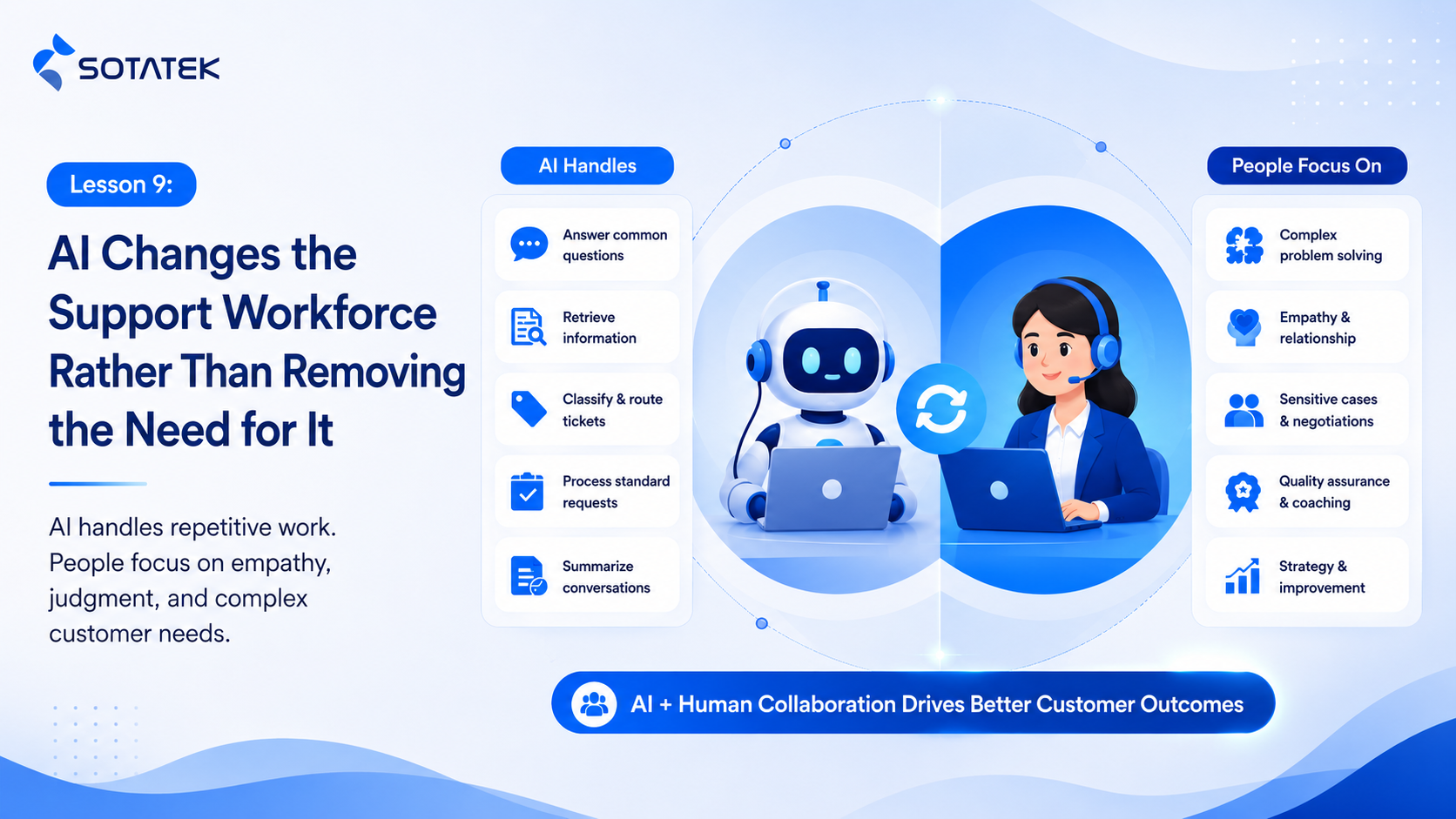
The strongest AI support model is often a hybrid operation.
AI handles repetitive information retrieval, summaries, classification, standard transactions, and routine communication. Employees focus on exceptions, emotional situations, negotiations, high-value customers, and decisions requiring judgment.
This changes the skills required from support teams.
Agents may become responsible for:
- Reviewing AI recommendations
- Correcting knowledge gaps
- Handling escalations
- Identifying emerging customer issues
- Testing new workflows
- Monitoring conversation quality
- Improving policies and response templates
- Coaching AI-enabled teams
The Philippines is well-positioned for this transition because of its established support expertise. The opportunity is to move from high-volume manual execution toward AI-enabled service management and higher-value customer experience roles.
This aligns with the wider direction of the Philippine IT-BPM industry, which is seeking growth through AI, analytics, technical support, and more complex services rather than relying only on traditional voice operations.
Companies should introduce AI as a capability that helps employees succeed, not as a hidden headcount program. Employees who understand the system's purpose are more likely to report errors, improve workflows, and support adoption.
Lesson 10: Privacy and Governance Cannot Be Added Later

Customer support conversations may contain names, phone numbers, addresses, transaction details, identification documents, health information, account histories, and complaints.
The Philippines’ Data Privacy Act of 2012 established requirements for the protection of personal data and created the National Privacy Commission to administer and enforce the country’s privacy framework.
AI support systems should therefore follow principles such as:
- Data minimization
- Purpose limitation
- Role-based access
- Secure data transmission
- Retention controls
- Audit logging
- Customer authentication
- Sensitive-data masking
- Vendor risk assessment
- Incident response
- Human review for high-risk actions
Companies should know whether customer data is being sent to an external model provider, stored for model training, retained in logs, or transferred across jurisdictions.
AI responses should also be governed.
The organization must define what the AI may promise, recommend, approve, disclose, or change. These controls should be enforced through system permissions and workflow rules, not only through written instructions inside a prompt.
SotaAgents in Practice: From Answering Questions to Completing Support Work

SotaAgents is designed to help businesses move beyond a basic question-and-answer chatbot.
A SotaAgents implementation can connect several operational layers:
- Customer channels: Web, application, messaging, or internal service portal
- Company knowledge: Policies, product information, procedures, and historical cases
- Business systems: CRM, ticketing, order management, billing, logistics, or internal tools
- Workflow rules: Approvals, limits, routing, and escalation logic
- Human teams: Agents, supervisors, subject-matter experts, and administrators
- Monitoring: Quality, cost, latency, errors, and business outcomes
The central lesson from the SotaAgents case study on SotaTek’s website is that support value does not come from generating text alone. It comes from coordinating knowledge, actions, systems, and employees within a single controlled workflow.
For example, consider an e-commerce support request:
“I paid for my order, but the app says payment failed.”
A basic chatbot may send a generic payment troubleshooting article.
A properly integrated SotaAgents workflow can:
- Authenticate the customer
- Retrieve the order
- Check payment status
- Compare payment and order records
- Identify whether the transaction is pending, completed, duplicated, or rejected
- Explain the situation in clear language
- Create a support ticket when records conflict
- Escalate a possible duplicate charge
- Send the human agent a complete case summary
- Record the interaction for audit and improvement
The difference is operational execution.
This is also why custom AI development services matter. Every business has different systems, policies, approval rules, customer journeys, and risk requirements. The support operation must be designed around those realities.
A Practical Roadmap for Philippine Enterprises
Phase 1: Assess readiness
Identify the target workflow, available data, system integrations, language requirements, risks, and measurable business objective.
SotaTek’s AI readiness checklist can help teams evaluate whether the organization is prepared for a production pilot.
Phase 2: Prioritize customer intents
Select a limited group of high-volume, rule-based cases. Document the expected answer, required data, permitted actions, and escalation conditions.
Phase 3: Build the knowledge foundation
Create approved sources, assign content owners, remove outdated information, and develop representative customer questions.
Phase 4: Design the human-AI workflow
Define automation levels, approvals, human handoffs, fallback behavior, and accountability.
Phase 5: Integrate key systems
Connect only the tools required for the pilot. Use controlled permissions and validate every action.
Phase 6: Test with real Philippine conversations
Include English, Filipino, Taglish, informal messages, incomplete information, emotional customers, and unusual cases.
Phase 7: Run a production pilot
Measure resolution, customer satisfaction, repeat contact, escalation accuracy, cost, and employee adoption.
Phase 8: Scale gradually
Expand intents, channels, integrations, and automation authority only after proving quality and control.
This phased approach supports broader digital transformation with AI without forcing the company into a risky, all-at-once deployment.
Choosing an AI Support Development Partner
The right implementation partner should offer more than access to an AI model.
Look for capabilities in:
- Workflow analysis
- AI agent architecture
- Data engineering
- Knowledge retrieval
- Enterprise integration
- Application development
- Cloud infrastructure
- Security
- Evaluation
- Monitoring
- Post-launch optimization
The partner should ask about your support operation before recommending a technology.
Which cases are most expensive? Where do customers repeat themselves? Which systems do agents use? Which policies create confusion? What actions carry financial or legal risk? What does successful resolution mean?
A technology partner should also be able to clearly explain limitations. No responsible provider should promise perfect accuracy, unlimited automation, or immediate replacement of the existing service operation.
Philippine enterprises evaluating regional partners can review SotaTek’s comparison of top AI outsourcing companies in Vietnam to understand common delivery models, technical capabilities, and evaluation criteria.
Although support automation is the focus here, companies may eventually connect the same AI operating foundation to other areas. The principles of detection, confidence, escalation, and human action also appear in applications such as vision AI in manufacturing.
Conclusion: Scale the Operation, Not Just the Chatbot
The most important lesson from scaling AI support operations is that customer service cannot be reduced to answer generation.
A production system must understand language, retrieve trusted knowledge, connect to business tools, follow policies, protect data, recognize uncertainty, and involve people at the right moment.
For Philippine enterprises, the opportunity is significant. The country already has deep customer service expertise, a large IT-BPM workforce, and a growing demand for digital support. AI can strengthen that advantage by increasing capacity and moving employees toward more complex, valuable work.
The winning approach will not be AI-only or human-only.
It will combine AI speed and consistency with Filipino service expertise, empathy, and judgment.
SotaTek helps enterprises assess AI readiness, redesign support workflows, develop custom AI agents, integrate existing systems, and scale solutions such as SotaAgents into reliable production operations.
Contact SotaTek to discuss how SotaAgents can support your customer service transformation in the Philippines.

 https://www.sotatek.com/
 (+84)2466585248