


Introduction
Education systems worldwide are undergoing rapid digital transformation, driven by the need for secure data management, efficient credential verification, and scalable infrastructure. However, despite increasing digital adoption, fundamental challenges remain particularly around data fragmentation, certificate fraud, and lack of trust across institutions.
In many countries, verifying academic credentials is still a manual and time-consuming process. Fraudulent diplomas continue to be a global issue, while student data is often stored in isolated systems that lack interoperability.
This is where blockchain in education is emerging as a foundational solution. By enabling decentralized, tamper-proof data management, blockchain creates a trusted infrastructure for academic records and credential verification. When combined with AI, it further enables intelligent, automated, and data-driven education ecosystems.
As an AI & Blockchain Innovation Partner, SotaTek supports enterprises and public institutions in building scalable education systems that enhance trust, transparency, and operational efficiency.
Blockchain in Education: Why Traditional Systems Are No Longer Scalable
As the volume of student data grows and education systems become increasingly globalized, traditional infrastructure struggles to keep up.
Educational institutions, certification bodies, and employers operate across disconnected platforms, making data sharing inefficient and verification processes slow.
According to global research, credential fraud remains a persistent issue. A report by World Education Services highlights that diploma fraud and unverifiable credentials continue to impact cross-border education and hiring processes.
At the same time, the shift toward digital credentials is accelerating. According to UNESCO, digital transformation in education is becoming a global priority, with governments investing in secure infrastructure for credential management and data sharing.
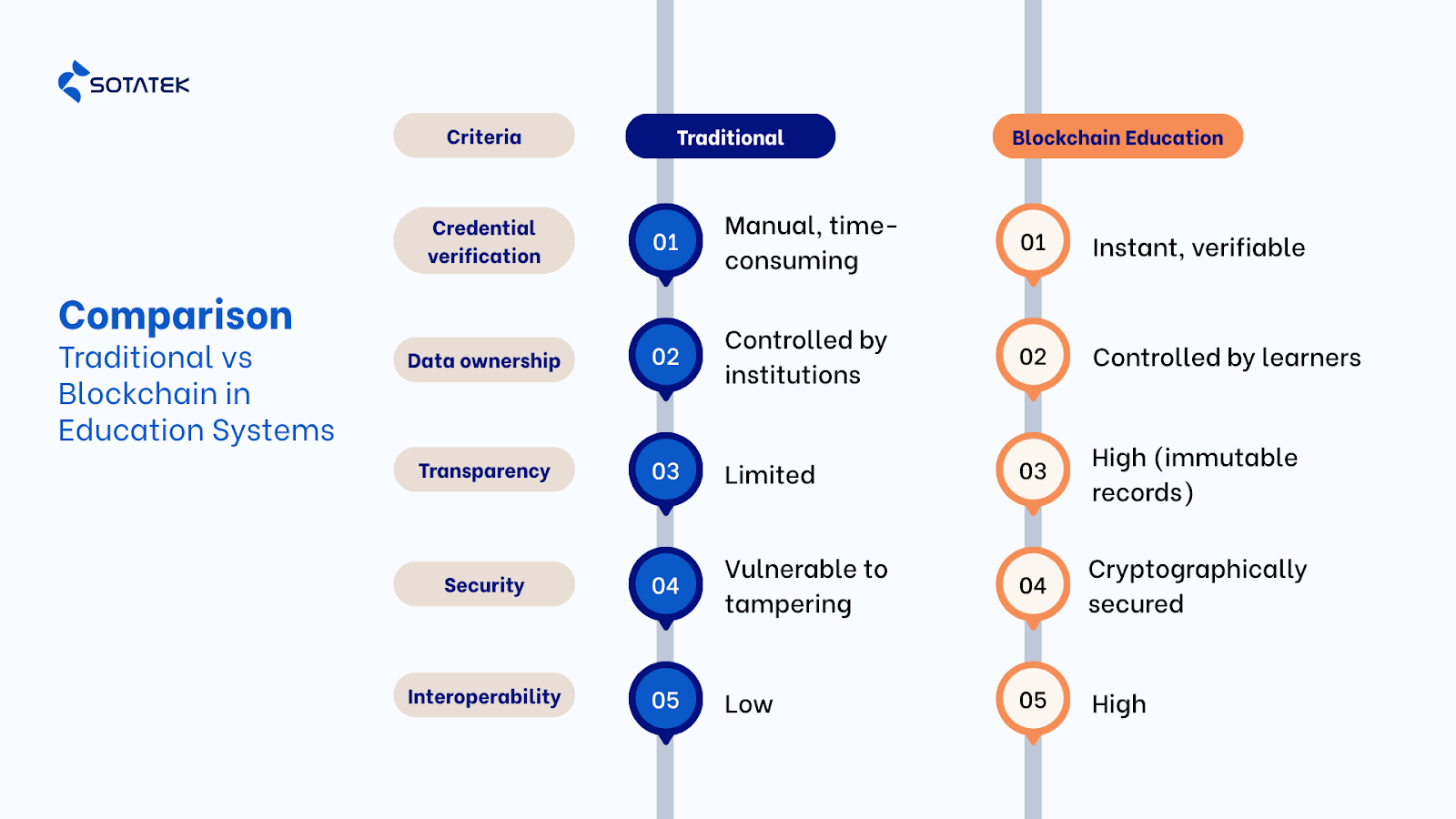
This shift highlights why many governments and institutions are actively exploring blockchain as a long-term infrastructure for education systems.
Blockchain in Education: Key Challenges in Traditional Systems

Despite digital transformation efforts, several core challenges persist across education systems:
- Certificate fraud: Fake diplomas and unverifiable credentials undermine trust
- Fragmented data systems: Student records are stored across multiple institutions
- Lack of transparency: Difficulty in auditing academic records
- Inefficient verification processes: Manual checks delay hiring and admissions
These issues not only impact institutions but also create inefficiencies for employers, regulators, and learners.
Blockchain in Education: How Technology Solves These Challenges

Blockchain introduces a decentralized and immutable ledger that transforms how academic data is stored, verified, and shared.
With blockchain in education, institutions can:
- Issue tamper-proof digital certificates
- Enable real-time credential verification
- Create unified student identities across systems
- Ensure secure and permission-based data sharing
Unlike traditional systems, blockchain eliminates the need for intermediaries, reducing both cost and verification time.
Blockchain in Education: Real-World Use Cases Across Countries
Several countries have already implemented blockchain in education to solve real-world challenges.
Malta: A Pioneer in Blockchain-Based Credentialing
Malta became one of the first countries to adopt blockchain in education through its collaboration with Learning Machine and the Blockcerts platform.
According to official announcements from the Government of Malta, Malta launched blockchain-based certification pilots to issue tamper-proof academic credentials, enabling instant verification and reducing administrative overhead.
The government introduced blockchain-based digital certificates that allow:
- Instant verification of academic credentials
- Reduced administrative overhead
- Increased trust in education systems
This initiative positioned Malta as a global leader in blockchain innovation.
Vietnam: National Blockchain System for Academic Records (SotaTek Case)
Vietnam has taken a significant step by implementing blockchain in education at a national level.
The Ministry of Education and Training (MOET), in partnership with SotaTek and TomoChain, developed the National Qualifications Archive (NQA), a blockchain-based system for storing and verifying diplomas.
According to the Ministry of Education and Training Vietnam, this system enables nationwide storage of academic records and public verification of certificates, significantly reducing fraud and improving transparency.

This project demonstrates how enterprise-grade blockchain solutions can scale at a national level, reinforcing SotaTek’s capability as an AI & Blockchain Innovation Partner.
South Korea: Investing in Blockchain Education Ecosystems
South Korea has actively invested in blockchain development, including education-focused initiatives.
According to the Ministry of Science and ICT South Korea, the government allocated millions of dollars to blockchain pilot programs and education initiatives aimed at building a future-ready workforce.
This includes training programs and integration of blockchain technologies into public systems.
The government allocated significant funding to:
- Develop blockchain talent
- Integrate blockchain into public systems
- Build education programs for future professionals
This approach focuses not only on application but also on building long-term capabilities within the education ecosystem.
Brazil: Tackling Diploma Fraud with Blockchain
Brazil has explored blockchain in education to address long-standing issues related to fake university degrees.
According to reports from the Brazilian Ministry of Education and local media, the government proposed blockchain-based digital diplomas to improve transparency and reduce fraud across educational institutions.
The Ministry of Education proposed a blockchain-based platform to:
- Issue digital diplomas
- Ensure authenticity of credentials
- Improve transparency across institutions
This initiative highlights blockchain’s role in strengthening trust in national education systems.
Blockchain in Education + AI: From Verification to Intelligence
While blockchain ensures data integrity and trust, AI enables deeper insights and automation.
According to McKinsey & Company, AI adoption in education is expected to significantly improve personalization, automation, and decision-making processes.
When combined with blockchain, this creates a secure and intelligent system where trusted data can be analyzed at scale.
Together, they create a powerful ecosystem:
| Capability | Blockchain | AI | Combined |
| Data security | High | Medium | High |
| Data analysis | Low | High | High |
| Automation | Medium | High | Very High |
| Trust & transparency | High | Low | High |
In education, this combination enables:
- Automated credential verification
- Predictive analytics for student performance
- Personalized learning pathways
- Fraud detection in certification systems
This marks a shift from static data systems to intelligent education platforms.
Blockchain in Education: Challenges in Enterprise Implementation
Despite its potential, implementing blockchain in education presents several challenges.
According to Deloitte, organizations adopting emerging technologies such as blockchain often face barriers related to legacy system integration, regulatory compliance, and scalability.

Organizations must carefully evaluate use cases and align blockchain adoption with strategic objectives.
Readmore: Top Blockchain Development Companies in Education
Blockchain in Education: Enterprise Implementation Framework

To successfully adopt blockchain in education, organizations should follow a structured approach:
- Identify high-impact use cases (e.g., credential verification)
- Select appropriate blockchain platforms (Ethereum, Hyperledger)
- Design scalable system architecture
- Integrate with existing education infrastructure
- Ensure compliance and long-term scalability
A well-defined roadmap is essential to move from experimentation to production.
Why SotaTek Is Your AI & Blockchain Innovation Partner
At SotaTek, we specialize in building enterprise-grade blockchain and AI solutions tailored for education systems.
We help organizations:
- Develop secure credential verification systems
- Build decentralized student data platforms
- Integrate AI for intelligent analytics and automation
- Scale blockchain solutions from pilot to national deployment
With proven experience in large-scale projects such as Vietnam’s NQA system, SotaTek delivers solutions that combine technology innovation with real-world impact.
Conclusion
As education systems continue to evolve, the need for trust, transparency, and efficiency becomes increasingly critical. Blockchain in education provides a secure foundation for managing academic data and verifying credentials, while AI unlocks the intelligence needed to optimize learning and operations.
However, successful adoption requires more than just technology, it demands the right strategy, architecture, and implementation expertise. From designing decentralized credential systems to integrating blockchain with existing education infrastructure, organizations must navigate both technical and operational complexities.
At SotaTek, we provide end-to-end blockchain development services for the education sector, including consulting, system architecture design, and custom solution development. Our team supports institutions and enterprises in building secure, scalable platforms for credential verification, student data management, and digital transformation.
As an AI & Blockchain Innovation Partner, we help organizations move beyond experimentation to real-world deployment turning blockchain into a practical, high-impact solution for modern education systems.
Contact SotaTek today to explore how blockchain solutions can transform your education ecosystem.
SotaTek State of the Art Technology - AI&Blockchain Innovation Partner
Website https://www.sotatek.com
Facebook: https://www.facebook.com/sotatek

 https://www.sotatek.com/
 (+84)2466585248




